Showing posts with label chape. Show all posts

Tuesday, 5 December 2006

Chapes - priests and miscellaneous images

Priests
Monks & priests have been wearing hoods for centuries by the 12th C. Juust a few examples here - these are not rare in the pictorial record.

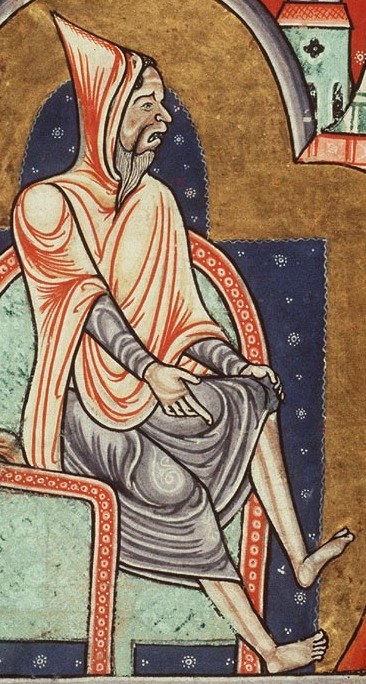
GKS 182 2°: Vita Anselmi. Vita Malachiae. Sermo
France, c. 1200
Fol 1v. a monk writing at his desk representing the author of the vita, Eadmer

  • A hooded tunic
  • The hood comes to a V point in front of the neck


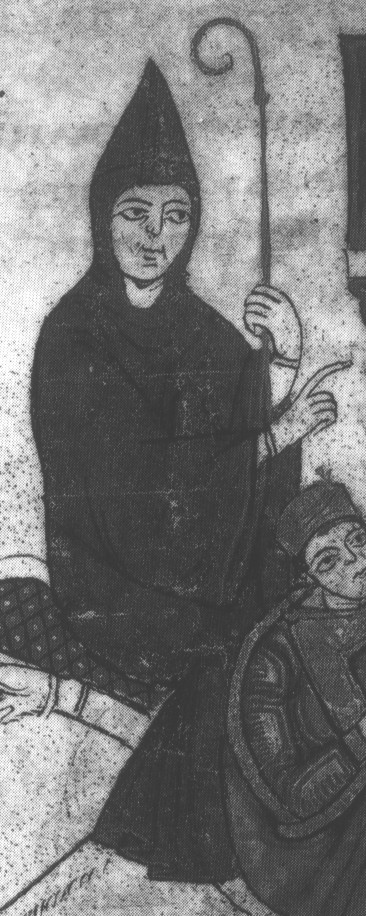
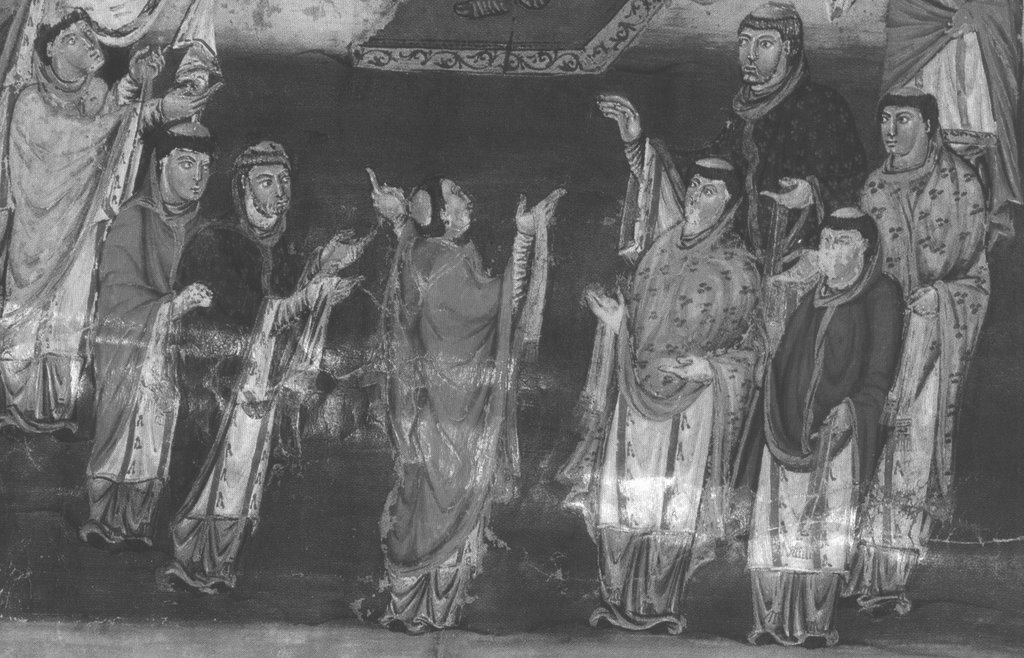
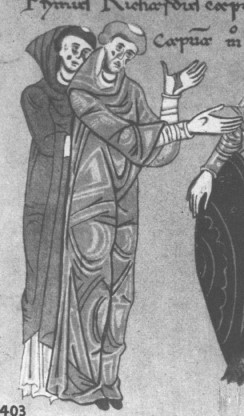
Vatican Bibl. Apost Vat, Ms Lat 4922, Vita Mathildis
Folio 49 German emperor kneeling before Countess Matilda (her confessor watches) around 1114

  • Another hooded tunic
  • The hood points straight up
  • A seam is visible vertical above the forehead.
  • A better picture (in colour) here.


Bibliothèque Nationale de France, Paris MS lat1 (Vivian Bible) Tours 845/6
Fol 423 presentation of the bible to Charles the Bald

  • This is a 9th C piece just to display how long the clergy had been using hoods. I chose it over conventional ones of hooded tunics because these clerical chapes/copes look quite like the mundane ones.
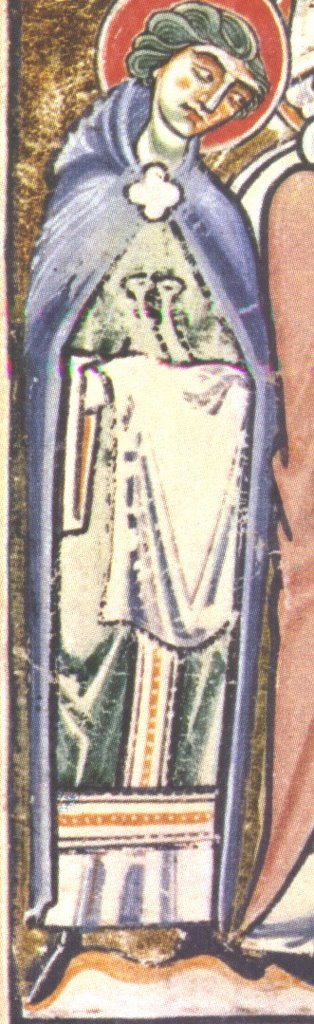
Valenciennes Library
Life of St Amand
France, Middle 12th Century
  • A long cloak worn over a priest's ceremonial clothing
  • The cloak appears to have corners at the bottom edges
  • The cloak is fastened at the neck with a broach, or at least appears to be
  • The hood is pointy


St Angelo in Formis, miniatures from the Register
12th C Italian

  • A hooded tunic and hooded cloak in the same picture
  • both hoods are pointy


Miscellaneous images

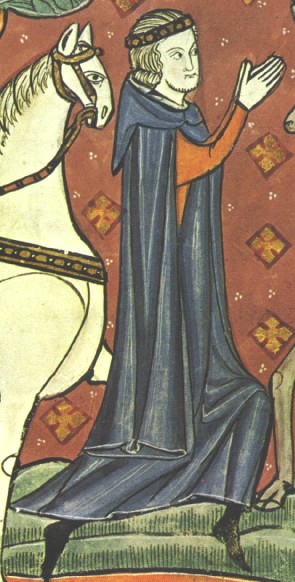
Bibliothèque nationale de France, Département des Manuscripts, Division occidentale Latin 16745 (bible des capucins )
c1170-1180 champagne France
Fol3 Anne priant

  • a man in a hooded chape. head section doesn't appear to be at all pointy.

British Library MS Cotton Nero C. IV (Winchester Psalter)
Winchester [Priory of St Swithun or Hyde Abbey], England; between 1121 and 1161
Folio 18v First temptation of Christ

  • A hood with shoulder length cape


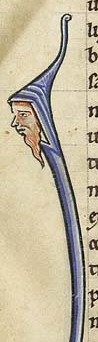
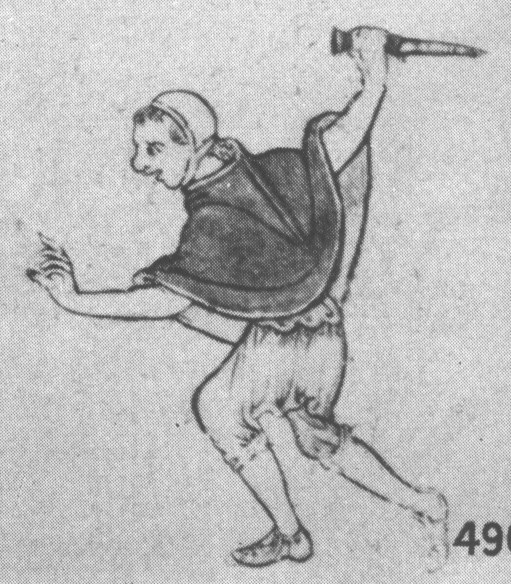
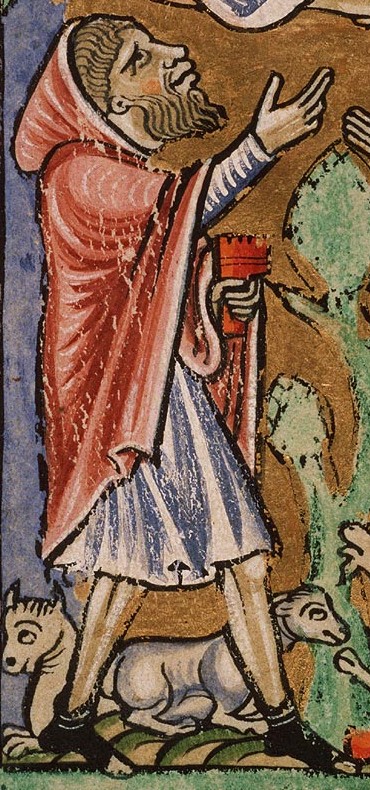
GKS 181 2°: Vita Bernhardi. Miracula. Radbertus
France, c. 1200
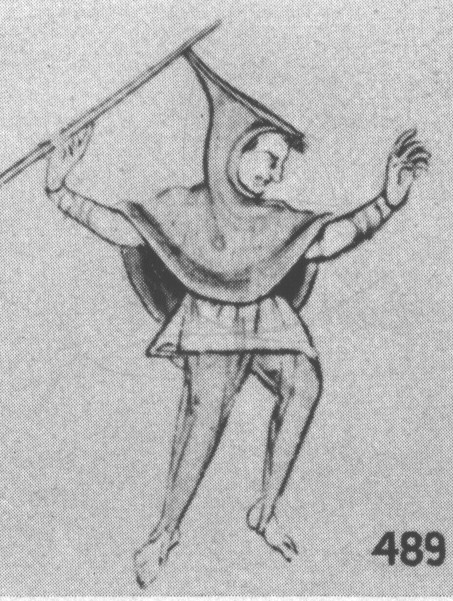
Fol 1v,Doodle, part of a historated letter
  • This only shows the nead covering and not what it does at the bottom of the neck due to the nature of the picture
  • the length of the liripipe and curl at the end of it are probably exaggerated too


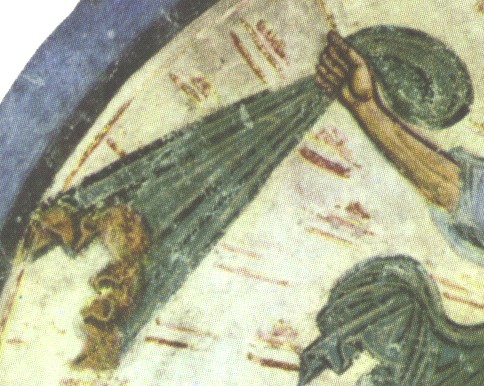
Wall Painting, Anagni, Cathedral Crypt c1255
Elijah on the Chariot of Fire (holding a cloak)

  • This could be a strange hold on a unhooded mantle, but there appears to be a clearly cut hood here
  • note the different coloured at the edge - a lining?


Berlin Print Room, MS 16
Liége c1160
Fol 9v John preaching and Baptising, A knight watches

  • might not be hooded, but rucking at neck suggests this

Friday, 24 November 2006

Lippoldsberger Evangeliar

The Lippoldsberger Evangeliar (aka Hardehäuser Evangeliar, Lippoldsberger Gospels) was created between 1150 and 1170 in Helmarshausen for The nuns of Lippoldsberg. The book dissapeared/was destroyed by bombs at the end of the 2nd worldwar. Black and white photographs were taken of part of the manuscript in 1932, and one colour copy of the dedication page was made.

A history of the manuscript (in german) and the remaining images of the manuscript can are now online. There aren't many images, but they are quite detailed and lovely. The book must have been really spectacular.

Below are comments on a few selected pages.

Mary and Child

  • An enveloping cloak that also acts as veil covers Mary from waist up.
  • The cloak has some trim on the bottom edges and also head hole.
  • The cloak could concievably have corners , but can't be sure.
  • Under this a calf length tunic made from patterned fabric. (some sort of repeating rondell or vaugely circular motif)
  • The hem of the tunic is decorated with trim.
  • A white/whiteish coloured floor length layer (chemise?) is under the tunic.


Birth of Jesus
  • plaits/locks of hair escaping veil?
  • Tunic decorated at collar and cuff
  • sleeves only flare slightly


Dedication page
  • As far as I can tell this page is a modern copy, not a photo of the original.
  • 3 nuns in the border and the abess in the bottom of the picture
  • The nuns wear blue or black tunics (habbits) - the way those and their veils alternate in colour makes me think maybe they are all black, and the colour is just used to show borders better
  • The habbits look to be generic loose tunics with slightly flared sleeves
  • The veils are 2 piece - a white section (barbette?) close to head and neck, and a dark cloth that sits on top of this.


ascension
  • We can't see much but Mary's cloak, which also acts as veil
  • note the cloak has corners at front bottom


The 3 Magi
  • large square decoration about the collar's like I've seen on several extant examples. One is the Sicilian King William II's alb. I was going to write more on this, but I think it deserves it's own post later.

Friday, 10 November 2006

Chapes - pictures of ordinary people and travellers

This continues from the previous post on shepherds and peasants.

I guess i should have explained more fully in the last part that I'm showing pictures of hoods as well as hooded cloaks, because I see so little differentiation between the two. If you can draw up a simple rule to tell me when a hood with a long bottom becomes a short hooded cloak, please tell me. And besides, hoods may provide valuable construction clues about hooded cloaks, besides being interesting in themselves. While I'm adding examples, it seemed sensible to add hooded tunics.

Oh, and I'm putting in some 13th Century examples too because I think the style may not have changed much and it's worth considering them (with due care for stylistic changes) even for 12th C evidence.

So, some common people in cloaks:

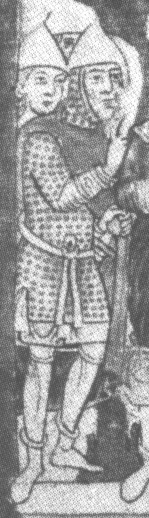
Bibliothèque nationale de France Division occidentale Latin 14771(bible at pent lv glos. ) 12thC France
Fol 1. Moïse et le taureau du sacrifice

  • man in centre (behind two other men) has a very pointy dark red hood
  • There are traces of red lower in the pictures, so this could be a cloak or tunic, but I can't be sure.


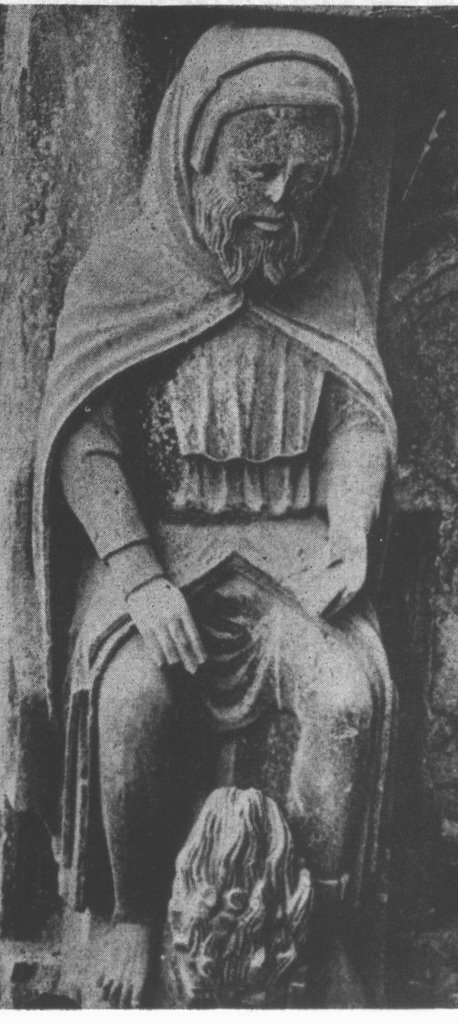
Chartres Cathedral carving
13th C France
February – Man warming himself

  • Note this is 13th C
  • Might just be a rectangular cloak draped over the head and fastened at the neck
  • notice how he wears what is probably a coif under it.


Belvior Castle manuscript (Rutland Psalter)
Mid 13th C English, Salisbury

  • Note this is 13th C
  • Both hoods have very pointy ends, drawn out a bit like a short liripipe
  • both hoods have a clear seam down the top of the head


British Library MS Cotton Nero C. IV (Winchester Psalter)
Winchester [Priory of St Swithun or Hyde Abbey], England; between 1121 and 1161
Folio21Betrayal and Flagellation. Spectator pictured with flail and lamp

  • A cloak with hood. Can't tell if it is fastened at the front or pullover style
  • This hood is strangely vertical
  • The hood is much looser at the neck than other examples


The Hague, KB, 76 F 13 (Fecamp Psalter ) Normandy (Fécamp?); c. 1180
Fol. 2v February: a man warming himself at a fire

  • cloak with hood. No front opening

  • very pointy hood. Points upward from the head rather than backwards

  • There is a slight notch at the front neck. I think this might be a keyhole neckline.


Another group that used cloaks were travellers - the chape was the medieval raincoat.

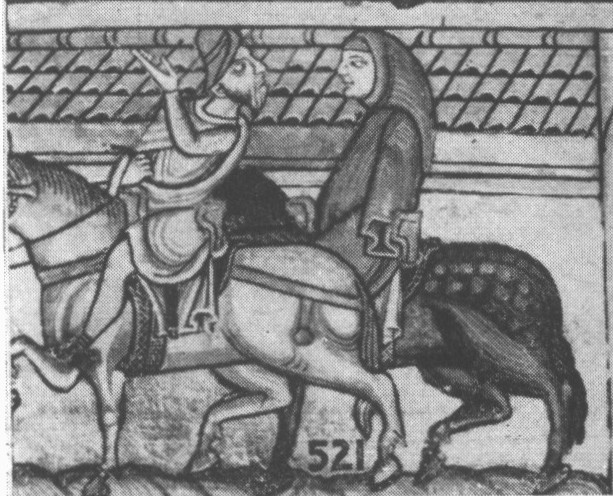
Morgan Library M710 (Abbot Berthold Missal)
Germany 1200-1252

  • Note 13thC
  • This second traveller may be the abbot (hence wearing a cowl (ecclesiastical chape) rather than secular chape
  • Notice how his has sleeves


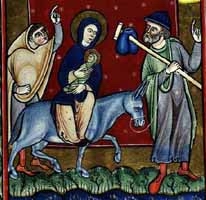
Thott 143 2º: (The Copenhagen Psalter )
England, 1175-1200.
Fol 11r. The Adoration of the Magi, Fol.12r. The flight into Egypt

  • The magi king wears a cloak that has a hood. It's possible that this is a cunningly folded fold in a rectangular cloak, but the flow of the rest of the cloak is sufficiently similar to other cloaks on this page that I'd say it's based on a circle
  • Note the wonderfully rich (expensive ) colour of his cloak.
  • In the second image, the traveller on the left wears a hooded cloak with an exaggerated rounded point. It's longer at the back than front.
  • His cloak sits with a point at the bottom of the hood neck opening. That's a rather particular set of stresses, and not just a straight round hole.
  • Mary could be wearing a cloak, but i think it's more likely she wears a wrap - an extra large veil type thing
  • The third figure (Jospeh I assume) wears a cloak with no visible hood -although one may be hidden, it's more likely he is depicted in a mantle


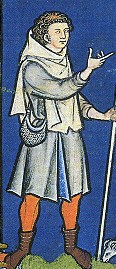
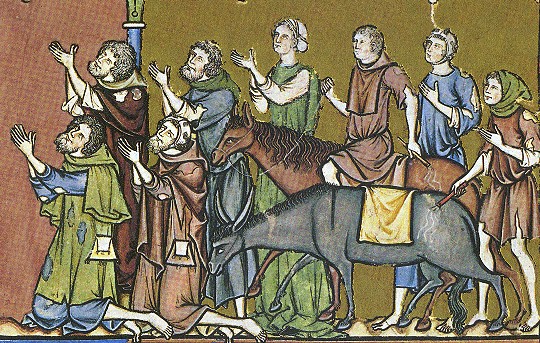
Morgan Library ms m.638 (Maciejowski Bible), Paris 1244-1254AD
leaf 10. The Gibeonites sue for peace with Joshua and the Israelites.
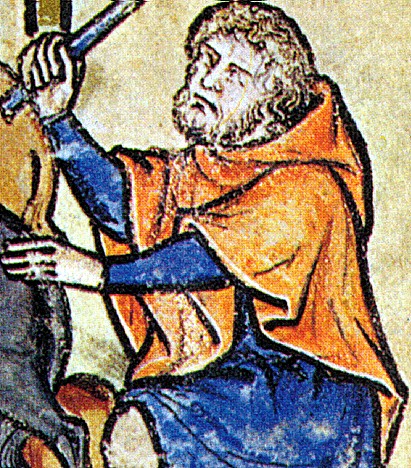
fol 45r. David flees Jerusalem, His steward Ziba (pictured), goads mules with supplies

  • Note 13th C
  • The first few Gibeonites wear (rather worn) hooded tunics with attached hoods and short sleeves with slits underneath so they can be worn as surcoats
  • The man riding a horse wears a hood like the ones we saw in the depiction of shepherds from the same manuscript
  • The last boy wears a hood which is different - it is tight at the neck and doesn't extend to the shoulders
  • second picture depicts a hooded cloak with no front opening
  • I think I can see a fine line running along the top edge of the hood, a seam?
  • slightly longer at back


Venice, Marciana Library Psalterium cum Cantis, 13th Century
St Eustice

  • Note 13thC
  • Sort of a cross between tunic and cloak.
  • The sleeve are much longer than his arms, and quite wide the ends would hang over the hands, keeping them warm and dry.
  • Slits under the arms allow him to wear it as a sleeveless surcoat
  • there is a line at the front of the neck - a line of stitching or a fastened keyhole?
  • The hood is tightly fitted and pointy along the top edge.


Conclusions
  • Even high ranking nobles (eg magi) are depicted wearing mantles occasionally when travelling.
  • There is plenty of evidence for a seam along the top edge of the hood
  • Some of these hoods appear to open a little ways down the neck at the front, possibly a keyhole or some other device to allow the head through more easily without making the hole hood larger
  • Two common styles of hood seem to be one where the point points to the top seam, (end of point tends to sit higher than the top of the head) and another that points downwards with a softer more rounded and generally longer point.
  • Cloaks sometimes have sleeves.
Next: Priests, miscellaneous images

Wednesday, 8 November 2006

The Chape (hooded cloak) - pictures of Shepherds and peasants

I made a hooded cloak for Rowany Festival this year. I think I need to share the documentation I managed for this around a bit, because most people (including me a year ago) think hoods and hooded cloaks didn't exist in the 12th Century, and this will prove to you, dear reader, that that is just not true.

This is going to take a few entries, so please be patient. (or nag me, sometimes it works)

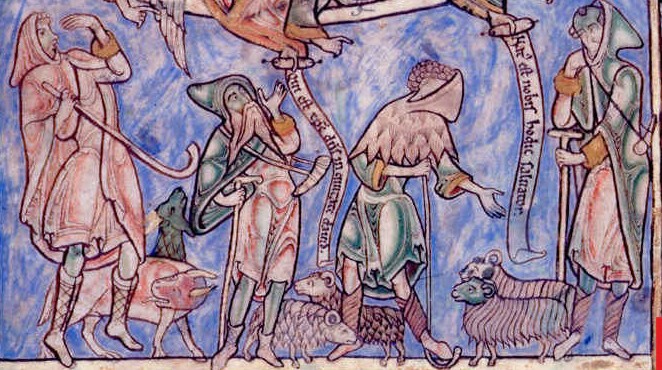
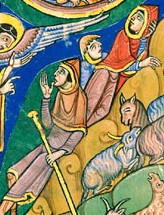
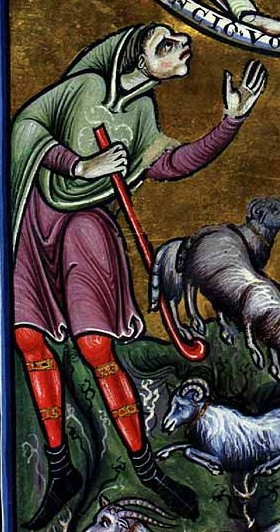
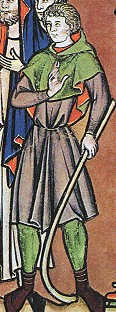
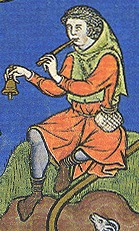
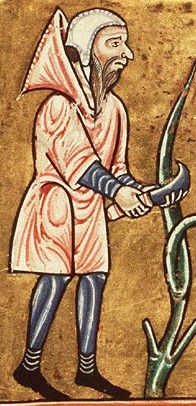
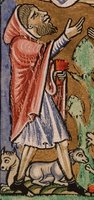
Let's start with pictures of shepherds wearing hoods and hooded cloaks. One of the main reasons we see a lot of unhooded cloaks is because of the mantle. The mantle was the cloak of the nobility, a ceremonial garment (frequently heavily decorated) and a marker of rank. Thus when nobles are depicted in art, it is generally wearing that marker of their rank. I mean would you depict a policeman as a plainclothes detective or a bobby in uniform if you wanted an audience to know what was happening? Precisely. Literary references tell us that the french and Anglo-Norman nobility wore hooded cloaks while travelling and for lower classes this was the only type of cloak available - called the chape. I'll get to those references later, but for now, I'm telling you this, in relation to shepherds - shepherds are depicted often as part of the nativity story and are stereotypically low ranked people who work outdoors. Thus they are a great place to look for what peasants wore outdoors.

The Hague, KB, 76 F5 (Picture bible )
North-western France (Monastery St. Bertin?) c. 1200
Fol. 10v Annunciation of Christ's birth to the shepherds

  • A hooded cloak, may or may not open at the neck. Hood tapers to a rounded end.
  • cloak has a bit of a corner at the hem, or is it just the way it folds?
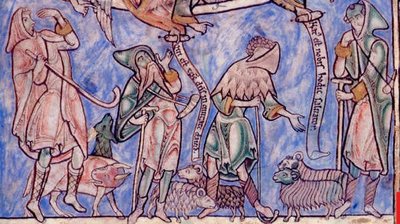

British Library MS Cotton Nero C. IV (Winchester Psalter) Winchester [Priory of St Swithun or Hyde Abbey], England; between 1121 and 1161
Folio11 Annunciation to the shepherds

  • Plenty of Variety means there were probably plenty of options available.
  • Some hooded cloaks that either fasten at the neck or are sewn together there (seems less likely). Note how these are much longer at back than front.
  • Also notice the corner on the cloak hem of the man on the left - I have a theory about this, that I'll write about eventually.
  • The Hood appears to have been made from fur or sheepskin, by the texture depicted.
  • The remaining cloak is difficult to tell details on, other than being hooded, and longer than a normal hood.


St Albans Psalter
England c1120-1140
page22: the annunciation to the Shepherds

  • An orange hood and a red cloak that doesn't open at front.
  • Both have yellow lines at edges - probably indicate a lining or binding
  • both have a seam down the top of the head.
  • lines also indicate stitching along edges with yellow borders, and i think there might be a seam down the arm of the orange hood. This implies that there aren't any other seams present.
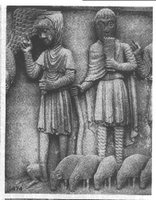
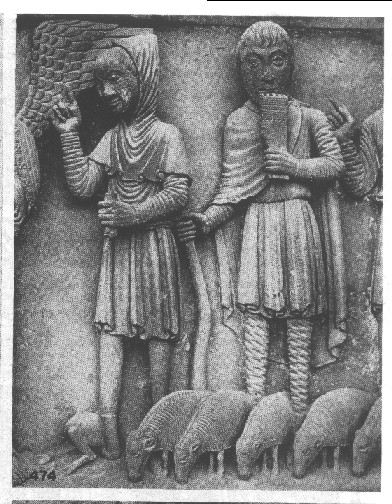
Chartres Cathedral carving, 12th-13th C France
Shepherds in Summer

  • Man on left wearing A short hood with fairly pointed back of head
  • Man on right's cloak stands up a little on the left of his head, this may be a hood that is not pulled up?
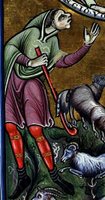

Thott 143 2º: The Copenhagen Psalter
England, 1175-1200Figure 13. Thott 143 2º: The Copenhagen Psalter
England, 1175-1200.
Fol9r. The Annunciation to the Shepherds.


  • Hood has a bit of a slit at the front neck. This probably makes it easier to pull on. And could mean a seam is located here.
  • The back of the hood is much longer and less pointy
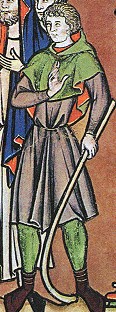


Morgan Library ms m.638 (Maciejowski Bible)
Paris 1244-1254AD
Fol 32r. David obtains Goliath's sword, bystander holding shepherds crook Fol 27r. The shepherd, David
Fol. 25r. The shepherd, David


  • Note - 13th C example
  • The left two seem to have left out a gore on the hood to make it easier to move the arms.
  • There is a strange notch at bottom front that may mean a seam is located here?
  • The one on the right is more conventional, a bit longer at the back than front.
  • It appears to be lined
  • At the front of the neck there is a small line which may mean a seam here.
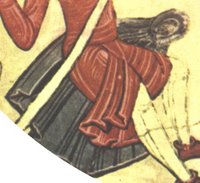
Frescoes from the vault of the Pantheon of Kings
Leon, San Isidro 12th Century
Annunciation to the Shepherds

  • Cloak with hood, front opening
  • Notice how the cloak has a corner at the hem.
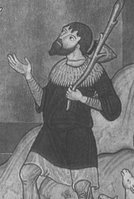

Bibliothéque Nationale, Paris, Ms17325 Periscope book
Rhine-Weser region c1140
Fol 8vAnnunciation to the shepherds

  • Might just be a hat thats been knocked off, but objects are rarely shown in motion
  • the collar section around his neck is fur. That could mean a fur hood or just a hooded tunic with fur collar, or something else entirely.


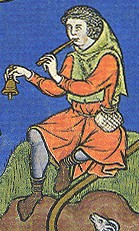
Peasants working in the fields is also a subject that gets illustrated to represent the seasons in calendars.
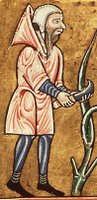
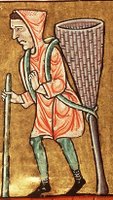
The Hague, KB, 76 F 13 (Fecamp Psalter )Normandy (Fécamp?); c. 1180
Fol. 3v March: men pruning
Fol. 3v March: men tying up and planting vines
Fol. 10v October: men sowing and ploughing;

  • Hooded tunics - practical for working. Not just for monks.
  • Notice the seam down the top of the hood on the left.
  • very pointy hoods. Notice how the one on the left remains pointy even when off the head.
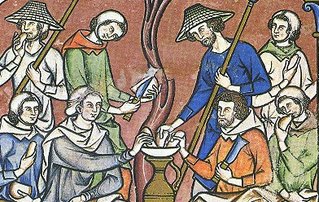

Figure 17. Morgan Library ms m.638 (Maciejowski Bible,)Paris 1244-1254AD
Fol 17v. Ruth dines with boaz (peasant meal just after harvest)

  • Another 13th C example
  • Lots of hoods, with notches at centre front - a seam here?
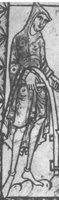

Figure 18-19. Florence, Laurentiana MS Plut. XII 17
Canterbury early 12th Century
Fol 1v The bad and the good and regiment

  • on the left a hooded cloak, no front opening, longer at back
  • a seam along the top of the head
  • On the right, a hooded tunic


Conclusions
  • There were a variety of hoods and hooded garments worn by peasant folk. It is definitely from this pictorial evidence that hoods and hooded cloaks are being worn in the 12th Century
  • The variety of shapes probably indicates a variety of ways of cutting such garments
  • Quite a few examples have a seam down the top of the head. Most of these are pointier than the rest.

Next Installment: The common man and travellers.