Showing posts with label seals. Show all posts

Monday, 26 April 2010

The weakness of integral parchment seal tags

Just having talked about integral parchment seal tags, it's worth I think talking about how they were easily damaged, and a few ways medeival scribes attempted to prevent this. As before, click on an image to see it full size, and the links in the text to find out more about the doccument. A number of these examples are from the excellent durham archives site, please note that you need to enable popups for the site if you wish to see transciptions of the text.

This post is for lots of examples of integral seal tags that have torn off, because the shape of the doccument and often where the seal had been can be seen (Again, order is roughly chronological). Next post I'll show a few exmples of attempts to repair or prevent this.


Writ of Henry II threatening consequences if Cecilia de Muschamps and Thomas because they didn't give Heatherslaw back to the Durham monks.
1154-1173
(Durham Cathedral Manuscript, 3.1.Reg.2)

This follows on from an earlier writ telling her to do so which will be shown in the next post. I find it interesting this is adressed to a women of power, presumably as regent for her son.


Writ of William II regarding Lincoln
After whitsunday, 1072
Tag: Seal tag has torn off
Wrapping: A thin tie survives. 3 vertical and 4 horizontal folds are visible.
(Lincoln D & library AI/I/I)


Writ of William II
Brigstock, 1095
Manuscript: In Latin
Tag:
Partly torn off.
Wrapping: partly torn off. 3 vertical and one horizontal folds.
(P.R.O. Duchy of Lancaster, Royal charters DL.10)


Writ of William II, regarding the bishop of Thetford & Norwich
Ceagewella 1095
Manuscript: In old English.
Tag: lost, looks like cut off to remove seal (by an early modern seal collecter perhaps?)
Wrapping: Part of wrapping tie remains.
(Norwich, D & C. Library)


Writ of William II, regarding Norwich Holy Trinity Church
Westminster 1096
Manuscript: In old English.
Tag: remains of seal tie visible, seal lost.
Wrapping: No renmains of a wrapping tie visible, but could have been removed. 3 vertical and 1 horizontal fold reported.
probably not drafted by te royal scriptorium - less use of formulaic phrases
(Norwich, D & C. Library)


Writ regarding Christ Church, Canterbury
Brampton, 1 May 1099
Tags: part of seal tag and wrapping tie remain
Folding: 3 vertical and 1 horiz fold
(Canterbury D & C Library Ch. Ant. C. 6)


Writ as title deed for Holy Trinity Church, Fecamp
Lillebonne, 1099 July-September
Tag: torn off.
Wrapping: Tie torn off. 3 vertical and 2 horizontal folds.
(Rouen, Archives Departmentales de la Seine-Maritime 7 H.12)


"letter patent of King John in favour of Robert earl of Leicester."
13thC


Doccument
Sweden, 1374-5
(Swedish National Archives DS8783)


Surrender at the Courts Baron of the Manor of Ersham Dubbells
Norfolk, Friday in the Vigil of Saint Luke the Evangelist, 1550
Manuscript: vellum, 100x250 mm.
(Griffin Manuscripts sale catalogue Number 23399)


Surrender at the Courts Baron of the Manor of Ersham Dubbells
Norfolk, Tuesday 14th May 1560
Manuscript: vellum, 85x295 mm.
(Griffin Manuscripts sale catalogue Number 23398)


Surrender at the Courts, Baron of the Manor of Ersham Dubbells of half an acre of land called Redfild Pightell
Norfolk, 1568
Manuscript: vellum, 280x80 mm, written in a typical Tudor scribal hand.
(Griffin Manuscripts sale catalogue Number 23387)

Indenture deeding a parcel of land in Morytton, England from Thomas Ladde to Robert Beane.
September 10, 1575
Manuscript: vellum, 105 x 265 mm, contains 10-lines of Latin script penned in a gothic cursive.
(Griffin Manuscripts sale catalogue Number 24104)

Surrender at the Courts Baron of the Manor of Ersham Dubbells of four pieces of meadow in Northmedowe in Ersham and two pieces in Prestes medowe
Norfolk, Sunday 4th November 1576
Manuscript: vellum, 150x310 mm
(Griffin Manuscripts sale catalogue Number 23393)

The surrenders are really transfers of property, but under the feudal system the baron has to approve of the transaction, even if it's a son inheriting.


There are many many more examples of broken off integral seal tags. Almost as many doccuments exist in archives today without their tags as with them, especially in this fragile style.

Wednesday, 17 March 2010

Closed letters and closed writs

In the last post, you might have noticed mentions of "ties" or even seen that some examples have what appears to be a second seal tag. The example below is a fine example from the 11th Century.


Writ of William II
1095, King's Cliffe
Seal: Great Seal in white wax
Wrapping: Tie remains. 3 vertical and 1 horizontal fold
(Burgley House)


Below the text, the parchment is slit into two narrow tounges, one holds the seal and the other is used to tie the doccument closed. It's generally called in the literature by the highly technical term of "a tie". You can see many of the standard features exhibited by 11th C wrapping ties here - the tie is long (the width of the document) and narrow, even if the seal tag is wider. The tie is located lower on the parchment thatn the seal tag. The folds in the parchment probably date from when it was created, the doccument being folded up and tied closed with the tie before being sent to the person it is adressed to. In fact if you look at the back (second image) of the royal writ above, you can more clearly see the fold marks, and a person's name, presumably the recipient.

So how did this habbit of folding up a writ or other doccument develop? Well, actually, rather than develop, this is a relic of the wax sealed letter. Although the writ is not longer sealed closed, people were still used to the king's word arriving in a folded letter. The tie was simply a way of keeping the doccument closed when there was no longer a blob of wax to keep the doccumnet sealed. And actually keeping a writ folded up was probably a better way of preserving it in a easy to store form than a long scrappy piece of paper.

The ever informative medieval writing website delves more deeply and provides more examples of the sealed 'letters close' from which these habbits developed. She uses the term letter close only for letters which are sealed closed with wax (as I shall), but points out that any doccument presented folded in this manner (sealed shut or not) could be called so.

Here's annother 11th C example, still in the genesis era of using seal tags.


Royal writ of William II
1096-7
Seal: Great seal in white wax with light brown varnish.
Wrapping: Wrapping tie present. 3 vertical folds and one horizontal fold.
(Durham D and C Library, 1.1.Reg.8)


There's a bit of variation in where on the tag the seal is sealed, but the general format is adhered to.

Giles provides some excellent examples of medieval period letters, both open and tied closed. In the last post I talked about how I think integral tags became used for less and less important transactions. You can see that the examples he provides are no longer grand royal writs, but more everyday doccuments - personal transactions, beurocratic ones, but not at the level of official writs of royals, but still important, and not the type of transaction you expect to have to keep more than a couple of years (unlike some of the 11th C royal writs which are more like the deeds for your house). As the writs have grown longer, and the seals are smaller seals associated with lesser personages or private transactions, now the seal can be more safely tucked inside the closed letter. The short 11th C royal writs with the grand royal seal shown above, the writ would have folded up smaller than the seal itself.

If you go back to the previous post, you'll find plenty more examples of ties, and there will be a number more in the next post too.

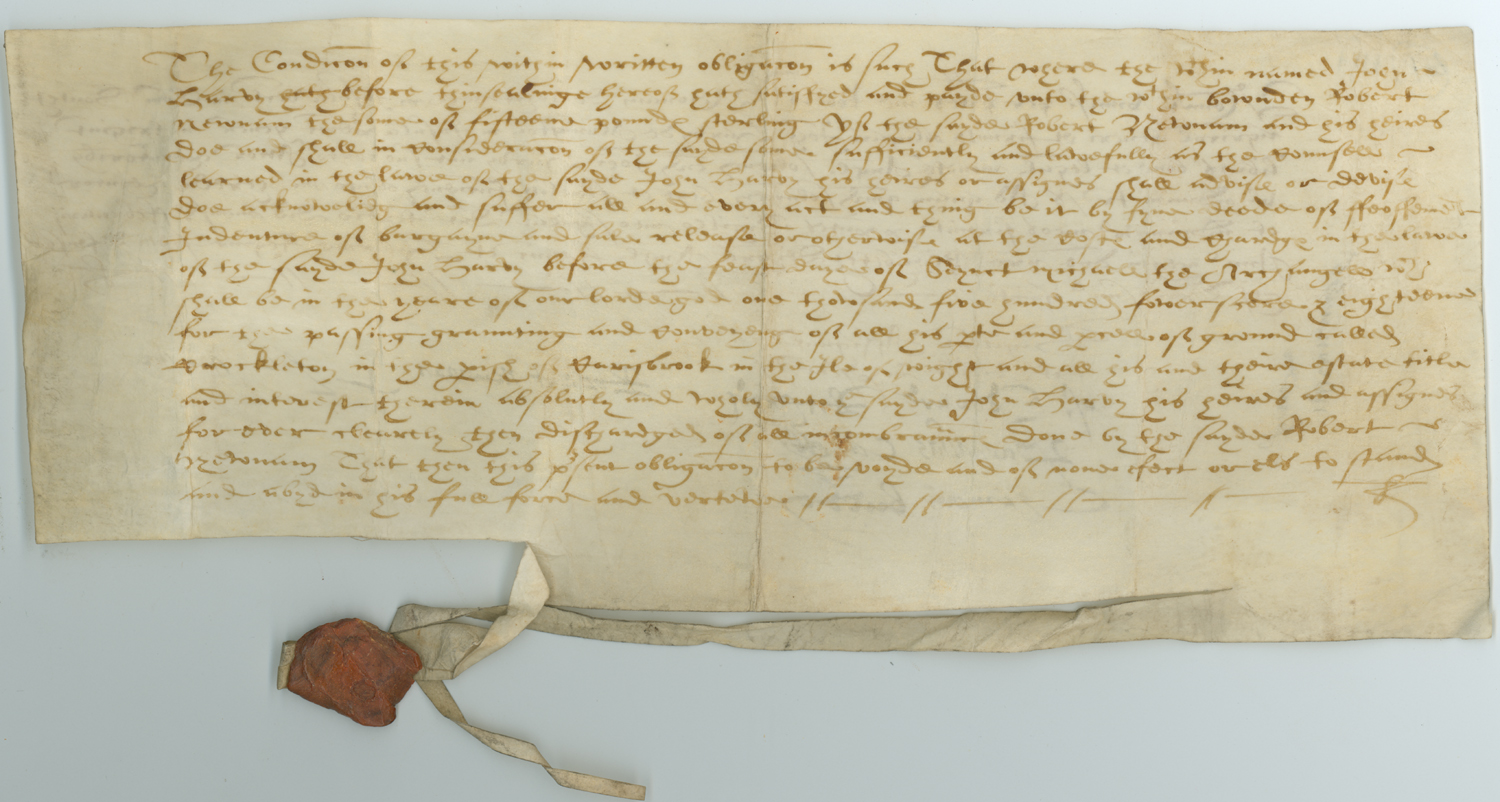
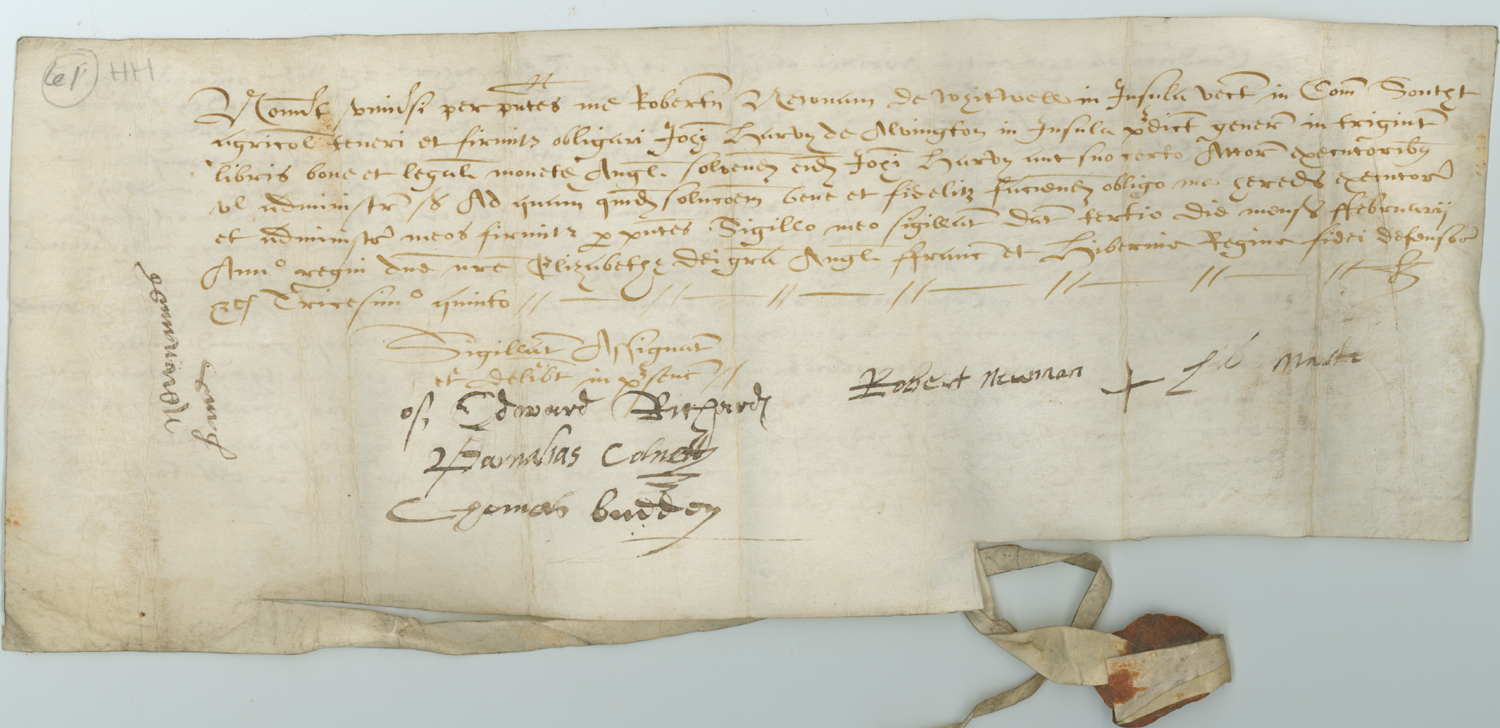
I'd like to move forward in time to the 16th C now, and that other large cache of integral seal tags. Below are two examples of integral tags with a tie. Note how while the seal tags themselves of this period cut only a short way across the page, in many of the examples, the ties cut a long way across the page. In these two examples, one might think the tie was used to close a doccument, but these are actually used to "staple" two doccuments together. There is no particular structural differences between a tie used for wrapping and a tie used for fastening to other doccuments, so where the tie is not attached to anything and no deep folds in the doccument are present, we can't be sure in which manner and particular very late period doccument was used.

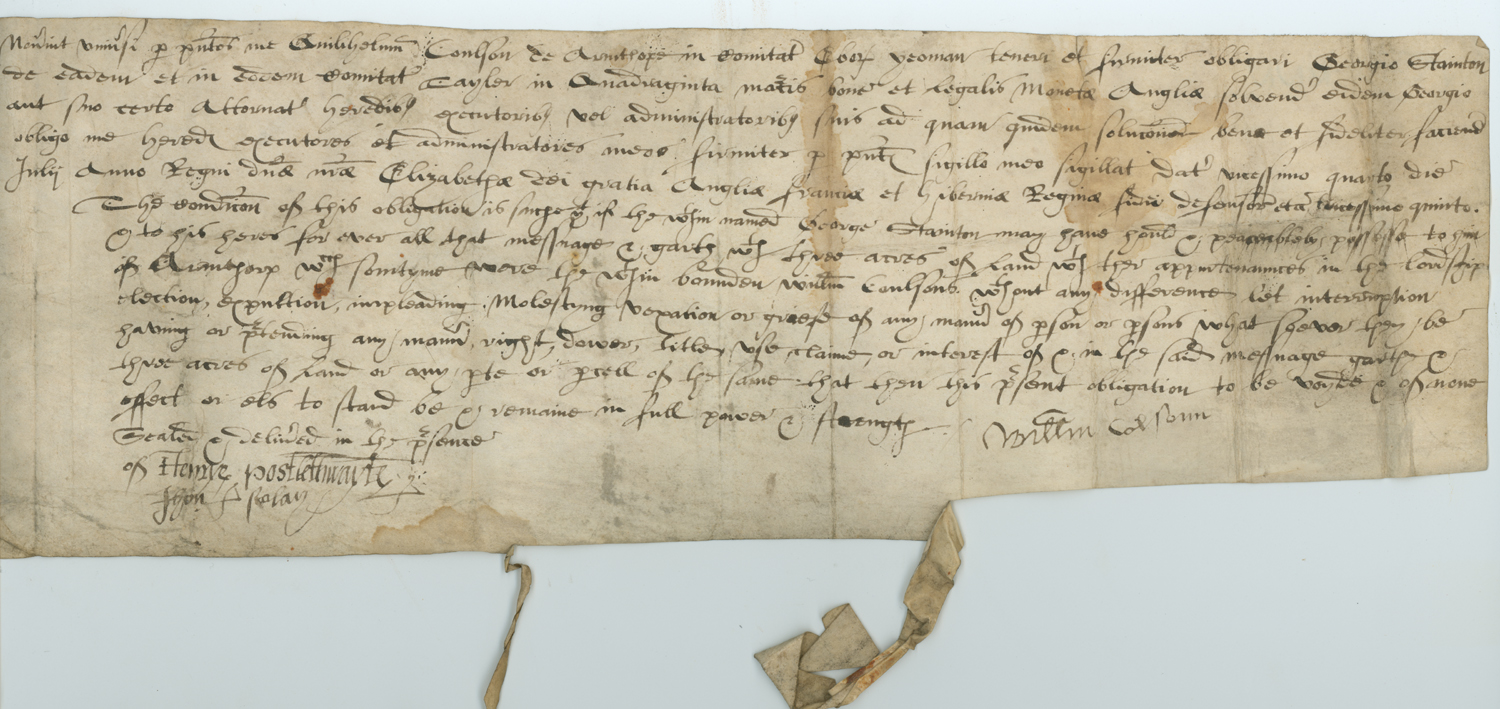
Bond by William Coulson to George Stainton for quiet possession.
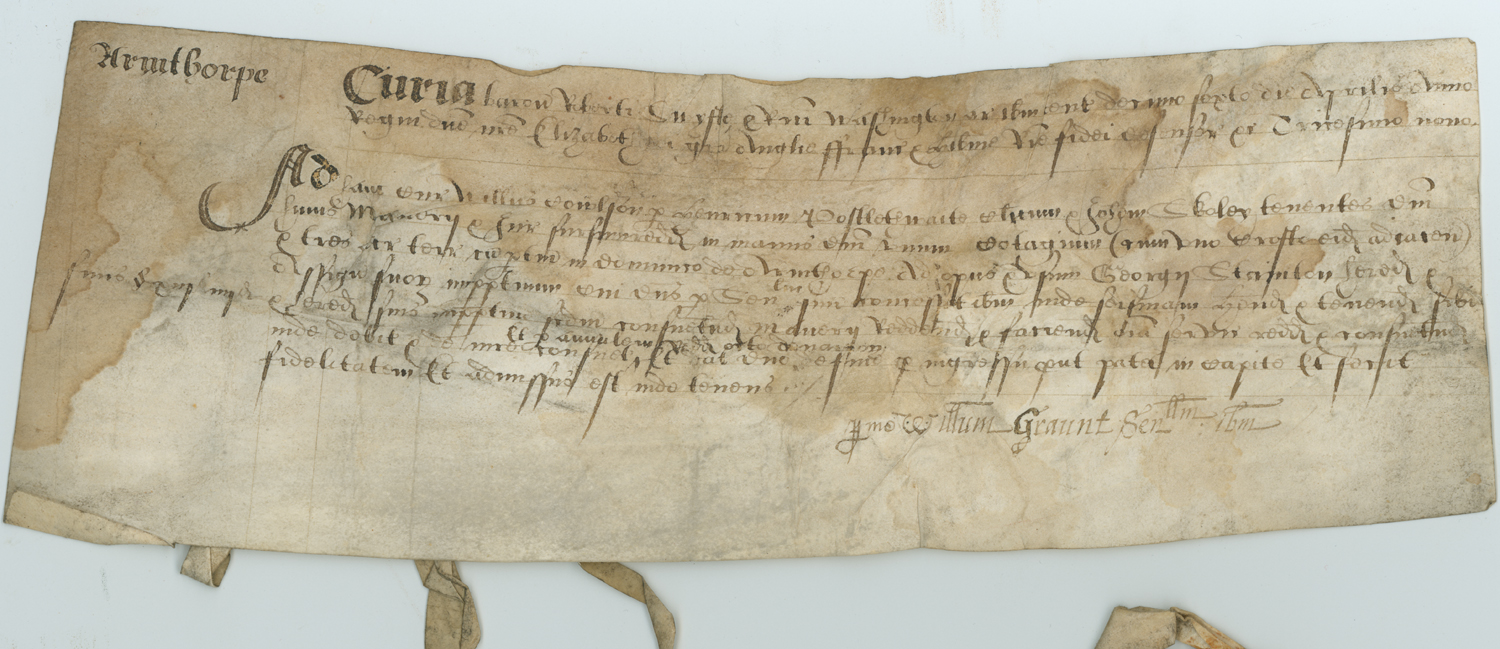
Surrender with admittance by William Coulson and others to George Stainton of land in Armthorpe, Yorkshire.

1593 (bond) & 1597 (surrender)
Doccuments: A pair of doccuments, one a bond (morgage?) by a "tailor" to a "yeoman" and a surrender (handover of property to pay debt?) a few years later.
Seal: Bond has seal tag missing seal, surrender unsealed
Wrapping: Tie on Bond binding it to surrender.
(McMaster University British Legal Instruments Collection No. 33)


Bond by Robert Newnam to John Harvey for performance of covenants.
1592/93.
Seal: Seal of Robert Newham (farmer) red wax, worn smooth
Tag: Seal tag and tag used to bind to associated deed (now lacking)
(McMaster University British Legal Instruments Collection No. 61)


Finally, all the above examples are of integral seal tags with ties. Here's and example of a tie fastened through the slits of a seperate parchment seal tag...

Forged charter of Bishop William of St Calais
c.1160-70 (proports to be from 1080-96)
Seal: appears to be yellow wax with a brown varnish
Tag: 3 slit dependant parchment tag, folded double. Single layer thin tie for wrapping passes through top slit.
(DCM, 1.1.Pont.4a; Durham Episcopal Charters no. 4a)


And here's annother which might be a version of the same thing (or it might have been an accident):

Charter of Henry II confirming land grant
1166-1169
Seal: Appears to be great seal of state, brown wax
Tie: Parchment dependant tag and extra thin integral tie (for wrapping?) cut from turn up.
(DCM, 1.2.Reg.12)


Longer fibre tags could also be wrapped around a doccument, but I have no proof if this was actually done. I see less fold marks on later doccuments, which might mean folding became less important. Probably the need to fold the doccument up decreased as period progresed and more doccuments were stored in an establishment, so standard storage processes developed. But that's just speculation.

Wednesday, 10 March 2010

Examples of integral parchment tags

Today I'm going to show a number of examples of what I'm calling (since I haven't found a proper technical name for it yet) the integral parchment seal tag. I've already outlined these basic types of tags earlier, today I want to show some of the diversity and breadth of use of this very simple tag type.

Click on the small preview image to link to the original source, and links to the full description of the item will be given in the brief item description. My comments upon the item are presented in italic. I've presented the tags in roughly chronological order. And have a few comments regarding the chronology of this style of tag's use at the end.

You'll notice I've written a number of pieces of information in the captions - anything that might be relevant to the process of recreating a sealed document. Don't worry if some of the terms are confusing, I'll be trying to explain these a few at a time in coming posts.


examples of integral seal tags


Royal writ of William I (the conqueror)
1087, before 9 Sept.
Seal: Double sided Great Seal of State in white wax.
Wrapping: Small tear bottom left corner probably was a tie.
(British Museum, Ms Cotton Ch. xvi 2)


Writ of William I
1087, before 9 Sept.
Seal: Double sided Great Seal of State in white wax.
Wrapping: Tie located below seal tag.
(Westminster Abbey Muniments, xxiv)


Writ of William I
1095.
Seal: Double sided Great Seal of State in yellowish white wax.
Wrapping: Small tear bottom left corner probably was a tie. 2 horizontal & 3 vertical folds
(Durham, Diocese and Cathedral Library, Misc. Ch 558)

writ of William II
Pont-de-l'Arche, 12 Nov 1098
Seal: Double sided Great Seal of State in white wax covered in light brown varnish.
Wrapping: Stub of wrapping tie visible. 3 vertical folds and possibly 2 horizontal folds.
(Burgley House)

Writ of William II
1099, after June 5.
Seal: Double sided Great Seal of State in white wax covered with light brown varnish.
Wrapping: Remnant of tie. 2 vertical & 2 horizontal folds.
(Durham, Diocese and Cathedral Library, 1.1.Reg.4)

Writ of William II in favour of canons of St Pauls Cathedral
Brockenhurst, 6 July 1099.
Seal: Double sided Great Seal of State in white wax covered with light brown varnish.
Wrapping: Wrapping tie. 3 vertical and 1 horizontal tie.
(St Pauls Diocese and Cathedral Library, A.59/4)


Writ of William II confirming grant of King Edgar
1095
Seal: Double sided Great Seal of State in white wax covered with light brown varnish.
Wrapping: Parchment wrapping tie. Two vertical and 2 horizontal folds
(DCM, Misc. Ch. 973)

Writ of Henry I
Wrapping: Thin parchment wrapping tie is visible.
(DCM, 2.1.Reg.17)


Document sealed by Adam de Clifton, knight, and his wife Margery
1363
(Public Record Office LR 14/26651)


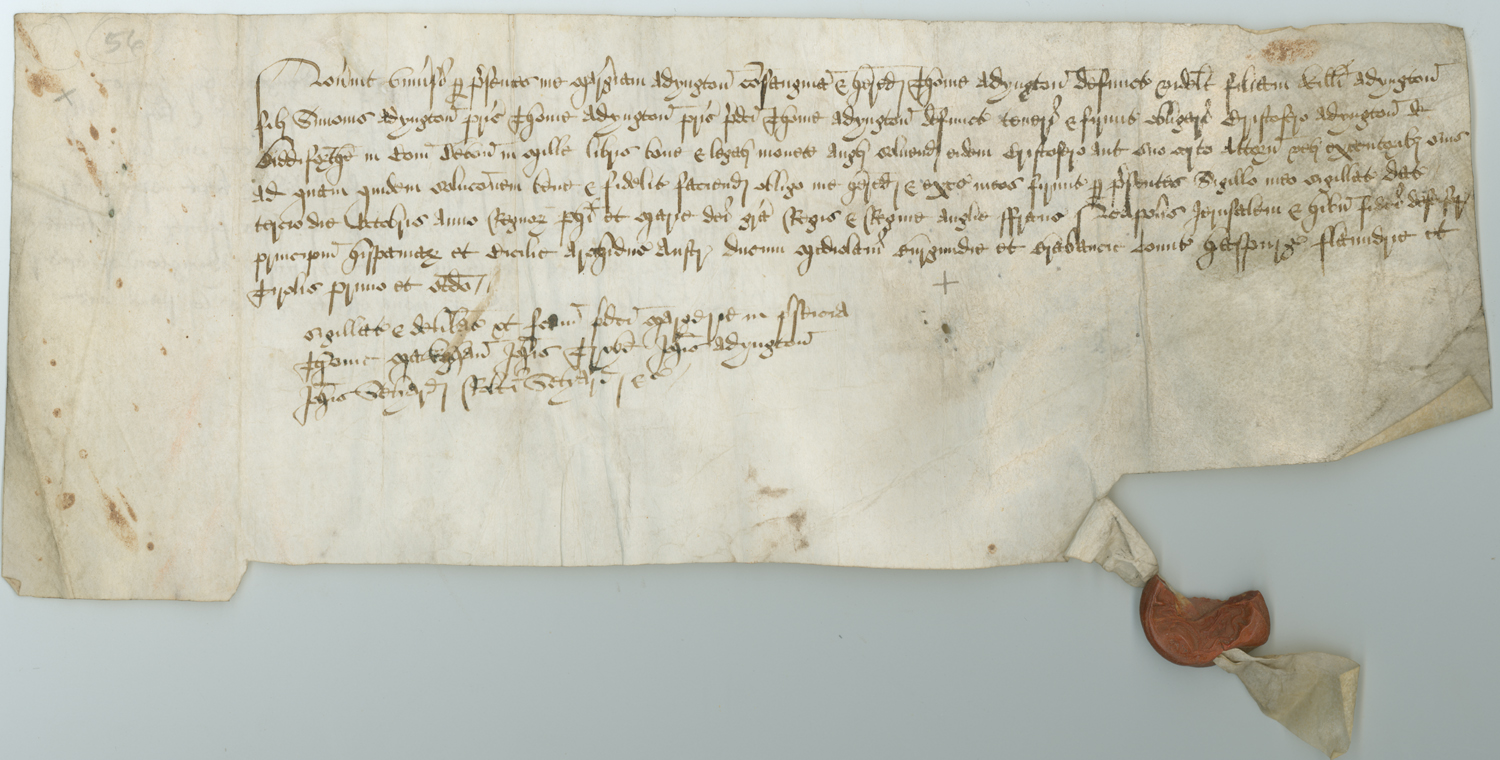
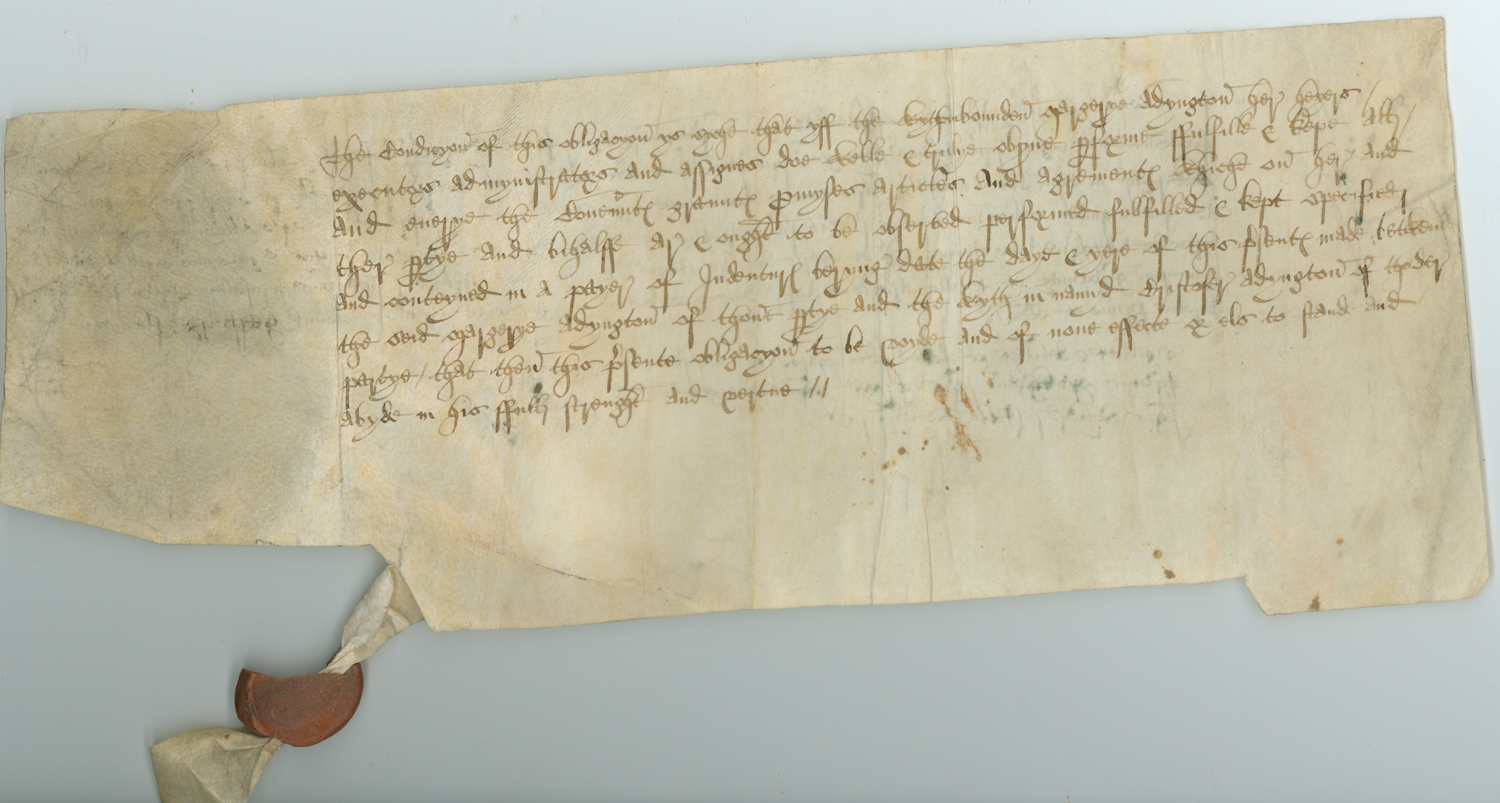
Bond by Margery Addington to Christopher Addington for performance of covenants .
1554
Seal: Red wax seal, depicting a coat-of-arms, cracked, portion missing.
Wrapping: Step in parchment corresponds to likely location for a broken off wrapping tie.
(McMaster University British Legal Instruments collection No. 56)

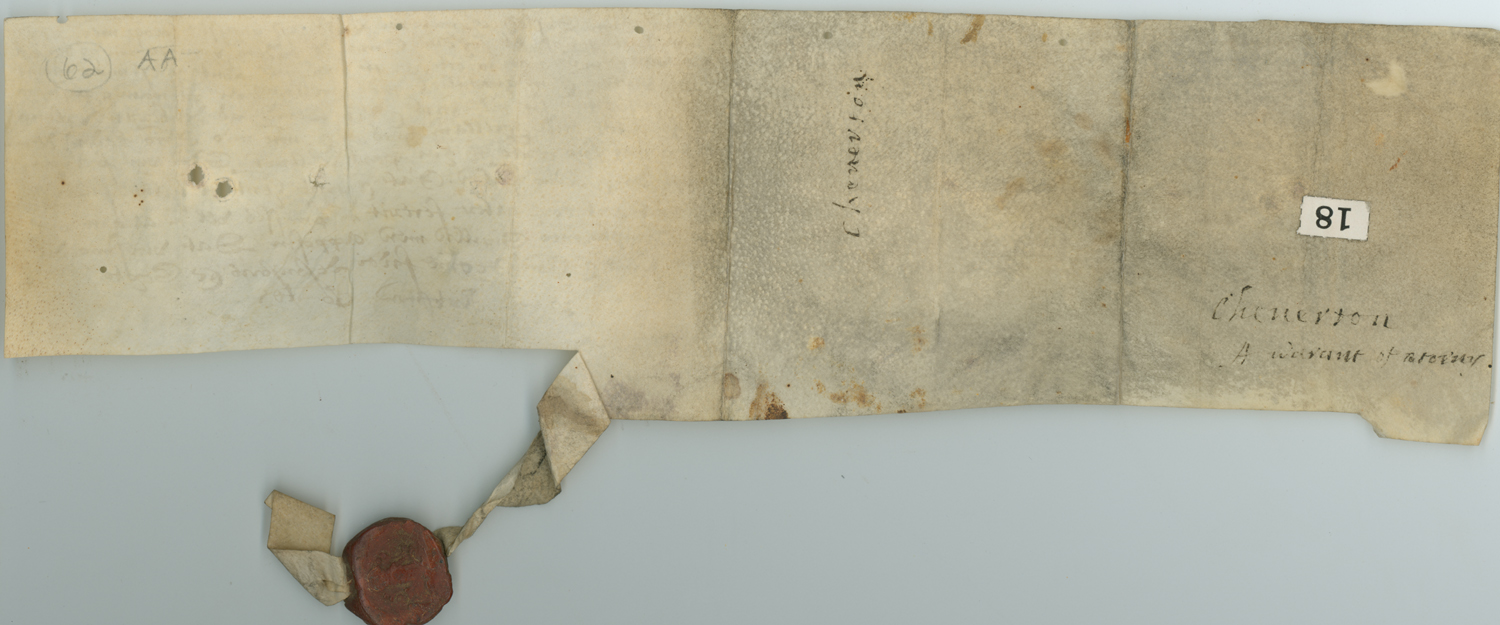
Letter of attorney by Arthur Genter to William Genter to deliver sasine to Richard Kedon of lands called Cheverton in Shorwell, Isle of Wight.
20 May 1564.
Seal: Red wax, depicting coat-of-arms with hand.
Wrapping: Step in parchment corresponds to likely location for a broken off wrapping tie.
(McMaster University British Legal Instruments collection No. 62)

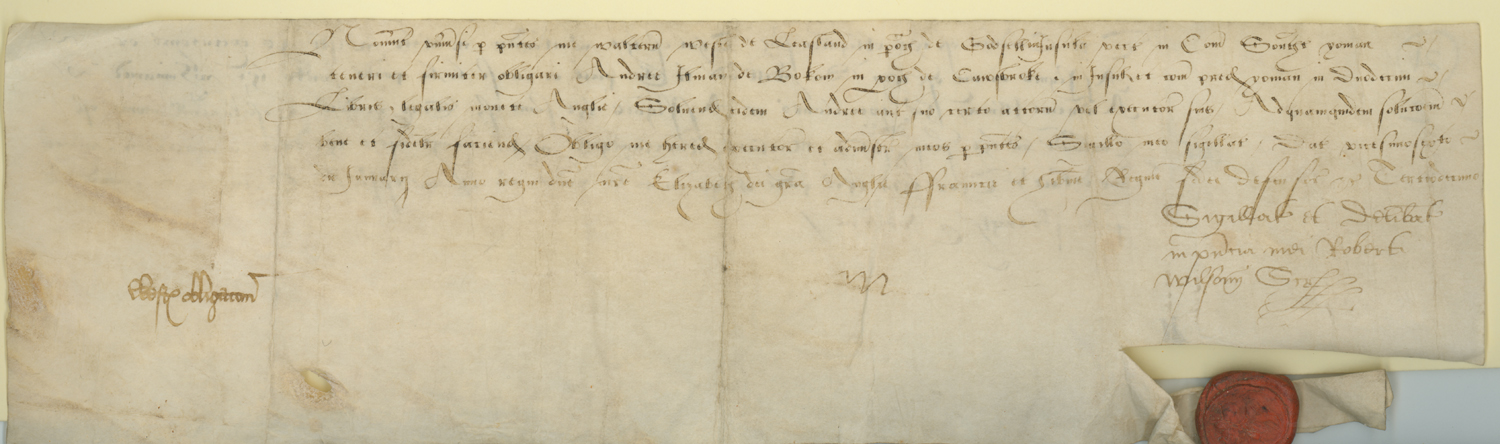
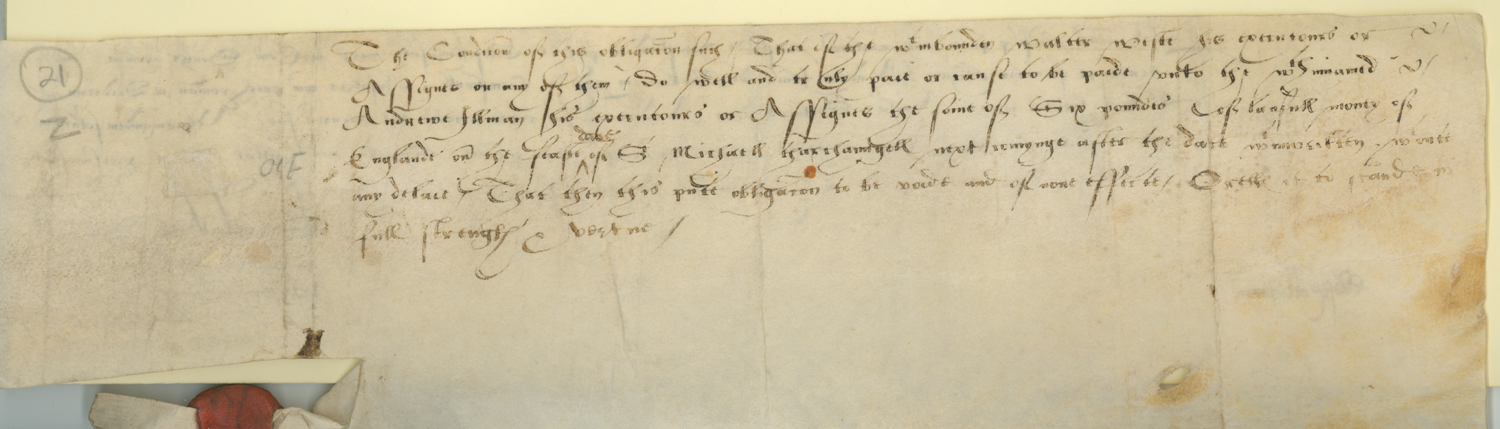
Bond by Walter West of Leasland to Andrew Ilman of Bowcombe, Isle of Wight for debt. (Deed poll).
1570
Seal: Red wax.
(McMaster University
British Legal Instruments collection No. 69)


Some observations from the above examples

Based on these examples, and more examples to be shown in the next few posts, the examples start with royal writs with the great seal, and letters patent in the 11th - 13th Centuries. Then there is a large gap with few documents, followed by fairly minor 16th C documents - promises to pay a debt,etc sealed with small probably personal seals. It's probable that as new styles of seal tag were developed, this style, rather than falling out of use completely, simply became used on less and less significant documents. Such insignificant documents are seldom preserved, especially with seals on them, so the few 16th C examples of this style might simply represent the greater chances of more recent documents surviving. Indeed such minor transactions were probably a spoken, possibly witnessed, agreement in earlier times, and likely only increased in usage as literacy increased (I imagine the transactors need not be fully literate, but they must at least have quick and easy access to a cheap scribe for minor transactions to be customarily written down).

It is of course also possible that this style fell out of favour, but was revived in the 16th C, although the singular example from the 14th C argues against this. A stylistic difference between the early and late documents can be noted - early tags are much longer and often thinner, generally cutting off 3/4 of the page width, while most of the late seal tags are wide and often cut only 1/4 of the page width. Both eras frequently have evidence of a wrapping tie (in fact every example above except the last one where the photo is not large enough), which I'll discuss soon.

Friday, 26 February 2010

Introduction to seal tag varieties

I recently spoke about medieval sealing practises. I'm now going to begin a series of posts that focus on seal tags. Seals on letters intended to be broken off as a simple security measure, but also acted as authentication of the sender. Seals affixed to the surface of a page of a public document as authentication of the writer had a tendency to fall off, which was a problem when the seal was the a major means used to prove a document was genuine, which was a concern in a rapidly bureaucratising society making the transition from verbal to written agreements.

Seal tags were a way to attach a seal to documents in a more secure way. That required that the seal was still firmly attached to the document (so that seals couldn't be swapped between documents), but would not be subjected to as bad a stresses as seals attached directly to the page were.

Today's aim is to introduce different varieties of seal tags. In later posts I'll give more examples of these, show you how to construct your own, and explore intricacies of construction.

In earliest form of seal tag, the spare parchment at base of the document was slit to form a long thin strip (like tearing up a minties wrapper), which the wax and seal was applied to. An example is shown below (click on the image to see it large, the links in the text for more provenance details). Like many other examples, there is a second strip of parchment, cut just like the seal tag, with which to tie the document closed when folded up. (which does suggest a possible origin for this method if it can be dated to before seal tags)


Charter with Seal of King Edward the Confessor
Seal in use 1042-1066, charter c1050. Diameter 70mm.
(London British Library, Campbell charter XXI.5)

Of course a long thin strip of parchment wasn’t very durable, and a seal didn’t authenticate a document it was no longer attached to, new ways of sealing were soon developed. This type of sealing was primarily used in the 11th Century, or on documents only expected to need to last a short time.

The most common form of seal tag by the 12th C is a strip of parchment which is a separate piece from the document. Any remaining parchment on the charter is folded up towards the writing so the edge of the parchment sits just below the end of the writing, permitting no space for additional words to be added. This turn-up is generally only a couple of cm wide - If large amounts of parchment remain at the end of writing a scribe could be expected to cut this off for other documents, and smaller portions for use as seal tags. One or three horizontal slits were cut in this doubled parchment, the width of the strip of parchment used as a seal tag. The seal tag was inserted through the slits with ends dangling below the parchment for the seal to attach to. The example below shows both front and rear of the document.


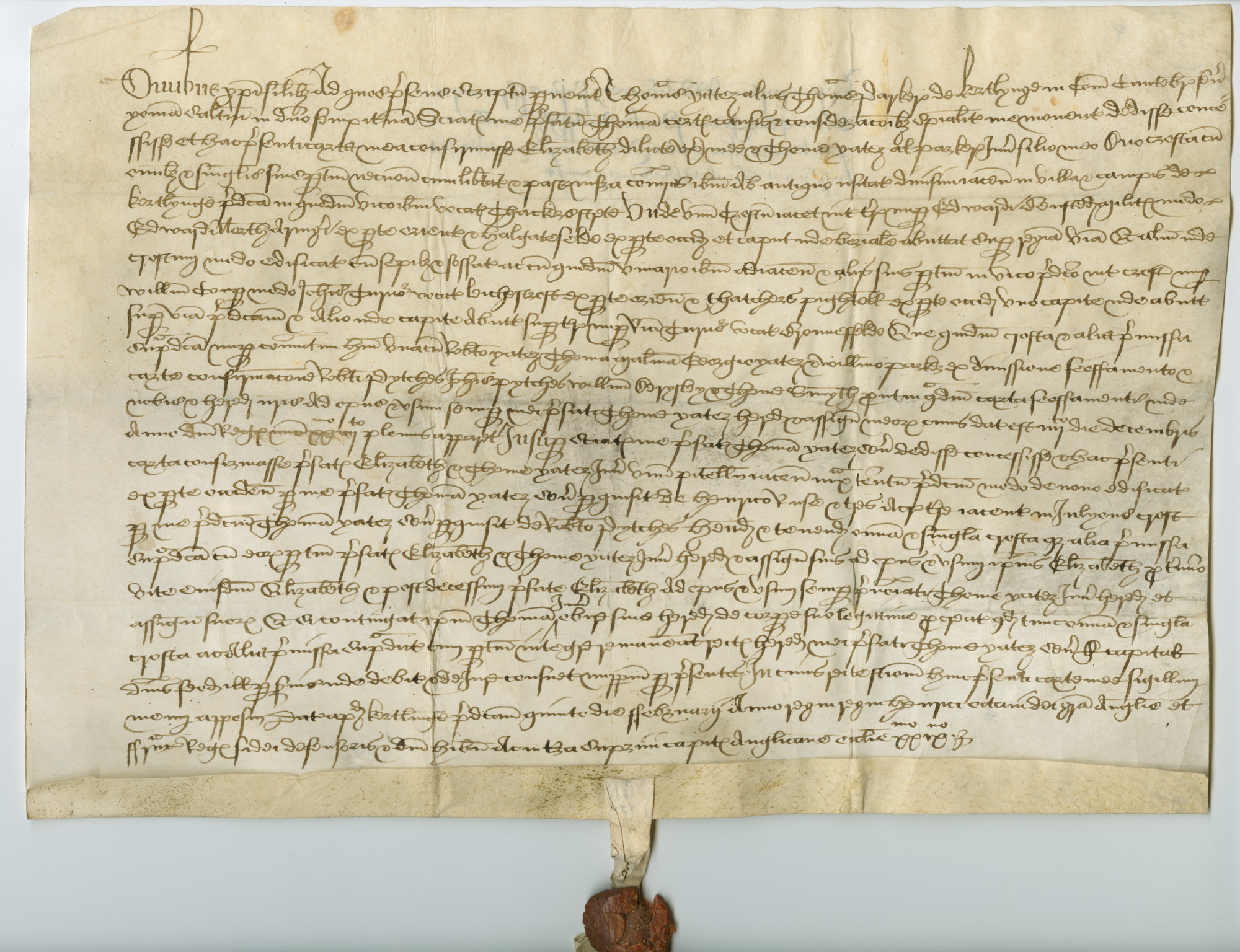
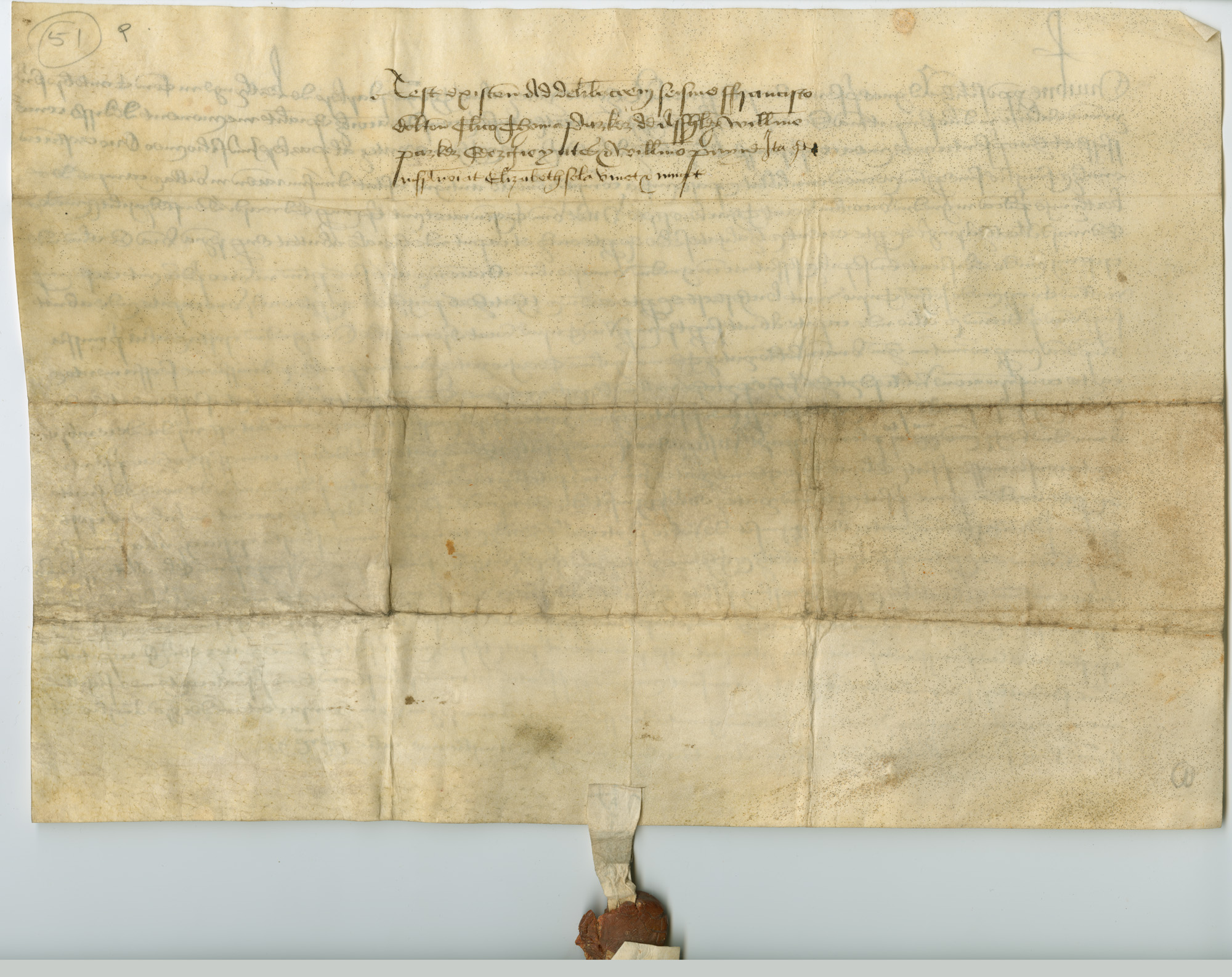
Feoffment by Thomas Yates alias Parker to Elizabeth, his wife, and Thomas Yates, Jr., his son, of a croft in Kirtling, Cambridgeshire.
1538/39
Tag with red wax seal, depicting a coat-of-arms (cracked, lacking portions).
Tag made from waste material, bearing inscription on inward side.
(McMaster University, British Legal Instruments Collection Ms. 51)

This parchment seal tag remained the most common variety of seal tag throughout the medieval and Renaissance periods. However, for some applications, a fancier document was desired. Just as fancier fonts and illuminated first letters could be used in the text, so could fancy seal tags be used. Such seal tags were normally made of fibres, braided or woven narrow strings. The earliest fibre seal tags I know of date from the late 12th Century, showing this technology developed quickly, although most documents stick with the utilitarian parchment seal tag.

The conceptually simplest forms of fibre seal tags (although often most decorated) are woven strips which replace the parchment seal tag in the same manner. Although the simplest seal tag to attach, these wider tags provide more space for more elaborate textile techniques, as seen in the example below.


William de Brus to Durham cathedral priory
c1194x1215. Double faced tabletweaving.
(Durham Dean and Chapter Muniments 4.8 Spec 2)


A form of fibre seal tag which uses a much simpler to make seal tag, but develops it's own method of attachment is the simple "twist" pattern. At it's simplest form the seal tag is a coarse piece of string (as exhibited on the papal bull below), at it's most complicated a narrow piece of braiding or weaving.


Mandate of Pope Martin IV for a case to be heard
1284
(DCM, 4.2.Pap.4)


One of the most complex forms of seal attachment is the "diamond" seal tag attachment. 2 braids or narrow cords are combined with a plait to make a pretty result, often with contrasting colours. The example below doesn't clearly show details, but you can see the diagnostic diamond pattern. This example appears to be a single coloured braid, but I'll explore the intricacies of the diamond pattern seal tag later.


Charter of Richard I, confirming to Alexander de Barentin, butler to Henry II, all his property fairly purchased or confirmed to him by Henry II.
12th Century
(London, Westminster Abbey Muniments no. 657).

A few much rarer fibre seal tag attachment patterns also exist, and I'll get to a discussion of these much later, when I've gathered more examples. (Please feel free to send me more, good photos of the tags rather than the seal or charter are hard to obtain, and with parchment seal tags the majority of tags, fibre tags are hard to find.)