Showing posts with label veils. Show all posts

Tuesday, 5 March 2013

The world's simplest veil: headrails

Headrails

The simplest veil I know of is the headrail. Firstly it is simple to construct because it is quite simply a long rectangular piece of fabric. In fact a light pashmina scarf makes a great headrail, and requires no construction at all. I find my smallest one that works is 162cm long and a width of 60cm, but a little wider may be good (not too much -try for the distance from the front of your head over your head to your neck and a bit of spare), and any amount of excess length is fine - I have one which is over 2m long.

Secondly the headrail is simple because you don't need a fillet under it. This is a good veil for people who are scared of pins in their head, or claim they are too uncoordinated to get a veil on straight, especially at events where no large mirrors are handy. Thirdly the headrail is simple because there are only 2 steps to draping it.

I don't know where the name headrail comes from, but I expect it's a reenactor term. I think the 12th C person would have called it the local equivalent of veil, eg the anglo norman guimple or perhaps coife. I doubt the language would have had a specific word for this type of veil versus that one, but modernly we find it useful, especially when referring to 100's of years of veil types at the same time.

How to drape it

The first step is to place the centre of the veil on top of your head. It may be easier to drape it around your neck like a scarf, then pull it up onto the head.


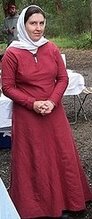
In the picture I've deliberately made the two ends slightly uneven, so it drapes evenly. This really isn't necessary, nobody gets to see both ends at once. Next, grab one end, and toss it over your shoulder. It doesn't matter which side.


  And that simply, you have a headrail.
For tasks where the long headrail may drape into things in front of you, simply toss both ends over your shoulders. For even more demanding tasks, tie the ends in a simple single knot behind your back.


Comparison to other veils

While the simplest veil, the headrail isn't quite as versatile as other veils in this manner.  I do find myself adjusting it occasionally and it isn't well suited to tasks where I must bend over (it drops off forwards). If I sit in chairs with a back, the headrail also doesn't work as well because it relies on the weight of the fabric to hold the veil tight against my face.  Sitting in a chair takes the weight off the veil.  For the same reason, while I've seen little evidence for it being the way things were done in most places in the 12th Century, a beaded or heavy trim edging or fringe could really add weight to a headrail, making it stay on better.


Extant 12th C images

When I actually look for 12th C headrails, I actually find it difficult to prove such a veil was used. Here are some of the closest images I've found:


England, 1175-1200.
folios 11r, 12v and 15r


These images show an unusual amount of detail for the period - generally you can only see a white or whiteish veil wrapped around a head. But on these examples you can clearly see the veil crosses over itself at the neck. There are a few other examples which do show the crossing of layers of the veil, and many which do not.

But I'm not at all sure what shape of veil is depicted here - we can clearly see a corner on the first image, but that could for example be the corner of a half circle veil as the corner of a rectangular veil. So we must guess based on the shape produced by comparing to our results and hoping that the artist was actually trying for a realistic impression. Whatever shape the veil, both ends are flipped back over the shoulder in all but the first image. And the ends depicted are fairly short - whereas my ends are fairly long to keep this veil closed by itself.

In all but the first image, no hair is visible under the veil - I find this very difficult to achieve with a headrail alone - I generally either need veil pins or an extra layer underneath to cover the forehead, or otherwise my veil creeps backwards on my head.

Overall, I think the headrail is a quick and easy way to introduce people to veils, but I'm not convinced that this is exactly how a veil would be worn. But it does teach about what fabric drapes well, is easy to put people (even if afraid of pins), and teaches them how to flip the ends over their neck - so I think it serves a useful purpose. And it may be right for other time periods.

Wednesday, 15 August 2012

Hairstyles and veils

Today, an intorduction to veils.  Yes, I know others have posted similar descriptions, but most use a band under the chin (which doesn't suit  a number of 12th Century styles) or aim at a different style, so here's how I make my simplest style of veil. Of course many variants exist, and I'll attempt to explain some of the ones I use later, but don't be afraid to experiment - If it's giving you the look you see in the illustrations, you are probably heading in the right direction.


The fillet
Veils don't just stay on by magic. And if you just jam a crown or circlet on your head on top of your veil, you run the risk of getting the dreaded muffin head effect. In fact, there are plenty of veils in manuscripts that don't have a circlet on top of them, so something else must be holding them up. My favourite way to do so is a fillet.

A fillet is a strip of fabric a bit bigger than the size of your head. Good fillets are made from fabric that will grip a little. For example a shiny satin ribbon works badly, slipping off easily. A velvet ribbon works a bit better because its pile grips the veil better. But those are both modern examples of materials. Period examples are likely to be linen bands or strips of tabletweaving or similar woven narrowwares. I have both and both work quite well.

Here's pictures of attaching the fillet:

The tabletwoven strip I prefer to tie behind my head, while the linen bands don't tie very comfortably or securely - I prefer to pin those tightly to itself at the back of my head.


Once the fillet is sitting on your head, you can now attach the veil. I'm using a simple oval veil today, but this method should work for most other vaugely cirular shapes of veils. Drape the veil over the fillet in the position you want it to be in.

Pop in a pin in the centre, that is above your nose

Add a pin on each temple.
And so the final product which drapes, but doesn't fall off your head when you dance. You can place a another fillet over top of this again, be it a simple metal circlet, a wreath of flowers, a cloth band or a crown. I'm told the underneath fillet will support the weight of a crown a bit, although I can't speak from personal experience.

Thursday, 18 January 2007

Dresses from Salzberg - Cod. lat. 15903 Bayerische Staatsbibliothek

The source, courtesy of Bildindex:
Periscope book, Saint Erentrud, around 1140 (München, Bayerische Staatsbibliothek, Cod. lat. 15903)

  • Commonly known as the "Periscope book of St Erentrud", but don't try googling that, or all you'll end up with is a single link to this blog :-) (almost a googlewhack!)
  • Saint Erentrud or Nonnberg Abbey is a Benedictine Monestary in Salzberg (in fact it's the one in Sound of Music).
  • Like most Austrian art it has a strong italo-byzantine influence, but Dodwell says it also has an Ottonian influence. I think I can see this in the fatness and posture of some figures, and maybe also in some of the trim positioning?
  • I don't know exactly what periscope book means - no-one wants to give me an exact definition (it might be something to do with spiritual illumination)
  • You can see one colour folio (men only) on wikipedia commons.
I'm going to summarise all the women in this manuscript below, but I'm not going to show all the pictures - none of these women have the fancy calf length style I'm looking for at the moment. In fact, most of them are cut pretty much the same as the first picture, although many have less details (no trim on sleeve edges, or sometime less dangly sleeve).

folio 58: Helena and Emperor Constantine
  • A fairly standard full length dress with flared sleeves, partially concealed by a wrap
  • Trim on sleeve edges
  • what looks like a cingulum style belt
  • Most interestingly, the tight sleeves under the flared oversleeves are a coloured patterned fabric. Most dresses show pale sleeves that could be a chemise, but this one is either a patterned fabric underdress or a chemise with wide decorative cuff panels applied. And it looks like there is a different coloured band at the cuff, which argues for the former. Exciting!
  • There is something strange hanging out of the bottom of the sleeve.
Folio 102v - Christ and Mary (not pictured here - follow link)
  • Fairly standard floor length dress with flared sleeves.
  • standard pale wrinkled tight sleeves under the flared ones.
  • Something strange hanging out of the bottom of her outer sleeves too (pictured, clearer on this picture than previous folio)
  • shoes with line of decoration down vamp
Folio 84 - Mary gives Birth (not pictured here - follow link)
Folio 39 - The 3 Mary's at the Tomb
Folio 76v - Waking of Jarias' daughter
  • Nothing special, clothing mostly obscured by blankets, cloaks or people
Folio 81 - Mary dies
Folio 70 - Healing of the mother-in-law of Petrus (caption points out that's what the text says even though it's obviously a man being healed)
Folio 31 - Annunciation
  • Clothing mostly obscured by cloak
  • shoes show line of decoration down vamp
  • Folio 81 and 31 also show use of scalloped edges as trim. This is also seen (eg pictures) in a number of the men's garments in this manuscript: 1, 2, 3, 4, 5
    and as men's belts with scalloped edges: 1, 2.
Folio 71v - Birth of John the Baptist
  • pretty average European ladies
  • what appears to be a byzantine midwife -I've seen extant earrings before, but only from byzantine and Russian sources. I've read a literary description (was it in Goddard?) that good European women didn't wear earrings, that only shameless byzantine hussies did (or at least that's what the Europeans were saying - I'm sure the Byzantines thought something similarly uncharitable about the western Europeans). It certainly fits with the archaeological absence of earrings in Europe - metal is more likely to survive and the German empresses did get buried wearing jewelry. I'm pretty sure I've seen earrings in byzantine art. So I guess this lady is a byzantine or Russian lady, but I can't think why she is appearing in this particular scene. (were byzantine midwifes better? was there a Byzantine princess married in to that family?) She also has an unusual hairstyle.
    Folio 14 - Flight into Egypt
    Folio 15 - The Circumcision (of Jesus)
    Folio 17 - The 3 Kings
    Folio 46 - "Noli me Tangere" ("touch me not" - what Jesus said to Mary Magdalen)

    • Mary's Dress and sometimes veil & Cloak both have trio's of dots on them. These dots also appear on some of the other characters. They could annotate decoration, but I've heard this could also be a symbol used to annotate a holy person. A clear giveaway that this is so in some other works is when trios of dots appear on foreheads or similar non-clothing places. I can't see any examples of that here
    • Other details of dress are obscured by cloak
    • Folio 46 Mary's veil - which is dark coloured, not the more common pale
    Folio 27 - Presentation in the temple
    Folio 9 - Birth of Christ
    • Most details of dress are obscured by cloak.
    • Different Coloured sleeves to dress on both pictures. Does this mean Mary is wearing some kind of sleeveless garment (surcoat, pelicon?) such that we see this surcoat over her legs, but the layer underneath over her arms. Or is she wearing widely flared sleeves that are hidden under the cloak. I can't see any clue to them, so I think not. Could the artist just be confused? Entirely possible. I really need a picture that isn't obscured by a cloak.
    • Folio 9 lady's veil has a bit of a fringe, but it doesn't continue all the way around. Looks like artist got bored halfway through. Is there another explanation? The fringe has 3-5 strings that are knotted together and end in a blob. It reminds me of this Mantiple (Aachen, Germany c1200) where strands of threads are pulled together to pass through a bead. Except this one has a different pattern, and I think each thread ends in a bead or knot (knots would be nearly as easy to use where the threads gather together too. I've been considering beading one of my headrail style veils - because that would add weight to the lower edge, making it stay in place better.
    Summary:
    Not much exciting on the dresses, indeed no patterned fabrics, calf length dresses, or beanie hats. But the accessories are shown in unusual detail, with some interesting variations. I'll continue with the accessories the men have in another post soon.