Showing posts with label 12thC austrian manuscripts. Show all posts

Tuesday, 29 May 2007

Admont Bible

Admont bible, Salzberg early 12th C, (Österreichische Nationalbibliothek, Wien. Cod. ser. nov. 2701 and 2 pages in École Nationale Superieure des Beaux-Arts, Paris. PC 22788)

The Admont Bible was produced in Salzburg, Austria, c1140's or maybe earlier (it's a topic of debate). Most of the book ended up in Hungary by the mid 13th C (it was bought back by Austria in 1937), except two leaves which ended up in France.

There is a lovely website with pictures of the manuscript and a history of it. Also on that site are links to a 14th C (Hungarian Angevin is 14th C !) and 15th C manuscript.

Dodwell finds it one of the best productions of the thriving world leading Romanesque Salzburg manuscript school. He says it's highly byzantine influenced, which I find quite clear to see in some of the women's hairstyles, decorative motifs, draperies, and more subtle details.


Women in this manuscript
This manuscript is not the best source material as are biblical figures, but the women certainly appear to be wearing fashionable clothes, not old fashioned ones. The answered question is how much is reality and how much fantasy?


f11 Boaz and Ruth. Ruth's sacrifice

  • Ruth is a down on her luck noble, depicted as faithful to her family, and doing the right thing, not a slut like Salome. In the first picture, Ruth is begging from and later courting a noble relative. In the second she works in the fields to feed herself and her mother in law.
  • The two pictures show differences in dress that may correspond to that change in activity.
  • In the First picture her dress has trim at neck and hemline, in the second none is apparent.
  • The first dress is shorter (although not the mid calf I expected) to display her long chemise underneath, and keep the precious trim off the floor. The second chemise may or may not be quite short - we can't see under her dress.
  • The first chemise is trimmed at the wrists, the second is not.
  • The first dress has wide flared sleeves, the second has loose sleeves that stop at her elbow - out of her way.
  • All of these seem practical changes to a dress for doing work.
  • The hairstyle in the first picture is more elaborate (possibly a byzantine style?) whereas in the second picture her plaits are enclosed in a covering and she wears a hat. While covering the hair while working is practical, I am not convinced that this style is more practical or quicker than the first style. A nice veil would be better, but maybe this would clash with her status as an available widow, and object of romance.

f12 Hannah and Peninnah,
  • Hannah, the favoured wife of Elkhanah, can't get pregnant, while the second wife Peninnah can.
  • Both Hannah (I'm assuming she's the childless one) and Peninnah wear similarly cut dresses and veils. The dresses are floor length, probably moderately loose in the body, and have flared sleeves.
  • Hannah's dress is from a patterned fabric, perhaps this displays her favoured status. (patterned fabrics are likely to cost more)
  • Both dresses are trimmed at the cuffs and hem. Hannah's dress has more decoration depicted on her trim.
  • The cuffs of Hannah's chemise or whitish layer underneath is trimmed, Peninnah's in not visible. No wrinkle effect is depicted on these tight sleeves.
  • Both women wear similar veils. Interestingly both are coloured veils, whereas white veils are more common.
  • No belt is visible.
f12 Hannah's sacrifice.
  • Elkhanah didn't mind that Hannah was childless, and still gave Hannah a larger portion of the sacrifice.
  • Hannah's dress is cut similarly to the last picture.
  • A small white blob is visible at the bottom of her maunche. Looking backwards, I think it might be visible on both women in the last picture too. I think this is what I've seen earlier, and thought might be a sleeve lining.


f12 Eli and Hannah
  • Hannah pleads with a priest to give her a son. (and it works, and all ends happily)
  • Hannah wears a red dress, with bell shaped sleeves - these seem to flare above the arm as well as below.
  • The dress is decorated at the v-shaped neck and has a couple of subtle lines of decoration above the hem
  • The dress appears to have been belted in tight at the waist with a wide yellow fabric band. (A corsolet?!)
  • A chemise is visible at the wrists with decorated cuffs, but interestingly I can't see it at her neck despite the lower v-neck of the dress.
  • Her hair is parted in the middle and plaited, probably in a single plait.

f18 The story of Hoshea
  • Hosea was a prophet who married a prostitute supposedly on god's orders. She probably cheats on him, he divorces her, then he can't stay away and buys her back from a lover or client.
  • The second picture depicts Hosea's inconstant wife in bed. She wears a cute beanie cap, and in the full picture I can just see pale yellow shirts to her ankles.
  • The second figure holding the child might be a midwife or just Hosea's wife on a more formal occasion?
  • A fairly simple dress, full length, gently flared sleeves from the elbow.
  • Who said pink wasn't period? Well actually this doesn't prove anything - the artist might just have the colour on his palette, but the colours used do generally seem to be plausible.
  • I wonder how she gets such wonderful folds in her veil in the first picture?
  • Has that white bit peaking from the bottom of the sleeve again.
  • The headwear provides a contrast between the lady in bed and the lady nursing. The veil appears to be headwear for a mature lady, while a prostitute wears young fashion of a cap.


f24 The affliction of Job
  • God permits Satan to test Job's faith by afflicting him with bad stuff, like the boils pictured. 3 male friends and his wife try to get him to give up on God, but he refuses.
  • The lady in red is mostly likely Job's wife, who refutes god and dies. I'm not sure who the second lady is - she doesn't seem to fit the story.
  • Both ladies wear loose dresses with flared sleeves. The lady in pinks' sleeves are a more traditional shape, with trim. I think the lady in red's sleeves are supposed to be the same, just badly drawn.
  • The lady in pink's sleeve has the white blob at the bottom again.
  • White chemises show at the sleeves of both garments.
  • Both wear veils. the y have a similar drape about the head, showing some of the neck, but the lady in red's veil has a loose end over her shoulder. This may represent a (partially undone) veil in which ends are crossed over the neck and flipped behind the head. the lady in pink's veil shows strong fold lines in opposing directions at the neck. the loose end looks a lot to me like the shape made by tapered fabric, rather than square, for example the corner of a half circle.

f26 Bride and groom (not illustrated)
  • It's very hard to see this picture, but the bride must be the one dressed in pink.
  • The garment has flared sleeves, with some decoration at cuff and collar.
  • There are also two vertical lines. They could be plaits, but i think she is wearing a veil. I think they look more like two lines of decoration, along side seams or just inside of them.

Costume accessories - men's hats
Hats from folio 9 & folio 10


Also in the manuscript are a number of interesting men's hats. I'm used to phygian caps and beanie caps, these caps are a slight variation in exact shape. But what caught my notice especially is the vertical stripes on the hats. Hats can easily be made by naalbinding or sprang, and I've been speculating (along with others) if 12th C hats in these styles might be made so. So far there's been no evidence.

Could these vertical lines be an indication? Maybe, but another hat from the same manuscript is in a diamond pattern, which could still be sprang, but a very different representation of it, so maybe we are just seeing a decorative finish by the artist.
Hat from folio 14

Monday, 19 February 2007

Two sparsely illustrated 12th C manuscripts from Regensburg

Nothing exciting today, mostly just crossing these manuscripts off the list.

Ambrosius, Hexaemeron,
(München, Bayerische Staatsbibliothek, Cod. lat. 14399).
Prüfening (Regensburg), around 1165 and 1170,


The Manuscript was made under Abbot Gossuin (1131/3-65), and although we have photos of it, the manuscript is now lost . Dodwell says this has 7 full page pictures of creation largely borrowed from the Admont Bible. He says Regensburg/Prüfening coppied Salzberg artwork (which in turn ws copying byzantine) a lot, but created thier own sub style. There is not much of costuming interest in this manuscript - figures of christ are too traditional to show contempory clothing.

Isidori Hispalensis - Etymologiarum libri 9,
München, Bayerische Staatsbibliothek, Cod. lat. 13031
Prüfening (Regensburg), before 1165, (probably 1160-5)


Annother manuscript Regensberg style. This one is still extant, I think. Again, little costuming detail, this tiem with the exception of a monk's costume. Since this manuscript was written by monks, we can expect heir self depiction to be knowledgeable, and likely accurate.
  • [1v] Men in Clothing in the Regensberg style - shirts/albs visible below tunics, much trim. Except the man lysing down, who is the monk author having his soul judged.
  • [46], [80] Decorated Initials (no people)
  • [102v] ancestry chart - lots of small torso sections only. Can see some female hairstyles on zoom.

Friday, 26 January 2007

Regensburg Manuscript - Vitae et passiones apostolorum

"Vitae et passiones apostolorum" (München, Bayerische Staatsbibliothek, Cod. lat. 13074.)
Prüfening (Regensburg), 1170/1180.


A more heavily illustrated manuscript, with quite a few women illustrated, but no calf length tunics and no patterned fabrics.

Women in the manuscript:
I haven't included picture captions, as bildindex was unusually uninformative. (captions such as "
Minature from Matthew")

[28], [66v], [90], [140], [100v],
Plain dress with flared sleeves, veil (or loose hair), some with rucked up chemise sleeves. The veils are probably wrap around ones - see how the 2nd image has a clear line across the shoulder where a wrap would cross itself, and the others have similar pattern of folds.


[66], [66v], [82v], As above, but with beanie caps. The beanie caps are worn over the same veils as above or just over the hair (2nd lady, first image). Most have bands of trim around the edge. Some of them are a plain circle, others vee upwards on the forehead. Several here appear to be worn jauntily, slightly off centre on the head, but they could be ones with a vee where i can't see the second side clearly. The one's that don't vee remind me of Jewish skullcaps.


[90v] Veil is loosely draped - doesn't cover front of neck. Rest of dress same as others. This could be a man (i've seen such head drapes on people with beards), but I don't think so.


[100v] Dress same as others, but she is wearing a turban. It's hard to tell with the smudge mark, but I think she is wearing the same wrap veil as the others (you can even see a dangling end behind her shoulder), and then the turban on top of that. It could be a pre-wrapped turban. Or it might be a different variety of hat I've not seen before, but I'm pretty sure I can see bands of wrapping. Her face appears to be contorted (big nose, fat face, scowl?) which may be a racial stereotype, or may just be me reading too much into a smudge mark. I should note my reasons for assuming this is a female - floor length dress and long maunches, features I haven't seen on guys before (ankle length, or longer with a slit, and only short maunches I have seen).


Image summary of remaining pages and rest of featured pages:

I find this manuscript a little strange in it's fashion sense. About half the men are still wearing the fashion of the prüfening miscellany - tunics with shirts showing underneath and many bands of decoration. But none of the women wear the female version of this fashion - all have floor length dresses, and none even have a band of decorated trim on the end of their sleeves. Some have what looks like a plain coloured band, but no decoration. Perhaps the artist didn't have enough time to do such elaborations (but calf length doesn't take time) or perhaps this vain fashion was not considered appropriate for saintly women (but none wear halos, and other manuscripts show Mary with a calf length tunic). Or maybe this shows a diversion over time (this manuscript is slightly later than the others so far) from byzantine fashion?

Wednesday, 24 January 2007

Revisiting the Prüfening Miscellany

Gloss of the Bishop Salomon 3. of Konstanz (München, Bayerische Staatsbibliothek, Cod. lat. 13002.)
Prüfening (Regensburg), 1158 and 1165,


If this manuscript looks familiar to me, it is because it is. I've previously written about 2 pages of this manuscript under the title Prüfening Miscellany.

Stylistically it's also a lot like another manuscript I've already written about - Bayerische Staatsbibliothek, ms. lat. 14159 made at Regensburg Abbey a little later (c1170/75).

summary of illustrations:

  • [1v], [2], [2v]Medical text. Shirts visible below tunic hem. Men with band of trim at mid thigh height (1v, could this just be a badly drawn visible shirt?) . Much trim.Cingulum style belts including wide ones in patterned fabric(2,2v). Phrygian cap in patterned fabric (2,2v). Glimse of Braes? (2v)
  • [3] medical diagram of the body
  • [3v], [4], [4 again], virtues and vices see previously entry on these pages.
  • [4v] castle diagram (no people)
  • [5v] mostly bishops & kings (little clothing detail)
  • [7v] microcosmos interlinked diagram (no clothing)
  • [8] and [8 again], [8v], [8v closeup], [13v], [80], [89v], [179], [?], [208], [209] decorated initials (no people) or text with slightly decorated borders (no people)
Folio 1 and 2 are the most exciting - more pictures in the style of the virtues and vices pages. Unfortunately all the figures are male. We get a lot more working men, and less kings and bishops, but the details are really much the same as the virtues and vices details. The brocaded fabric phygian caps are the only new addition.

Tuesday, 23 January 2007

Less interesting manuscripts from Regensburg/Prüfening

A Collection of links to 12th C Manuscripts from the Regensburg/Prüfening Abbeys. Pictures of costuming interest are annotated.

Rupert von Deutz, "De officiis divinis" (München, Bayerische Staatsbibliothek, Cod. lat. 14355)
Prüfening (Regensburg), 1140/1150


Two texts from Hieronymus and two papal directives (München, Bayerische Staatsbibliothek, Cod. lat. 13102)
Prüfening (Regensburg), before 1140

"Augustini in actus sancti Johannis tractatus" (München, Bayerische Staatsbibliothek, Cod. lat. 13085)
Prüfening (Regensburg), around 1140

  • fol 89: Wandering Jew (unfinished sketch) -What looks like a straw hat with an exaggerated point. Jews were represented in a conical hat, I think this is a characature of one, complete with exaggerated beard.
  • other images: [183v]

Rhabanus Maurus, "Explaination of Matthew's Gospel" (München, Bayerische Staatsbibliothek, Cod. lat. 13032)
Prüfening (Regensburg) before 1140

  • folio 1: Initial M with King - He might have a separate piece skirt. Rippled sleeves on tunic (not shirt).
  • Other images: [6], [119v], [183v].

exegetical (relating to exegesis) manuscript (München, Bayerische Staatsbibliothek, Cod. lat. 14398)
Prüfening (Regensburg), around 1140

  • folio 1a: royal portrait - A thin (perhaps sketched and not filled in?) band of trim on the forearm as well as at the wrist. Also a decorative roundel on the cloak.
  • folio 1v: The author Bede- decorative bands on forearm and bicep. A sideways keyhole neckline.
  • other images: [folio 2].

Haymonis "Exposition to the letters of the Apostle Paul" (Handschrift, München, Bayerische Staatsbibliothek, Cod. lat. 13036)
Prüfening (Regensburg), 1146/1155,

Gradual or Antiphon, (München, Bayerische Staatsbibliothek, Cod. lat. 10086).
Prüfening (Regensburg), 1176/1200,

Gospels and prayerbok, (München, Bayerische Staatsbibliothek, Cod. lat. 14444).
Prüfening (Regensburg), 1186/1200
Well apart from a nice image of a sideways keyhole neckline in the first post, if you've read this far, you've seen a lot of average pictures that aren't particularly useful for costuming. Sorry. Had to cross them off my list.

Costume acessories from Cod. lat. 15903 Bayerische Staatsbibliothek

While I was browsing the rather lushly illustrated in the last post, I noticed lots of features not related to women's costume. Several of them are ones I haven't seen in visual sources before.

Remember, the manuscript was Periscope book of St Erentrud, Nonberg Abbey, Salzburg around 1140 (München, Bayerische Staatsbibliothek, Cod. lat. 15903)

Garters
Fol . 68 Healing of the sick
That holy grail of pictures, a depiction of hose gartered at the knee. Not you can see what we know from extant examples. The extant examples have their garters sewn to the back of the hose at the top (eg Roger's pair - but you can't see that in this photo). The pair I've made so far I use a separate piece of cord and fold the top of the hose over. It works quite nicely, but I'll have to try the other way with my next pair.

The depiction is of gartered long hose, or at least it shows no tops of the hose, so I presume these are separate garters of necessity.


Hose
Their are lots of depictions of people wearing hose in most manuscripts, but most don't give many clues to their construction. There are quite a few pairs of hose depicted in this manuscript that have diagonal stripes checks or diamond patterns. [1] , [2], [3], are just a few examples. These may be indications of the cut of the hose - extant hose are known to be generally bias cut (the later ones are definitely so, I don't have any info on 12th C ones), such that the hose are slightly stretchy. Plain woven stripes and checks become diagonal stripes and checks when cut on the bias. I think this tendency to show diagonal patterns on hose (which I've also seen on other artwork) represents this. This manuscript also contains the first example I've seen contrary to the rule - a pair of hose with horizontal stripes. Mind you, I think only a couple of stripes is unlikely to be a woven in pattern, so this could represent post-construction decoration. Or just an artist on a funny day.
Just for variety, there is also one pair with trios of dots on them.
This manuscript also has a depiction of what I think are pairs of hose when not on the body.
folio 11v stoning of st Stephen
This site says stoners "were laying down their garments at the feet of Saul, that they might be more ready for the task devolved upon them" so the object should be clothing, unspecified variety. They look like hose to me, but I see no reason why they should remove only their hose and not their other garments. The feet of the hose are not visible, making this identification uncertain, but the string at the top point of this pair is just what we expect from 14th C hose. The pattern on the reverse side reminds me of the buskins of archbishop Walter Hubert (c1200), pictured on right. I presume showing one side patterned and the other not is artistic license for showing the folds more clearly.


Sandals?
Fol 93, Martin divides his cloak with a beggar
This pilgrim
/beggar (the caption and story say beggar, his bag and staff say pilgrim) looks like he might be wearing sandals. I've seen biblical figures with thonging around their feet, but they might just be romanticising the past. A pilgrim might wear rather humble footwear than average, so this might be realism. The drawing of his legs makes him look barelegged.

Hoods?
If you look at the object around his shoulders, you'll see an object that sits above his tunic. Quite a few other guys have these , but on the others you couldn't tell if it was part of the tunic (although in several cases it was a different colour) for example the trim or neck facing. This example clearly shows the object on top of the trim on the tunic. I can think of few objects that are wrapped around necks other than hoods and scarfs (and it looks to structured for a scarf). This is quite different (shorter) from any other 12th C hoods I've seen, but compare it to this 13th C hood (caption on this post), which is quite tight on the neck and doesn't extend far down the torso. I think it's a hood, but I can't prove it conclusively, since not one of the following examples from this manuscript wears one over his head: [1], [2], [3], [4], [5], [6], [7], [8], [9].

Bags
Fol 93, Martin divides his cloak with a beggar
The pilgrim has a nice example of pilgrim satchel in fairly typical shape (rectangular or square with a flap, and pilgrimage symbol eg cross or shell) and size (look how small they are!).

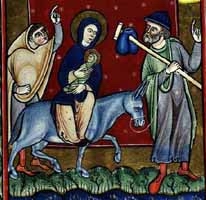
fol14, The flight to Egypt
This is another scene I've seen a few times (caption on this post)- poorer male travellers carrying their goods over a stick. The goods appear to be contained in some kind of saddlebag or roll. I've heard of a later period bag style where you make a roll like a long pillowcase, sew the ends closed and create a slit across the width of one side only of the middle. I think this has a similar construction, but not being a rich man's object we are unlikely to find out.

Tuesday, 21 November 2006

Bayerische Staatsbibliothek, ms. lat. 14159

The manuscript (Bayerische Staatsbibliothek, ms. lat. 14159)was made at Regensburg Abbey (not far from Salzburg, Austria) c1170/75. It measures 31cm by 21.5 cm and has 188 pages. Pictures of most (all?) of the illustrated pages can be found on Bildindex.

It's a lovely manuscript full of nice details, so I have to share it! Or at least some of the fantastic Austrian Women's fashions in it. I've only selected the pictures that are most interesting to me (mostly shorter skirts) there are more pictures (includign more women) on Bildindex.

Thanks to Wencenedl for help interpreting captions and identifying biblical stories

fol.1r Ecclessia & crosstree

  • Well the modern german translation calls it a "crosstree", but it's a tree of life in the shape of a crucifix.
  • Ecclessia is the personification of the church. This doesn't seem to be a typical pose.
  • Ecclessia wears a calf length tunic with somewhat flared sleeves.
  • The tunic is belted at the waist (you can see the overlap of the tunic, but not the belt)
  • Trim is present at hem, cuffs and neck
  • Her hair is braided, but I can't see other headwear under her crown, but it could be the poor angle.

fol.2rTamar & signet ring & staff from Judah, Joseph & Potiphar's wife
  • wikipedia on Tamar: Judah promised to her that his third son, Shelah, would become her husband. This promise was not fulfilled, and Tamar disguised herself as a temple prostitute and offered herself to her father-in-law Judah. She claimed his staff and signet as pledge of payment. When she later became pregnant and Judah accused her of fornication, she produced the staff and signet and identified Judah himself as the father."
  • Potifar's wife is grabbing a piece of Joseph's (he of the dreamcoat) clothing to use as evidence to falsely accuse Joseph of rape.
  • Tamar wears a plainish long dress with flared sleeves edged with trim. A veil covers her head.
  • Potiphar's wife's tunic is calf length, belted at the waist with flared sleeves. Tunic is trimmed at cuffs and hem, and possibly a thin line at the neck too. Her hair is plaited, but there does appear to be something on her head too - a beanie hat?
  • Wencenedl notes that Tamar is dressed as a prostitute (veiled!) and pontifar's wife should be dressed as a respectable wife. As both are on the same page, it's reasonable to expect the artist to have compared them.....And yet Tamar is more conservative, veiled (even as a prostitute).

fol.3r Jael kills Sisera, Rahab hangs a red rope in the window
  • Jael killed a fleeing enemy army captain (by driving a tent peg through his head as he slept), thus preventing him returning with a new army.
  • Rahab (a former prostitute) hid Jewish spies investigating the siege of Jericho. On the spies instructions she hung a red cord out the window,and thus her family was spared from massacre when the siege was broken.
  • Jael (with the lovely chisel and mallet action) has one of her sleeves tucked back behind her elbow as she works
  • Both ladies wear small beanie hats over veils (or possibly wimples) although Jael's is the classic shape, and Rahab's is split at the front like 2 leaves
  • Rahab's dress has Byzantine influenced decoration on the front panel
  • Again there appears to be no important difference in dress code between the (at some stage reformed) prostitute and the respectable householder.

fol.3v Jephta sacrificers his daughter
  • This appears to confirm the idea that unmarried women/girls would wear their hair loose while older ones would tie it up or cover it with a veil.


fol.4r Elias and the widow of Zarephta
  • Wikipedia (that wonderful source of dubious info) says " the prophet Elijah, .... multiplied the meal and oil of the widow of Zarephath (Sarepta) and raised her son from the dead"
  • She is dressed in a calf length tunic, belted at the waist. Trim is present at hem and cuffs.
  • She wears a veil over the dress.


fol.4v Judith kills Holofernes
  • Judith is a jewish folk hero, seducing an enemy army captain (Holofernes) so she could kil him in his sleep. (look at teh parallels with Jael)
  • Judith wears a tunic with flared sleeves, belted waist and decoration at collar and cuff.
  • Her lower body is not visible.
  • The cuff of the garment under her tunic (chemise or underdress) is decorated with trim.
  • She wears a veil, but it does not cover the decoration at the collar (so does Rahab above). I've supposed several other examples of dreses without decoration at collar were such because a veil rendered the decoration imposible to see/draw, but this disproves this as a constant fact. (it may still be true sometimes).
  • There is annother man on this page (not pictured - follow link) wearing a beanie hat, this one flat across the bottom.

fol.5r Superbia vanquished by Humilitas
  • Superbia or Pride is one of the personified vices, and Humilitas/Humility her opposite virtue.
  • Look at the lovely depictions of braided hair. Looks just like a 3 strand plait.
  • Humility wears a long tunic with flared cuffs. It is decorated at cuff and collar. It is probably belted at the waist. She wears a beanie hat over her plaits (doesn't seem to be a veil) , that again vees above the forehead.
  • What is visible of Superbia's clothing is almost identical, except no hat.
  • Medieval bestiaries (eg Aberdeen bestiary) draw links between a peacock's brilliant plumage and vanity, showing a consciousness of pride of appearance, and yet Superbia is not dressed any more vainly than Humilitas. While Pride takes in a much greater scope than simple narcissism, it does include it. So I find it surprising that this simple to show symptom of one type of pride isn't used to help build the stereotype of Pride. They just don't seem to have chosen this option. So I can't consequently draw any links between Humility's clothes and what was modest clothing of the day. Damn.

fol.5v The mystical Paradise (Not pictured - follow link)
  • Supporters include several virtues wearing clothing in the same style as the above examples. I haven't included them as we can only see their upper bodies.
  • The central figure (Jesus?) has a nice example of a beanie hat that vees at the forehead.

fol.6r Cross filled with people (Not pictured - follow link)
  • Several female supporters (possibly virtues?) in the same mould as the figures above.
  • Hair worn loose, only upper body visible.

Other pages from this manuscript on bildindex:
fol.1v, fol.2v, fol.8v, fol.9r, fol.46v, fol.187v, fol.188v.

Conclusions:
  • This style does seem to be consistant with the other manuscripts of the area and time. (i'll try to explain why I think this in a later post hopefully.
  • There doesn't seem to be any clothing conventions to mark women as prositutes in this time and place.
  • New dress features: beanie hats that aren't flat along their bottom edge.

Thursday, 14 September 2006

More patterned Dresses - Prufening Miscellany

I'm not even halfway yet :-)
The following entry (no 6 only) is also illustrated in Davenport's "Book of Costume"

6.Prüfening "Vices and Virtues" Prufening Miscellany CLM 13002 f3v&f4 1158/65 (Bayerisches Stadtsbibliothek, Munich)

  • Prüfening was an (influential) abbey just outside Regensburg (then capital of) Bavaria.
  • Wikipedia (slightly unreliable, but so tempting, and generally giving the info i wanted most sucinctly) gives slightly differing versions of the 7 virtues and vices, but I think I can guess at most of them.
  • The complete illustration is apparently (Dodwell gives examples) full of paralells and symbolism.


filia Babylonis (daughter of Babylon) with Cupiditas (greed),paralleled by Daughter of Sion (filia Syon) with caritas (charity).


A King (Lido?) with opulentia (wealth/oppulence) accompanied by fortuna (fortune), opposed by prudentia (prudence/foresight).


honortay petentia? (?)opposed by Mansvetd?(or is it M Ansu Etudo?).


potentia (might) opposed by Longanimitas (forbearance).


Gula?, (gluttony) opposed by humilitas (humililty).


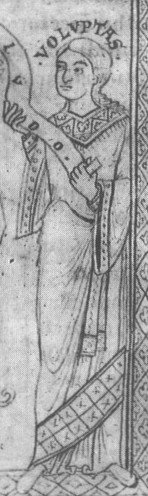
voluptas (pleasure) oppossed by sobriatas (sobriety/temperance).

I think I've still got some of those pairings wrong, but I'll work on it. And I'd welcome info on who the mystery pair is.