Some of you might have seen my wire rings by now. I'm fascinated by medieval wire jewelry because it's so simple to make with few tools, and looks cool. I've taught making these with stripped copper electrical wire, and was able to briefly explain the context, and get people to make rings and even the slowest was complete within 45 minutes. I can't think of many other medieval mini projects that can be taught on such a short timescale without the teacher doing a lot of preparation work.
Here's my latest collection (in silver so they could be donated as silver rondell tokens): These are based on an brass wire example from late 13th- early 14th C London, as described in "Dress Accessories".
The original piece is rather carelessly made, with less care to where the wire sits than I now show. They did take care to make sure the ends of the wire pointed outwards, rather than into the finger though.
I've been playing with the subtle changes you can make to the pattern. Here are some closeups as examples.(Sorry the closeup photos are dark, otherwise the reflection off the wire is too much with my primitive photography setup).
With lots of twists close together:
 With one twist separated by wide gaps:
 With two twists separated by gaps:
 With three twists separated by gaps:
 Note that the one-two-three twists represent the first three passes of the neatest way to make these rings - by making multiple passes around the ring. At first I thought it would be better to make all the twists in one pass around the ring, but that doesn't work well in wire. The medieval example though, only makes one pass around the ring - it just doesn't add many twists.
And here's a few experiments (not at all based on medieval precedent), that I did just for fun:


Wednesday, 18 July 2007
wire rings

A new tent picture!
Great news - Bildindex now has an English option - click on the union jack flag on the front page
While I was looking on bildindex for a better copy of a 12th C manuscript I know has tents and lamps and sidesaddles and all manner of interesting stuff in it, I found an earlier single bell tent:
f45. Abraham and the 3 angels
Prudentius Manuscript
St Gallen Abbey, Switzerland, 10th C
(Bern Stadtsbibliothek, Cod.264)
Araham's wife has some snazzy clothes too.
As far as I can tell, It's not listed here or here or here, so I think I might have found a depiction hardly anyone knows about.
Here's what I was actually looking for (unfortunately only one page of many so far):
f143 - Biblical figures (Noah, Abraham, Moses, David), centre- Freidrich Barbarosa & sons, bottom - Freidrich on crusade
Petrus de Ebulo, "de rebus Sicilianis carmen"
Salerno, Sicily, c1195
(Bern Burgerbibliothek Cod.120)
I'd love to get my hands on a complete copy of the illustrations of this. Looks like latrobe uni might have something in German.
Other Tents also found while searching:
http://www.bildindex.de/bilder/ch00033f08a.jpg
A 15thC tent and annother from
Schilling's Bern Chronicles 1480's
For more pages (without tents), search bildindex - place Switzerland, Bern, Stadt, Geschicte, allgemeine.
Monday, 2 July 2007
Aachen Cathedral Treasury - Part 2: Stole with brickwork
In the previous post, I've done a rough listing of medieval reenactor interesting contents of Aachen Cathedral, now to my first highlight from a 12th C perspective:
Stole
"stole, Germany? c1200. silk? (w 11cm, l 265cm)"
The stole and mantiple, I found about a year ago while looking for belts. The centre section is a lovely typical example of goldwork (underside couching I think) at it's best. But it's the ends that fascinate. Firstly both end with a fringe which passes through beads before hanging as a fringe. Simple, but very effective, and clearly shown in the photos. Secondly, the Stole has an end section of brickstitch. This is the earliest example of the style I've ever seen. It doesn't look like a later addition, and the rest of the piece looks very typical for 1200 (to my untutored eye), so maybe the labelling is correct, and it truly is a very early piece. It doesn't have the devices or non-geometric motifs of later pieces, but the piece is so small that they wouldn't fit easily. The pattern is geometric, but more complex to count out and stitch than it initially appears.
 I've graphed it out. On the left is my interpretation of the overall pattern. On the right, I've overlaid it on the original photograph (over the section which sits flattest). I stretched the pattern a little to do so, but did not distort it in any other way. Below is my best guess at where the individual stitches might have been placed. It's based on the layouts of other brickstitch items given in "A Stitch out of Time" since I'm already squinting to see the pattern the colours make. (and I don't have a higher resolution photo). Be sure to click on the image to make it large enough to read. The sharp edges represent how I think the edges were stitched, the soft edges represent places where the pattern continues similarly.
Given the width of 11cm, and my estimate of 4x24=96 stitches we can also estimate stitch density as about 8.7 stitches per cm. I've left a little grid on a section of my pattern, and the squares of this grid would be 8.7stitches/cm or 1.1mm wide squares. I talk about stitch width because stitch length varies. Also the original fabric may not be woven completely evenly in warp and weft, but the embroiderer has compensated well, or it is quite good as there is no apparent elongation of the pattern.
Friday, 29 June 2007
Aachen Cathedral Treasury - Part 1: Catalogue
Bildindex (more properly Marburg Photo Archive) now supports English language. Well sort of - there's still a of of german in there, but less than before. Look for union jack flag to the left to switch languges.
Thanks to a link elsewhere, I was made aware of the awesome stuff in the Aachen Cathedral treasury, so today's topic is a summary of the contents that bildindex has photos of. I'll post about a few of my highlights in subsequent posts.
To look at the photos, select 'places' from the top bar. Now on the left bar, select the following sequence of folders: Aachen > Öffentliche Sammlungen > Domschatz (cathedral)
and within that are subfolders. Below is a listing of what's there (I may have missed a piece of two, but nearly everything). You'll be sure to find something to facinate you.
I've also added links to webpages with colour photos of individual objects. One in particular worth mentioning, for it's high resolution and range is artserv and it's section for the cathedral treasury. (I find it works better under IE than mozilla).
Summary (by subcategory):
>Malerei (paintings)
- Mary and child, Ungarn, before 1367
- falkstein Portable altar, Aachen, 1401/1415,
- Wenzel Portable altar, Prag, 1467/1500
- Aachener Marientafeln, Meister der Aachener Marientafeln, c1485 (many pictures)
- Der Aachener Altar / Passionstriptychon, Meister des Aachener Altars, 1515/1520 (many pictures)
- crucifix, Nideggen, 1060/1070
- statue of Mary, Aachen, c1280 [artserv1], [2], [3], [4]
- statue of Mary and donor, Niederrhein, um 1330 [artserv1], [2], [3]
- Felixschrein - 14thC gilded silver & silversheets. (h23cm, l 50cm w22.5cm) . Pictures: mi00007c07a-mi00007c08a, mi03344f10a- mi03344f11a
- Karlsschrein (Charlemange shrine)- 1200-1215 Aachen , gilded silver and enamelled copper. Pictures: mi00007c09a-mi00007c14a, mi00007d01a-mi00007d14a, mi00007e01a-mi00007e14a, mi00007f01a-mi00007f14a, mi00007g01a-mi00007g10a, mi03344f12a- mi03344f14a, mi03344g01a- mi03344g04a, mi09141i12a-mi09141i13a, [search for Aachen]
- Marienschrien -1220-1238 Aachen. Oak, gilded silver and enamelled copper. (h 95 cm, w 54 cm, l 184 cm). Pictures: mi00007g11a-mi00007g14a, mi00008a01a-mi00008a14a, mi00008b01a-mi00008b14a, mi00008c01a-mi00008c14a, mi00008d01a-mi00008d14a, mi00008e01a-mi00008e14a, mi03344g05a- mi03344f14a, mi03345a01a- mi03345a05a, mi09141i14a, mi09141j01a-mi09141j04a
- Reliquary of Anastasius Byzantine Emporer, 986/1015, [artserv1], [2], [3], [4], [5], [6], [7], [8], [9]
- Crucifix & reliquary of charlemange, 1101/1200?, gilded silver
- St Simeons reliquiary, Aachen 1330/1340 [artserv1], [2], [3], [4], [5]
- disc Reliquiary for a flabellum (huge eclesiastical fan), Vienna?, c1350 [artserv1], [2], [3], [4], [5]
- Bust figure reliquary of Charlemange 14thC [karl bust], [artserv1], [2], [3], [4]
- crown, Aachen c1349
- crown of Margaretha of York 15thC
- cross relliquary, 14thC
- Charlemagne reliquary, in the shape of a church, Aachen, 1346/1355, Restored: 1978, (lots of detailed photos)
- 3 tower reliquary, Aachen, um 1370/1390, Restored 1829, 1978
- ciborium Relliquaries of the belt of Mary, flagellum-cord (or scourging?) of Christ & belt of christ, Prag?, um 1360
- reliquary for King Stephen I, Deutschland, after 1370
- ciborium reliquarys, 1386/1400, Köln 1401/1415,
- reliquary with true cross and Agnus Dei, Hans von Reutlingen, 1501/1515 [artserv]
- statue reliquary of Peter, Hans von Reutlingen, 1510
- arm reliquary for Charlemange, Lyon, 1481 [arm reliquary]
- monstrance, Hans von Reutlingen, 1520, [artserv1], [2]
- 19th C reliquary of true cross
- goblets 1497-1522, 16th C and 16th-early 17th C.
- paten (plate) c1200, engraved gilded silver. Pictures: MI00010c03a.jpg-MI00010c04a.jpg
- 18th C candle sticks
- Lothair cross, Western Germany, c1000, with 19th & 20th C "restorations" [scroll down, 1st pic], [artserv1], [2], [3], [4], [5], [7], [8], [9], [10], [11], [12], [13], [14], [15]
- "Breast cross of charlemange", 1101-1200, restoration 1871, (h 8.5cm) Pictures: MI00010e04a.jpg
- dove staff?, 1201/1300 Pictures: MI03345e01a.jpg
- eagle topped staff 15th C [artserv1], [2], [3], [4], [5]
- clasp for a cope, c1180, reworked 1870, gilded silver (19x16cm). Pictures: MI00010e06a.jpg [artserv1], [2]
- various very decorative (good closeups) clasps for copes, dated: 1371-1381, 1376-1400, 1401-1415, before 1520, 14thC, 14th C [artserv-16thC]
- box for a crown (relquary?) England, 1475
- beaker& case of the holy Elizabeth 15-16thC
- carrying cross, Western Germany, 1146/1155, bronze & wood, hollowcast & gilded. Picture: MI00010f11a.jpg
- coat of arms, Ungarn, 1371/1381
- seal, Ungarn, 1528
- Aquamanile in the form of a Bust, Aachen?, 1201/1215, bronze, hollowcast & gilded. (h 18.3cm). Pictures: MI09141j11a.jpg-MI09141j12a.jpg, mi03345f13a.jpg-mi03345f14a.jpg,MI00010g02a.jpg, MI00010f12a.jpg-MI00010f14a.jpg, MI00010g01a.jpg-
- bookcover of the schatzkammer bible, Westdeutschland, um 1020 [artserv1], [2], [3], [4], [5], [6], [7]
- 19th C bishop's staff, 20th C pectoral pendant, 18th C waferbox?
- 9th, 10th & 14thC carved panels [artserv- 10th C], [2]
- bucket c1000 [artserv1], [2], [3], [4], [5], [6], [7], [8], [9], [10], [11], [12],
- carved book decoration, Maas c1100. Pictures: MI03345g12a.jpg, mi04801g02 [artserv1], [2], [3], [4]
- "hunting horn of Charlemagne" Unteritalien c1000, with shoulder strap (woven? with inscription made by belt mounts?) Lüttich, 1386/1400 [artserv-horn], [artserv-strap]
- Many 6thC silk fragments, Antinoe, byzantium, Alexandria, sasanid, East Rome, Persia
- more fragments, mostly silk: 7-8th C Persian, 8-9th C Persian, 8-9th C sasanid, 9thC? islamic or byzantine, 10-11th C byzantine
- 10thC byzantine elephant patterned fabric from the "Karlsschrein"
- sicilian-arabic silk from the "Karlsschrein" c1200
- "bernhardskastel" (Bernhardt's Cope) 1160-70. Probably beaded. Pictures: MI00011b05a.jpg-MI00011b06a.jpg [artserv1], [2]
- stole & mantiple, Deutschland? c1200. silk? (w 11cm, l 265cm)Picture: MI00011b07a.jpg
- 13th C silk cope Picture: MI00011b08a.jpg
- 13th or 14thC Pluviale /cope (beadwork?) Picture:MI00011b09a.jpg-MI00011b011b.jpg [artserv1], [2], [3], [4], [5]
- 15th C Damatic
- 15thC chausible
- 15thC picture
- 16thC stole
- 16thC heavily embroidered cope (lots of closeups)
- annother 16thC cope
- clothing of the "gnadenbildes" 1627
- several 17-18thC vestments
- "Schatzkammer Bible" start of 9thC
- "Silver book cover of the Otto Bible" c1020
- Liutuar or Otto Bible, Reichenau c990 (very well illustrated) [artserv1], [2]
- "so called knife of charlemange" (in sheaf), England 700-1100 or maybe 10-11thC. Pictures: mi00011g14a, mi03346a08a [artserv]
- "so called armorial case of Richard von Cornwallis" Limoges, 1246/1255, Cedar (red stained), Copper & enamel, studded? & gilded. (h 38.5 cm, w 40 cm, l 79 cm). Pictures: mi00011g03a-mi00011g07a, mi03346a09a-mi03346a12 [scroll down, 2nd pic]
There is one major item that doen't appear on bildindex but does on artserv:
- Book cover, metalwork upper Rhine area, c1170-80 with 10th C byzantine ivory plaques [artserv1], [2], [3], [4], [5]
I've also updated my German glossary post , with many of the new terms I've had to translate for the above.
[edit: more posts about the Aachen Cathedral treasury]
Tuesday, 29 May 2007
Admont Bible
Admont bible, Salzberg early 12th C, (Österreichische Nationalbibliothek, Wien. Cod. ser. nov. 2701 and 2 pages in École Nationale Superieure des Beaux-Arts, Paris. PC 22788)
The Admont Bible was produced in Salzburg, Austria, c1140's or maybe earlier (it's a topic of debate). Most of the book ended up in Hungary by the mid 13th C (it was bought back by Austria in 1937), except two leaves which ended up in France.
There is a lovely website with pictures of the manuscript and a history of it. Also on that site are links to a 14th C (Hungarian Angevin is 14th C !) and 15th C manuscript.
Dodwell finds it one of the best productions of the thriving world leading Romanesque Salzburg manuscript school. He says it's highly byzantine influenced, which I find quite clear to see in some of the women's hairstyles, decorative motifs, draperies, and more subtle details.
Women in this manuscript
This manuscript is not the best source material as are biblical figures, but the women certainly appear to be wearing fashionable clothes, not old fashioned ones. The answered question is how much is reality and how much fantasy?
 f11 Boaz and Ruth. Ruth's sacrifice
- Ruth is a down on her luck noble, depicted as faithful to her family, and doing the right thing, not a slut like Salome. In the first picture, Ruth is begging from and later courting a noble relative. In the second she works in the fields to feed herself and her mother in law.
- The two pictures show differences in dress that may correspond to that change in activity.
- In the First picture her dress has trim at neck and hemline, in the second none is apparent.
- The first dress is shorter (although not the mid calf I expected) to display her long chemise underneath, and keep the precious trim off the floor. The second chemise may or may not be quite short - we can't see under her dress.
- The first chemise is trimmed at the wrists, the second is not.
- The first dress has wide flared sleeves, the second has loose sleeves that stop at her elbow - out of her way.
- All of these seem practical changes to a dress for doing work.
- The hairstyle in the first picture is more elaborate (possibly a byzantine style?) whereas in the second picture her plaits are enclosed in a covering and she wears a hat. While covering the hair while working is practical, I am not convinced that this style is more practical or quicker than the first style. A nice veil would be better, but maybe this would clash with her status as an available widow, and object of romance.
 f12 Hannah and Peninnah,
- Hannah, the favoured wife of Elkhanah, can't get pregnant, while the second wife Peninnah can.
- Both Hannah (I'm assuming she's the childless one) and Peninnah wear similarly cut dresses and veils. The dresses are floor length, probably moderately loose in the body, and have flared sleeves.
- Hannah's dress is from a patterned fabric, perhaps this displays her favoured status. (patterned fabrics are likely to cost more)
- Both dresses are trimmed at the cuffs and hem. Hannah's dress has more decoration depicted on her trim.
- The cuffs of Hannah's chemise or whitish layer underneath is trimmed, Peninnah's in not visible. No wrinkle effect is depicted on these tight sleeves.
- Both women wear similar veils. Interestingly both are coloured veils, whereas white veils are more common.
- No belt is visible.
 f12 Hannah's sacrifice.
- Elkhanah didn't mind that Hannah was childless, and still gave Hannah a larger portion of the sacrifice.
- Hannah's dress is cut similarly to the last picture.
- A small white blob is visible at the bottom of her maunche. Looking backwards, I think it might be visible on both women in the last picture too. I think this is what I've seen earlier, and thought might be a sleeve lining.

f12 Eli and Hannah
- Hannah pleads with a priest to give her a son. (and it works, and all ends happily)
- Hannah wears a red dress, with bell shaped sleeves - these seem to flare above the arm as well as below.
- The dress is decorated at the v-shaped neck and has a couple of subtle lines of decoration above the hem
- The dress appears to have been belted in tight at the waist with a wide yellow fabric band. (A corsolet?!)
- A chemise is visible at the wrists with decorated cuffs, but interestingly I can't see it at her neck despite the lower v-neck of the dress.
- Her hair is parted in the middle and plaited, probably in a single plait.

 f18 The story of Hoshea
- Hosea was a prophet who married a prostitute supposedly on god's orders. She probably cheats on him, he divorces her, then he can't stay away and buys her back from a lover or client.
- The second picture depicts Hosea's inconstant wife in bed. She wears a cute beanie cap, and in the full picture I can just see pale yellow shirts to her ankles.
- The second figure holding the child might be a midwife or just Hosea's wife on a more formal occasion?
- A fairly simple dress, full length, gently flared sleeves from the elbow.
- Who said pink wasn't period? Well actually this doesn't prove anything - the artist might just have the colour on his palette, but the colours used do generally seem to be plausible.
- I wonder how she gets such wonderful folds in her veil in the first picture?
- Has that white bit peaking from the bottom of the sleeve again.
- The headwear provides a contrast between the lady in bed and the lady nursing. The veil appears to be headwear for a mature lady, while a prostitute wears young fashion of a cap.


f24 The affliction of Job
- God permits Satan to test Job's faith by afflicting him with bad stuff, like the boils pictured. 3 male friends and his wife try to get him to give up on God, but he refuses.
- The lady in red is mostly likely Job's wife, who refutes god and dies. I'm not sure who the second lady is - she doesn't seem to fit the story.
- Both ladies wear loose dresses with flared sleeves. The lady in pinks' sleeves are a more traditional shape, with trim. I think the lady in red's sleeves are supposed to be the same, just badly drawn.
- The lady in pink's sleeve has the white blob at the bottom again.
- White chemises show at the sleeves of both garments.
- Both wear veils. the y have a similar drape about the head, showing some of the neck, but the lady in red's veil has a loose end over her shoulder. This may represent a (partially undone) veil in which ends are crossed over the neck and flipped behind the head. the lady in pink's veil shows strong fold lines in opposing directions at the neck. the loose end looks a lot to me like the shape made by tapered fabric, rather than square, for example the corner of a half circle.
f26 Bride and groom (not illustrated)
- It's very hard to see this picture, but the bride must be the one dressed in pink.
- The garment has flared sleeves, with some decoration at cuff and collar.
- There are also two vertical lines. They could be plaits, but i think she is wearing a veil. I think they look more like two lines of decoration, along side seams or just inside of them.
Costume accessories - men's hats


 Hats from folio 9 & folio 10
Also in the manuscript are a number of interesting men's hats. I'm used to phygian caps and beanie caps, these caps are a slight variation in exact shape. But what caught my notice especially is the vertical stripes on the hats. Hats can easily be made by naalbinding or sprang, and I've been speculating (along with others) if 12th C hats in these styles might be made so. So far there's been no evidence.
 Could these vertical lines be an indication? Maybe, but another hat from the same manuscript is in a diamond pattern, which could still be sprang, but a very different representation of it, so maybe we are just seeing a decorative finish by the artist.
Saturday, 26 May 2007
sidesaddle
Because Joanna piqued my curiosity....
What do images show of 12th C women riding? I think I remember only sidesaddles, but can I actually provide some proof so I can say this with confidence.Before you do, check out this fantastic article on the construction of a replica from pictures and guesswork. Someone on the 12th C mailing list pointed out that I may be using the wrong terminology. Side chair might be the better term for what I am referring to.A quick skim of the Museum of London Book "the medieval Horse and it's equipage" reveals nothing about riding on the side, although I could have missed something in the fine text. Holmes's "Daily living in the 12th C" names a sidesaddle as a sambue in 12thC french and says that Enide rides one through out her adventures in the medieval romance Erec und Enid. The sambue is also mentioned in Aoil and in Chanson de Guilamme, where it is used with stirrups. He also says it's unclear how often they were actually used by women.from the artwork: (as always, click on pictures for a bigger version)| The flight into Egypt, roof mural Zillis, St Martin c1140-60 Mary rides a donkey (the ears!) |  |
 | The flight into Egypt, Wall painting, Church of St Aignan, Brinay, mid 12th C. It's hard to see in black and white, but Joseph is leading the donkey. |
| The flight into Egypt, Bib. Nat. Ms lat. 12117, fol 108, c1050 A smidge earlier - just to prove this wasn't a new phenomenon. |  |
 | The whore of Babylon, horus delectarum f258, Hohenbourg, Alsace 1170-1200 (This is a 19th C copy, but unlikely to get these big details so wrong) Look at the lovely demon horse monster! Obviously riding on the side is not limited to sedate ladies like Mother Mary, but is also practiced by scandalous women. |
 | Superbia (allergorical figure) horus delectarum (unknown folio) (I don't know if this is an original or copied page - if it's a copy it's certainly one of the better ones). Superbia is leading an army to attack here. It seems rather ridiculous for her to be doing so sitting sideways, but she is. Maybe riding sideways was more ingrained than I thought, after all allegorical figures are allowed to do things like throw spears that women can't but the still can't ride astride? Her feet are at uneven heights, whereas the previous pictures have even feet. Perhaps the others have sidesaddles with footrests, but Superbia has stirrups? |
    | Betrix of Reithel travelling (to wed) and Queen Constance travelling (to wed Henry VI, then to Sicily, then home), Berne Codex of Pietro of Eboli's poem in honour of Henry VI, Late 12/early 13th C? These are horses, not more donkeys, and you can see two feet below the ladies skirts. Note how they are both travelling to their new home to wed. That seems to have been a very 12th C thing - a noble lady only made one big journey in her life, and that was when she left her father's house to go to her bridegroom's house. (Or at least according to my memories of what Holmes says in "Daily living in the 12th C"). Although Constance makes 2 big trips - From home (Sicily) to the Holy Roman Empire (Germany) then back to Sicily so Henry could claim Sicily through right of marriage to her, the only daughter of the last Sicilian King (with the help of an army and a kidnapped pope). Constance was so essential to this claim that she was dragged along even though she was pregnant with Henry's heir. The last picture is the only one you can see clearly, (sorry,I'd love a better copy of this fascinating manuscript) and Constance is clearly riding a stallion. No sedate donkeys for the wife of the richest man in Europe. |
   |
| Copenhagen psalter, England, 1175-1200 f10v 3 Magi/Kings, f12r the flight into Egypt, f13r The entry into Jerusalem Three images of different types of riding. The three Kings show men riding horses in saddles which are high at front and back. Mother Mary sits sidesaddle on a donkey (or mule?) led by Joseph. Finally Jesus rides into Jerusalem on a donkey sitting sidesaddle but holding the reins himself. It's interesting that they portray Jesus doing this - I guess they extend the humbleness of riding a donkey one step further to riding a donkey like a woman does. I can't recall other depictions of this scene shown this way, but maybe I wasn't paying much attention. At any rate What Jesus is depicted as doing will have little relevance to ordinary men. |
 | Picture bible, North-western France (Monastery St. Bertin ?); c. 1200, (The Hague, KB, 76 F 5) Ah, here's a more conventional picture (I've found a few others the same now too) of Jesus' entry into Jerusalem. Humble on a donkey, but astride. Notice the apparent lack of saddles on donkeys, just a blanket. Interesting, although maybe the fabric is hiding the saddle. I guess maybe they didn't need a saddle if the donkey had a gentler gait and never went fast. |
I'm not going to say that all women rode on the side, just that the illustrations give some good evidence that quite a few did - they weren't all riding astride. (No I haven't left out any illustrations of women astride, I didn't find any).
Friday, 27 April 2007
romanesque venice
I was perusing the details for a local midwinter ball recently. It's set in renaissance Venice, and clothing to suit is encouraged. Except one of the fliers left off the word "renaissance". Which got me to thinking - what was worn in 12thC Venice? I'm not going to make up a dress specifically - It's a productive year when I make 2 full garments lately, and I've worn out chemises to replace and a half sewn woolen dress. This is just a though experiment and research jaunt. Let's see how much the Internet can tell me. I guess i might as well document how Ii search too, in case it helps others.
Firstly, I'm extremely unlikely to find anything about actual venetian costume - with all my 12th C costuming links I would likely have heard about any authoritative sites. Instead I'm going to look for artworks.
Well firstly to find something out about Venice. Wikipedia has a fairly good introductory article, that confirms Venice was around and not a tiny outback town in the era. It gives a list of churches and monuments, but it doesn't give any clues about the date of these.
So I'll try googling "romanesque venice", this will probably want to tell me about building built in the era, which might just have some original decorations. I find romanesque an indispensable search term when looking for 12th C artworks.
In the first few blurbs is one that tells me of 2 romanesque churches:
- Romanesque church of SS. Maria and Donato in the region of Murano
- Torcello: this little island has a seventh-century cathedral, the Romanesque church of S. Fosca
- Basilica di Santi Maria e Donato
- Santa Fosca
Next I google image search both the English and Italian versions of the names collected above.
I've developed a fair eye for what looks romanesque, jsut by looking at hundreds of romanesque artworks. I still need to check the likely ones, luckily the era of pictures is often labelled on Italian sites that have more than one entry - and it's fairly easy to find given the convention to use roman numerals that many European countries use. "(XVI sec.)" is 16th C and "un periodo antecedente al XII secolo" sounds like the period before the 12th C for example.
so notable results:
- blurry pictures of torcello
- a couple of good shots of the mosaics in "Basilica dei Santi Maria e Donato" - click to zoom.
- something about the templars in Italian.
- some details about the Cathedral of Santa Maria Assunta, like dates various bits were built. and some more details with a better picture of that 1208 mosaic. And another with the floor mosaic.
- the most complete site of mosaics I've ever seen. SO GORGEOUS! good closeups, unfortunately poorly labelled - which ones are which? Still If I can find blurry dated pictures on other sites, I can find closeups here.
- making holograms of 15thC artworks and it's serious art restoration uses.
- details about Venice landmarks and when they were built.
- A close-up of that mosaic and a date at last - late 11th to 12thC. Even closer up on that mosaics site.
So comments upon that last linked picture:
- To the left of Jesus is a lady in red. She appears to have both cloak and veil. The rest is obscured.
- In the middle row, the virgin Mary stands to Jesus's left. She's not a good one to base costumes upon because she dresses more conservatively and old fashioned.
- In the bottom row, the kneeling woman right of centre is likely to be a patron - a real person. What we can see of her dress is that it is just above floor length, and has tight sleeves with a bit of decoration at the wrists. Her red cloak appears to be also used as veil. It looks like the virgin Mary's dress and cloak isn't a bad model for her garments.
- All in all this is a pretty generic early 12th C look. No regional differences apparent in this picture. Maybe I'd find some with a wider range of pictures. If I could be bothered.
Tuesday, 24 April 2007
gores and bias
I was explaining this to a friend, and then I thought this is something a lot of people could use knowing. A big thank you to the charming Estienne for acting as model (in his own creations no less).
Stuff beginner sewers will need to know first
The first thing you need to know if you are a beginner sewer is a few fabric terms. (If you are not a beginner sewer, skip ahead to the next section). The selvage is the bit at the edge when weaving that strengthens the whole piece - it's a bit firmer and stiffer than the rest and may occasionally have words or other colours woven into it to tell you about the fabric. When you pick up fabric on a roll, the selvages are at the sides (ends) of the roll, and run along all of the fabric. Selvages won't fray like normal edges will, something used to great advantage in garb.
Now the grainline is an imaginary line that runs parallel to the selvages. (It also represents the warp when weaving, and is the strongest thread.) If you try and stretch fabric in this direction it won't stretch much (except knit fabrics eg t-shirts and stretch fabrics, which are both pretty much modern inventions). The direction perpendicular (at 90°) to the warp/grainline/selvages is the weft and it doesn't stretch either. (Being the weft the thread may be a bit weaker too - that's why we generally cut out pieces with the longest dimension being along the grainline - called cutting on the straight grain).
The bias is either of the two directions at 45° to the grainline/warp/selvages/weft. It's quite stretchy in comparison to the other directions. In modern sewing this is used to great effect in bias cut dresses which cling to the body without using stretch fabric. It's also quite wasteful of fabric, and really tricky to do if you have narrow fabric widths. Medieval Tailors in general don't seem to have figured out that they could do this, but they didn't really need to - linen and wool shape to the body better than most cotton & synthetics do. Another way that the bias is used modernly is to create 'bias binding' which is used to bind edges of garments and can be used to make neat machine hems. Medieval tailors used straight grain tape to bind the edges of garments (eg collar, cuff edges, and even the seam allowances in the St Louis shirt) and it worked quite well for them because they used better materials and finer seams than we generally do today. I find bias binding looks almost the same as straight grain tape, so I thoroughly recommend it as a good substitute to the intermediate sewer.
While the true bias is at 45° to the grainline, that is the greatest stretch, there is still quite a fair bit of stretch at 30° to the grainline, so this partial bias can be used too. For example a full circle skirt will hang in lots of folds because much of the circle hangs on some kind of bias. A narrow A-line skirt will hang quite stiffly because most of the skirt hangs on the straight grain.
Now how this relates to gores:
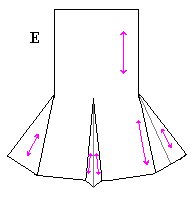
Now fairly early medieval tailors did work out how to use bias to their advantage, in the form of gores. When you cut a triangle out of fabric, at least one edge is on a partial bias cut. How you situate this determines how the shirt of the dress or shirt falls.
straight edge to straight edge, bias to bias edge When you sew a straight grain edge to a straight grain edge the two sit flat in relation to each other. They also sit a little more stiffly than they would if there was no seam there, because of the seam. This is even more accentuated when using seam finishes which sew the edges of the seam down (which is the majority of medieval examples). A modern example of this is the outside of the leg seam on jeans. This is great if you are making a piece you want to sit very flat, but the side seam of the skirt section of a shirt or dress is normally a place where you want the fabric to fall in graceful folds.
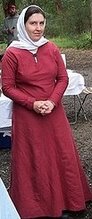
In contrast, when you sew a bias seam to a bias seam, the last thing it wants to do it sit flat. Both sides of the seam want to stretch, and you often end up with a seam that puckers and refuses to sit flat for even the width needed to sew seam allowances down. It makes your sewing look poor after a few washes with puckers and mini-gathers that you didn't sew in. Such seams also tend to curve up on themselves in a messy way. I guess I'm overstating the case here, the effects are quite minor, but do exist, and are not due to your lack of skill, but to the bias-bias seam. One of the most common ways people utilise bias-bias and straight grain-straight grain seams is shown in diagram A. This makes skirts that stick out at the sides. (it's much less apparent on shirts). Take a look at the shirt in the photo on the right. It doesn't look like the majority of the medieval examples, and I find it rather unflattering. This is also one of the (more minor) problems I have with the trace around you quick and dirty t- tunic method - it generally also sticks out at the sides like this, unless the skirts are quite wide.
I don't have any period examples of this usage, but given that nearly everything was tried at some stage in history, I expect there are a handful. It's harder to prove something uses this pattern unless you have a detailed archaeological report that shows grainlines on the pieces. But the examples I have gathered do point to bias to straight edges being more common (as I expected).
bias edge to straight edge
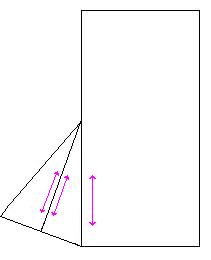 When you sew a bias edge to a straight edge you get the best of both worlds for a skirt. The straight edge remains stiff and firm, but the bias edge stretchy and curvy. As you sew it, or as it washes, the bias edge may stretch a little, but the firmness of the straight edge, stops the overall shape from distorting badly. The bias edge might fall in a few more folds as a consequence of stretching, but that's just what you want a flowy skirt to do.
- The bockstein tunic (14thC) has two pairs of gores - each has a 1 piece gore and one with a vertical seam. (note the back gore has a fake seam for symmetry, but is actually one piece)
- similarly the Moselund tunic (early middle ages, maybe 12th C)
- the st louis shirt (13th C France) uses an unusual cutting plan, but has gores with straight grain to partial bias.
- the Moy bog gown has a center gore in this method. I'm not sure about the side gores.
How to cut gores, Method 1:

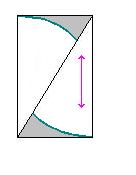
When used to put only two gores in the side of a garment, this cutting plan wastes quite a bit of fabric unless you want a tunic that with a gores that dip at the bottom. Gores that have a dip in the seamline are quite rare in medieval pictures.
This shape of gore can be used to good effect to produce a train . This is not the standard straight edge to straight edge arrangement, but a bias to straight edge arrangement that pushes the longer corner to the back edge of each gore.
 This generally works better with 3 or more gores on each side seam.
Two arrangements are probable - the first has many gores arranged in pairs to add fullness to the back of the skirt. Each pair of triangles has to be slightly longer than the preceding one if you don't want to cut a lot of fabric off your hemline.
Second just adds one of these triangles to the standard arrangement
possible period example:
- the Gown of St Claire of Assisi (mid 13th C) has 3 pairs of gores of differing sizes. Marc Carlson's cutting diagram shows all as right angled triangles, and thus likely produced by method 1. This cutting diagram shows the largest gores as isoceles triangles, thus likely produced by method 2, however rearmost (2nd largest) gores still seem likely to have been produced by method 1. The slight train on this garment corresponds well with the rearmost gores being potentially cut by this method.

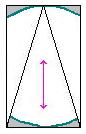 While geometrically appears to have about the same fabric wastage, the different distribution means that less actually is chopped off to get a panel that appears straight across the bottom. An octagon is a suitably good approximation of a circle that most people don't notice if the panels aren't trimmed at all.
This also has another advantage - it produces it produces two isosceles triangles - one for each side- of approximately equal size. Method 1 produces two right triangles, but right triangles don't sit neatly like isosceles ones do (honest!). If you have lots of fabric, you can cut two pairs of the right triangles from method one and sew them together, but if fabric is scarce, it may be difficult to get them the same width. And if they aren't approximately the same width you could end up with a lopsided garment. With method 2, you automatically produce pairs of isosceles triangles and if you cut an extra pair of gores of a different width, you can still put one of each width in each side of the tunic.
Period examples:
- The Kragelund Tunic (probably 1045-1155AD Denmark - based on radiocarbon dates) appears to be cut in this way - it has a front gore which although slit is not seamed, but side gores which have seams. Which direction the grain runs in is not apparent from the diagrams.
- Several of the greenland garments feature side gores to the armpits. These gores feature false seams to imply a larger number of gores. On one side a real seam runs along the centre of the gore, on the other a false seam.
- The Moselund gown features two pairs of gores - front gore of two pieces and back gore of one split piece. Side gore ssimilarly have one large gore on one side and a pair of pieces on the other.
 Manuscript possible example:
- Maciejowski Bible c1250 example and another. The centre front line (presumably gore) points downwards and sits rather stiffly - may be using this method. I suggest that this might combine methods- with bias-to-straight grain seams at the sides and straight to straight grain seams at front (note I've drawn that closed, but the center front seam shouldn't be sewn.)
Conclusions:
Did I make sense? Which bits did I get wrong? Do you have any examples I haven't listed?
Thursday, 19 April 2007
Handsewing wool - stitches used?
I've been musing over what stitches would have been used to sew a 12th C women's fulled woolen dress.
References:
*Heather Rose Jones "Archaeological Sewing"
*Jennifer L. Carlson "Sewing Stitches Used in Medieval Clothing"
*http://www.cs.vassar.edu/~capriest/mensgarb.html
*"Woven into the Earth"
*MOL "Textiles & Clothing"
My conclusion - I still can't decide what would be particularly 12th C. I think I need more examples that are 12th C woolen garments without lining. Well any examples really.
Since I made a cutting error resulting in extra piecing, and this is not a competition entry, I suppose ultra authenticity doesn't matter so much. So I've decided to use the seam finish that most intrigued me. (and to get it started before Rowany Festival, even if my hope of wearing it there was futile).
It's from Hedeby in Denmark, I'm not sure exactly when - "medieval era", I'm not sure of more than that (maybe 10th C?) - the original article is rather obscure and difficult to obtain.
The seams are turned over once or twice (only once on this garment as it's fulled) and hemmed, then overcast together. One example had additional (presumably decorative) running stitch. I've pulled out my bronze needle and linen thread and it's working nicely.
 Here's pictures of a seam: (Front & Back)
You can't see most of the hemming stitches from the front even though the cloth is purple and the thread stark white. You can see the construction seam sometimes, and a line of dints alongside it. I think with a few washes the wool will full together over the join and make the thread less visible.
 And here's pictures of a seam in progress for those of you having trouble working out what I was doing: (laid flat & how it actually sits as I stitch)
I'm happy with the speed of this technique. Strength I will test over time with wear. I still want to know what would be the best technique for 12th C woolen garments though!


![[artserv1]](http://rubens.anu.edu.au/raid4/europe.0602/germany/aachen/chapel_palatine/treasury/IMGP2811.JPG)
![[2]](http://rubens.anu.edu.au/raid4/europe.0602/germany/aachen/chapel_palatine/treasury/IMGP2813.JPG)
![[3]](http://rubens.anu.edu.au/raid4/europe.0602/germany/aachen/chapel_palatine/treasury/IMGP2815.JPG)
![[4]](http://rubens.anu.edu.au/raid4/europe.0602/germany/aachen/chapel_palatine/treasury/IMGP2817.JPG)
![[artserv1]](http://rubens.anu.edu.au/raid4/europe.0602/germany/aachen/chapel_palatine/treasury/IMGP2803.JPG)
![[2]](http://rubens.anu.edu.au/raid4/europe.0602/germany/aachen/chapel_palatine/treasury/IMGP2805.JPG)
![[3]](http://rubens.anu.edu.au/raid4/europe.0602/germany/aachen/chapel_palatine/treasury/IMGP2807.JPG)
![[artserv1]](http://rubens.anu.edu.au/raid4/europe.0602/germany/aachen/chapel_palatine/treasury/IMGP2773.JPG)
![[2]](http://rubens.anu.edu.au/raid4/europe.0602/germany/aachen/chapel_palatine/treasury/IMGP2775.JPG)
![[3]](http://rubens.anu.edu.au/raid4/europe.0602/germany/aachen/chapel_palatine/treasury/IMGP2779.JPG)
![[4]](http://rubens.anu.edu.au/raid4/europe.0602/germany/aachen/chapel_palatine/treasury/IMGP2781.JPG)
![[5]](http://rubens.anu.edu.au/raid4/europe.0602/germany/aachen/chapel_palatine/treasury/IMGP2782.JPG)
![[6]](http://rubens.anu.edu.au/raid4/europe.0602/germany/aachen/chapel_palatine/treasury/IMGP2783.JPG)
![[7]](http://rubens.anu.edu.au/raid4/europe.0602/germany/aachen/chapel_palatine/treasury/IMGP2785.JPG)
![[8]](http://rubens.anu.edu.au/raid4/europe.0602/germany/aachen/chapel_palatine/treasury/IMGP2787.JPG)
![[9]](http://rubens.anu.edu.au/raid4/europe.0602/germany/aachen/chapel_palatine/treasury/IMGP2789.JPG)
![[artserv1]](http://rubens.anu.edu.au/raid4/europe.0602/germany/aachen/chapel_palatine/treasury/IMGP2833.JPG)
![[2]](http://rubens.anu.edu.au/raid4/europe.0602/germany/aachen/chapel_palatine/treasury/IMGP2835.JPG)
![[3]](http://rubens.anu.edu.au/raid4/europe.0602/germany/aachen/chapel_palatine/treasury/IMGP2837.JPG)
![[4]](http://rubens.anu.edu.au/raid4/europe.0602/germany/aachen/chapel_palatine/treasury/IMGP2839.JPG)
![[5]](http://rubens.anu.edu.au/raid4/europe.0602/germany/aachen/chapel_palatine/treasury/IMGP2841.JPG)
![[artserv1]](http://rubens.anu.edu.au/raid4/europe.0602/germany/aachen/chapel_palatine/treasury/IMGP2821.JPG)
![[2]](http://rubens.anu.edu.au/raid4/europe.0602/germany/aachen/chapel_palatine/treasury/IMGP2823.JPG)
![[3]](http://rubens.anu.edu.au/raid4/europe.0602/germany/aachen/chapel_palatine/treasury/IMGP2825.JPG)
![[4]](http://rubens.anu.edu.au/raid4/europe.0602/germany/aachen/chapel_palatine/treasury/IMGP2827.JPG)
![[5]](http://rubens.anu.edu.au/raid4/europe.0602/germany/aachen/chapel_palatine/treasury/IMGP2829.JPG)

![[2]](http://rubens.anu.edu.au/raid4/europe.0602/germany/aachen/chapel_palatine/treasury/IMGP2635.JPG)
![[3]](http://rubens.anu.edu.au/raid4/europe.0602/germany/aachen/chapel_palatine/treasury/IMGP2637.JPG)
![[4]](http://rubens.anu.edu.au/raid4/europe.0602/germany/aachen/chapel_palatine/treasury/IMGP2639.JPG)
![[artserv]](http://rubens.anu.edu.au/raid4/europe.0602/germany/aachen/chapel_palatine/treasury/IMGP2643.JPG)
![[artserv1]](http://rubens.anu.edu.au/raid4/europe.0602/germany/aachen/chapel_palatine/treasury/IMGP2645.JPG)
![[2]](http://rubens.anu.edu.au/raid4/europe.0602/germany/aachen/chapel_palatine/treasury/IMGP2647.JPG)
![[artserv1]](http://rubens.anu.edu.au/raid4/europe.0602/germany/aachen/chapel_palatine/treasury/IMGP2663.JPG)
![[2]](http://rubens.anu.edu.au/raid4/europe.0602/germany/aachen/chapel_palatine/treasury/IMGP2665.JPG)
![[3]](http://rubens.anu.edu.au/raid4/europe.0602/germany/aachen/chapel_palatine/treasury/IMGP2667.JPG)
![[4]](http://rubens.anu.edu.au/raid4/europe.0602/germany/aachen/chapel_palatine/treasury/IMGP2669.JPG)
![[5]](http://rubens.anu.edu.au/raid4/europe.0602/germany/aachen/chapel_palatine/treasury/IMGP2671.JPG)
![[7]](http://rubens.anu.edu.au/raid4/europe.0602/germany/aachen/chapel_palatine/treasury/IMGP2673.JPG)
![[8]](http://rubens.anu.edu.au/raid4/europe.0602/germany/aachen/chapel_palatine/treasury/IMGP2675.JPG)
![[9]](http://rubens.anu.edu.au/raid4/europe.0602/germany/aachen/chapel_palatine/treasury/IMGP2677.JPG)
![[10]](http://rubens.anu.edu.au/raid4/europe.0602/germany/aachen/chapel_palatine/treasury/IMGP2679.JPG)
![[12]](http://rubens.anu.edu.au/raid4/europe.0602/germany/aachen/chapel_palatine/treasury/IMGP2681.JPG)
![[13]](http://rubens.anu.edu.au/raid4/europe.0602/germany/aachen/chapel_palatine/treasury/IMGP2683.JPG)
![[14]](http://rubens.anu.edu.au/raid4/europe.0602/germany/aachen/chapel_palatine/treasury/IMGP2685.JPG)
![[15]](http://rubens.anu.edu.au/raid4/europe.0602/germany/aachen/chapel_palatine/treasury/IMGP2687.JPG)
![[artserv1]](http://rubens.anu.edu.au/raid4/europe.0602/germany/aachen/chapel_palatine/treasury/IMGP2653.JPG)
![[2]](http://rubens.anu.edu.au/raid4/europe.0602/germany/aachen/chapel_palatine/treasury/IMGP2655.JPG)
![[3]](http://rubens.anu.edu.au/raid4/europe.0602/germany/aachen/chapel_palatine/treasury/IMGP2657.JPG)
![[4]](http://rubens.anu.edu.au/raid4/europe.0602/germany/aachen/chapel_palatine/treasury/IMGP2659.JPG)
![[5]](http://rubens.anu.edu.au/raid4/europe.0602/germany/aachen/chapel_palatine/treasury/IMGP2661.JPG)
![[artserv1]](http://rubens.anu.edu.au/raid4/europe.0602/germany/aachen/chapel_palatine/treasury/IMGP2689.JPG)
![[2]](http://rubens.anu.edu.au/raid4/europe.0602/germany/aachen/chapel_palatine/treasury/IMGP2691.JPG)
![[artserv-16thC]](http://rubens.anu.edu.au/raid4/europe.0602/germany/aachen/chapel_palatine/treasury/IMGP2641.JPG)
![[artserv1]](http://rubens.anu.edu.au/raid4/europe.0602/germany/aachen/chapel_palatine/treasury/IMGP2725.JPG)
![[2]](http://rubens.anu.edu.au/raid4/europe.0602/germany/aachen/chapel_palatine/treasury/IMGP2627.JPG)
![[3]](http://rubens.anu.edu.au/raid4/europe.0602/germany/aachen/chapel_palatine/treasury/IMGP2629.JPG)
![[4]](http://rubens.anu.edu.au/raid4/europe.0602/germany/aachen/chapel_palatine/treasury/IMGP2631.JPG)
![[5]](http://rubens.anu.edu.au/raid4/europe.0602/germany/aachen/chapel_palatine/treasury/IMGP2733.JPG)
![[7]](http://rubens.anu.edu.au/raid4/europe.0602/germany/aachen/chapel_palatine/treasury/IMGP2737.JPG)
![[artserv- 10th C]](http://rubens.anu.edu.au/raid4/europe.0602/germany/aachen/chapel_palatine/treasury/IMGP2693.JPG)
![[2]](http://rubens.anu.edu.au/raid4/europe.0602/germany/aachen/chapel_palatine/treasury/IMGP2695.JPG)
![[artserv1]](http://rubens.anu.edu.au/raid4/europe.0602/germany/aachen/chapel_palatine/treasury/IMGP2699.JPG)
![[2]](http://rubens.anu.edu.au/raid4/europe.0602/germany/aachen/chapel_palatine/treasury/IMGP2701.JPG)
![[3]](http://rubens.anu.edu.au/raid4/europe.0602/germany/aachen/chapel_palatine/treasury/IMGP2703.JPG)
![[4]](http://rubens.anu.edu.au/raid4/europe.0602/germany/aachen/chapel_palatine/treasury/IMGP2705.JPG)
![[5]](http://rubens.anu.edu.au/raid4/europe.0602/germany/aachen/chapel_palatine/treasury/IMGP2707.JPG)
![[6]](http://rubens.anu.edu.au/raid4/europe.0602/germany/aachen/chapel_palatine/treasury/IMGP2709.JPG)
![[7]](http://rubens.anu.edu.au/raid4/europe.0602/germany/aachen/chapel_palatine/treasury/IMGP2711.JPG)
![[8]](http://rubens.anu.edu.au/raid4/europe.0602/germany/aachen/chapel_palatine/treasury/IMGP2713.JPG)
![[9]](http://rubens.anu.edu.au/raid4/europe.0602/germany/aachen/chapel_palatine/treasury/IMGP2715.JPG)
![[10]](http://rubens.anu.edu.au/raid4/europe.0602/germany/aachen/chapel_palatine/treasury/IMGP2716.JPG)
![[12]](http://rubens.anu.edu.au/raid4/europe.0602/germany/aachen/chapel_palatine/treasury/IMGP2717.JPG)
![[artserv1]](http://rubens.anu.edu.au/raid4/europe.0602/germany/aachen/chapel_palatine/treasury/IMGP2625.JPG)


![[2]](http://rubens.anu.edu.au/raid4/europe.0602/germany/aachen/chapel_palatine/treasury/IMGP2769.JPG)
![[artserv1]](http://rubens.anu.edu.au/raid4/europe.0602/germany/aachen/chapel_palatine/treasury/IMGP2791.JPG)
![[2]](http://rubens.anu.edu.au/raid4/europe.0602/germany/aachen/chapel_palatine/treasury/IMGP2793.JPG)
![[3]](http://rubens.anu.edu.au/raid4/europe.0602/germany/aachen/chapel_palatine/treasury/IMGP2795.JPG)
![[4]](http://rubens.anu.edu.au/raid4/europe.0602/germany/aachen/chapel_palatine/treasury/IMGP2797.JPG)
![[5]](http://rubens.anu.edu.au/raid4/europe.0602/germany/aachen/chapel_palatine/treasury/IMGP2799.JPG)
![[artserv1]](http://rubens.anu.edu.au/raid4/europe.0602/germany/aachen/chapel_palatine/treasury/IMGP2719.JPG)
![[2]](http://rubens.anu.edu.au/raid4/europe.0602/germany/aachen/chapel_palatine/treasury/IMGP2721.JPG)

![[artserv1]](http://rubens.anu.edu.au/raid4/europe.0602/germany/aachen/chapel_palatine/treasury/IMGP2741.JPG)
![[2]](http://rubens.anu.edu.au/raid4/europe.0602/germany/aachen/chapel_palatine/treasury/IMGP2743.JPG)
![[3]](http://rubens.anu.edu.au/raid4/europe.0602/germany/aachen/chapel_palatine/treasury/IMGP2745.JPG)
![[4]](http://rubens.anu.edu.au/raid4/europe.0602/germany/aachen/chapel_palatine/treasury/IMGP2747.JPG)
![[5]](http://rubens.anu.edu.au/raid4/europe.0602/germany/aachen/chapel_palatine/treasury/IMGP2749.JPG)