Showing posts with label ruffled sleeve lining. Show all posts

Tuesday, 29 May 2007

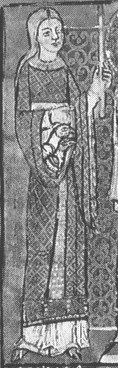
Admont Bible

Admont bible, Salzberg early 12th C, (Österreichische Nationalbibliothek, Wien. Cod. ser. nov. 2701 and 2 pages in École Nationale Superieure des Beaux-Arts, Paris. PC 22788)

The Admont Bible was produced in Salzburg, Austria, c1140's or maybe earlier (it's a topic of debate). Most of the book ended up in Hungary by the mid 13th C (it was bought back by Austria in 1937), except two leaves which ended up in France.

There is a lovely website with pictures of the manuscript and a history of it. Also on that site are links to a 14th C (Hungarian Angevin is 14th C !) and 15th C manuscript.

Dodwell finds it one of the best productions of the thriving world leading Romanesque Salzburg manuscript school. He says it's highly byzantine influenced, which I find quite clear to see in some of the women's hairstyles, decorative motifs, draperies, and more subtle details.


Women in this manuscript
This manuscript is not the best source material as are biblical figures, but the women certainly appear to be wearing fashionable clothes, not old fashioned ones. The answered question is how much is reality and how much fantasy?


f11 Boaz and Ruth. Ruth's sacrifice

  • Ruth is a down on her luck noble, depicted as faithful to her family, and doing the right thing, not a slut like Salome. In the first picture, Ruth is begging from and later courting a noble relative. In the second she works in the fields to feed herself and her mother in law.
  • The two pictures show differences in dress that may correspond to that change in activity.
  • In the First picture her dress has trim at neck and hemline, in the second none is apparent.
  • The first dress is shorter (although not the mid calf I expected) to display her long chemise underneath, and keep the precious trim off the floor. The second chemise may or may not be quite short - we can't see under her dress.
  • The first chemise is trimmed at the wrists, the second is not.
  • The first dress has wide flared sleeves, the second has loose sleeves that stop at her elbow - out of her way.
  • All of these seem practical changes to a dress for doing work.
  • The hairstyle in the first picture is more elaborate (possibly a byzantine style?) whereas in the second picture her plaits are enclosed in a covering and she wears a hat. While covering the hair while working is practical, I am not convinced that this style is more practical or quicker than the first style. A nice veil would be better, but maybe this would clash with her status as an available widow, and object of romance.

f12 Hannah and Peninnah,
  • Hannah, the favoured wife of Elkhanah, can't get pregnant, while the second wife Peninnah can.
  • Both Hannah (I'm assuming she's the childless one) and Peninnah wear similarly cut dresses and veils. The dresses are floor length, probably moderately loose in the body, and have flared sleeves.
  • Hannah's dress is from a patterned fabric, perhaps this displays her favoured status. (patterned fabrics are likely to cost more)
  • Both dresses are trimmed at the cuffs and hem. Hannah's dress has more decoration depicted on her trim.
  • The cuffs of Hannah's chemise or whitish layer underneath is trimmed, Peninnah's in not visible. No wrinkle effect is depicted on these tight sleeves.
  • Both women wear similar veils. Interestingly both are coloured veils, whereas white veils are more common.
  • No belt is visible.
f12 Hannah's sacrifice.
  • Elkhanah didn't mind that Hannah was childless, and still gave Hannah a larger portion of the sacrifice.
  • Hannah's dress is cut similarly to the last picture.
  • A small white blob is visible at the bottom of her maunche. Looking backwards, I think it might be visible on both women in the last picture too. I think this is what I've seen earlier, and thought might be a sleeve lining.


f12 Eli and Hannah
  • Hannah pleads with a priest to give her a son. (and it works, and all ends happily)
  • Hannah wears a red dress, with bell shaped sleeves - these seem to flare above the arm as well as below.
  • The dress is decorated at the v-shaped neck and has a couple of subtle lines of decoration above the hem
  • The dress appears to have been belted in tight at the waist with a wide yellow fabric band. (A corsolet?!)
  • A chemise is visible at the wrists with decorated cuffs, but interestingly I can't see it at her neck despite the lower v-neck of the dress.
  • Her hair is parted in the middle and plaited, probably in a single plait.

f18 The story of Hoshea
  • Hosea was a prophet who married a prostitute supposedly on god's orders. She probably cheats on him, he divorces her, then he can't stay away and buys her back from a lover or client.
  • The second picture depicts Hosea's inconstant wife in bed. She wears a cute beanie cap, and in the full picture I can just see pale yellow shirts to her ankles.
  • The second figure holding the child might be a midwife or just Hosea's wife on a more formal occasion?
  • A fairly simple dress, full length, gently flared sleeves from the elbow.
  • Who said pink wasn't period? Well actually this doesn't prove anything - the artist might just have the colour on his palette, but the colours used do generally seem to be plausible.
  • I wonder how she gets such wonderful folds in her veil in the first picture?
  • Has that white bit peaking from the bottom of the sleeve again.
  • The headwear provides a contrast between the lady in bed and the lady nursing. The veil appears to be headwear for a mature lady, while a prostitute wears young fashion of a cap.


f24 The affliction of Job
  • God permits Satan to test Job's faith by afflicting him with bad stuff, like the boils pictured. 3 male friends and his wife try to get him to give up on God, but he refuses.
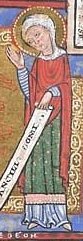
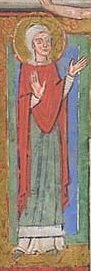
  • The lady in red is mostly likely Job's wife, who refutes god and dies. I'm not sure who the second lady is - she doesn't seem to fit the story.
  • Both ladies wear loose dresses with flared sleeves. The lady in pinks' sleeves are a more traditional shape, with trim. I think the lady in red's sleeves are supposed to be the same, just badly drawn.
  • The lady in pink's sleeve has the white blob at the bottom again.
  • White chemises show at the sleeves of both garments.
  • Both wear veils. the y have a similar drape about the head, showing some of the neck, but the lady in red's veil has a loose end over her shoulder. This may represent a (partially undone) veil in which ends are crossed over the neck and flipped behind the head. the lady in pink's veil shows strong fold lines in opposing directions at the neck. the loose end looks a lot to me like the shape made by tapered fabric, rather than square, for example the corner of a half circle.

f26 Bride and groom (not illustrated)
  • It's very hard to see this picture, but the bride must be the one dressed in pink.
  • The garment has flared sleeves, with some decoration at cuff and collar.
  • There are also two vertical lines. They could be plaits, but i think she is wearing a veil. I think they look more like two lines of decoration, along side seams or just inside of them.

Costume accessories - men's hats
Hats from folio 9 & folio 10


Also in the manuscript are a number of interesting men's hats. I'm used to phygian caps and beanie caps, these caps are a slight variation in exact shape. But what caught my notice especially is the vertical stripes on the hats. Hats can easily be made by naalbinding or sprang, and I've been speculating (along with others) if 12th C hats in these styles might be made so. So far there's been no evidence.

Could these vertical lines be an indication? Maybe, but another hat from the same manuscript is in a diamond pattern, which could still be sprang, but a very different representation of it, so maybe we are just seeing a decorative finish by the artist.
Hat from folio 14

Sunday, 1 October 2006

More German Dresses - Henry the lion

Lets return to two of the pictures from my first post on German dresses, because they are such lovely artwork, and I've managed to find a few more pages.

I said last time before I knew that they were from the same workshop

  • Helmarshauen is now a suburb of Bad Karlsruhe in central Germany (Hessen)

  • Apparently the vertically elongated figures are to be expected due to the influence of the english Matilde, who became empress

This is all still true. Helmarhausen abbey was important centre of illumination, Duke Henry commissioned both these manuscripts and several others. The Gospel is considered the best work of this monastery.

Gospel of Henry the Lion
Helmarshausen. Gospels of Henry the Lion from Brunswich, MS Guelph 105 Noviss 2°, c1188 (Herzog August Bibliothek, Wolfenbüttel)

Whole page views online (don't forget to check next 3 pages).


1st 3 images:
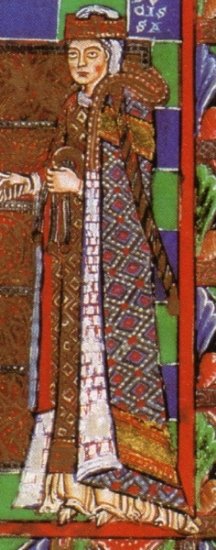
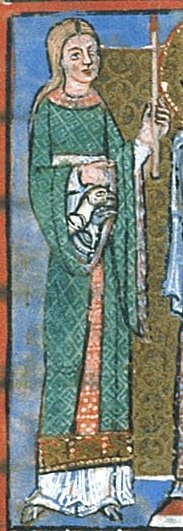
  • A repeat of the one we saw earlier, but this time so we can see the style of another family member, in a green dress. Note trim at waist.
  • Henry's relatives, one in blue has trim at waist and has the interesting headwrap that we've seen before. The other wears a mantle concealing everything (but what a pretty mantle).

  • Matilde wears the longest sleeves of anyone, but we can't see many other details other than patterned fabric, because of her pretty fur lined mantle.


next image: fol 19 dedication image
  • This is Matilde, Henry's english wife herself, richly dressed.
  • her underlayer is a rich cream colour, although maybe the artist just wanted to differentiate it from the fur lining of her mantle.

  • her sleeves are longer than anyone else's and have a white lining.


Next 3 images: fol 170v Crucifixtion
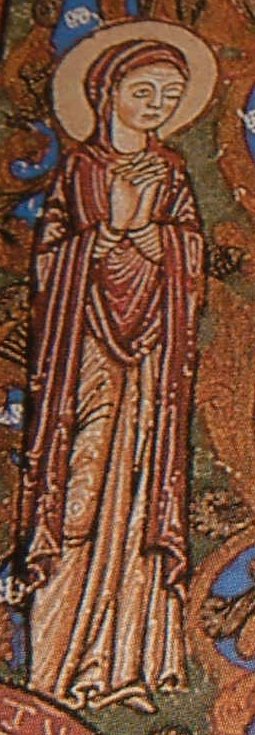
  • Can't be sure middle figure is female, but long plaits suggest this.
  • Being a crucifixtion scene the first figure, the only female saint present, has to be the mother Mary. The third figure might be a virtue (something about her posture) and the second could be likewise or could be the donor (Matilde), or I could have it all wrong.

  • examples of full length dresses alongside patterned ones - probably do represent co-existant fashions, with the younger figure (hair out instead of veil) wearing the fancier fashion.

  • Lots of gorgeously coloured veils


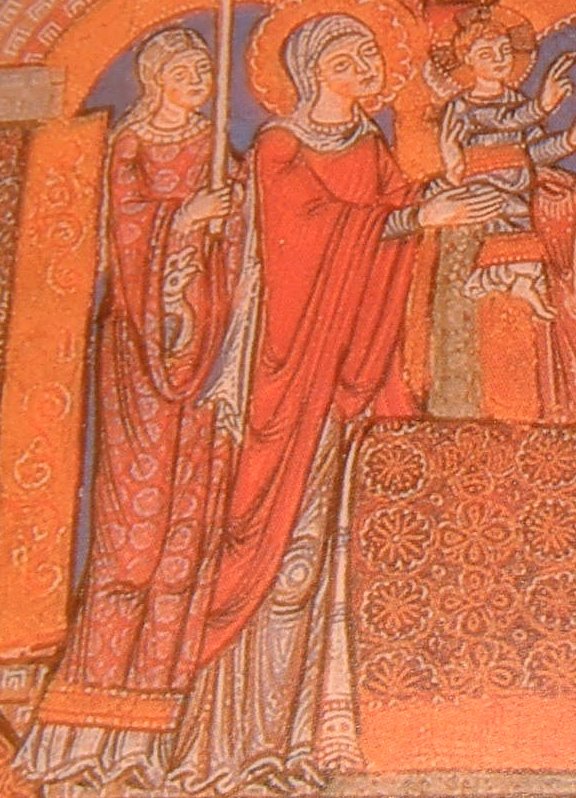
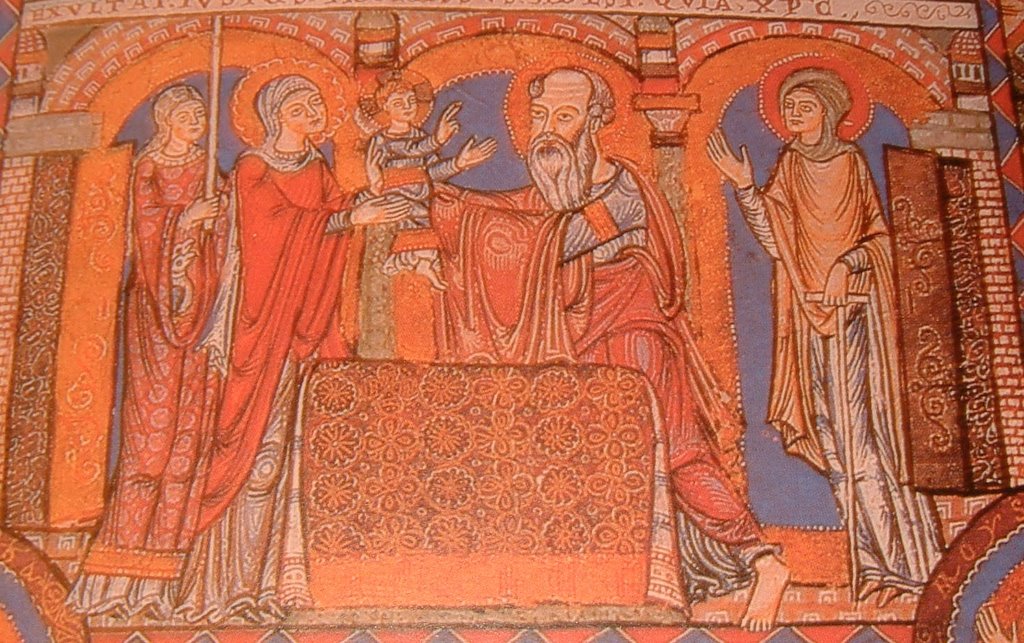
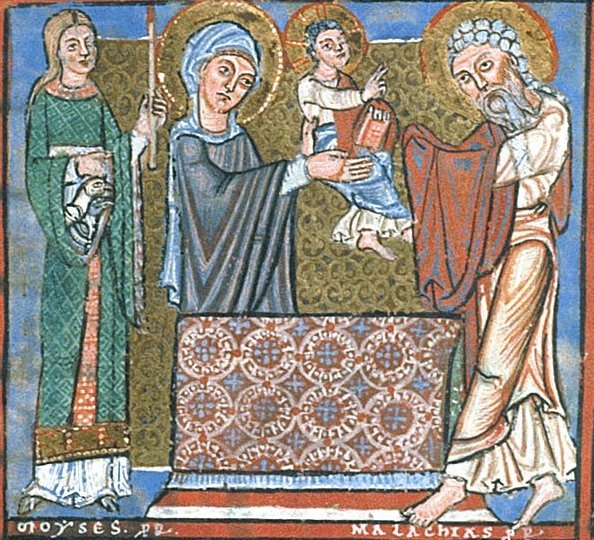
2 images: fol 111 presentation in the temple
  • Mary (holding Jesus) wears a full length dress veil and wrap

  • to the left of Mary, an attendant (might be a virtue) wears the fancier fashion with her hair uncovered

  • the attendant's fabric is shown with rondell patterns - a popular design in fabrics of the time (especially expensive imported silks).

  • A pilgrim saint (holding pilgrim's walking stick) watches, also dressed conservatively rather than fashionably


2 images: fol. 171r Mary meets the desciples, Jesus sends Mary to the desciples and Mary at the grave.
  • This page is most comic book like - it's the adventures of Mary during the resurection, in reverse order.

  • With the comic book theme, Mary is dressed almost identically in all pictures (her trim might change a little, but that's all). We can see the same costume in different postures.

  • Her dress is belted up a little (see the sag line at her waist) presumably by a thin cord, since no belt shows

  • This time she is not being presented very conservatively, but a little more loosely - she wears the fashions, but is veiled as a married woman is likely to be.


image details unknown
You can't see this page very well, because the original image is so small (if anyone has a better copy....), but you can see in the bottom centre a female saint, almost certainly the 'virgin' mary, and see that her tunic hem is higher than the white layer underneath.


Psalter of Henry the Lion
Psalter of Henry the Lion, MS Lansdowne 381 fol 8, Helmarshausen 1168/89 (British Library)
Can be found online courtesty of the British Library.


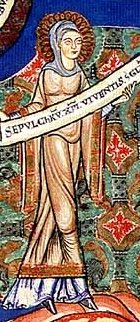
1st figure: fol. 7v Annunciation
  • Will be Mary, since she's the only female present and this is the annunciation

  • While she has a conservative wrap and veil, she has a shorter patterned dress

  • She has fancy wrinkled chemise sleeves


2nd figure: fol 10v Mary at the Crucifixtion
  • Again, a conservative wrap and veil, but a shorter dress, this time unpatterned. Perhaps this artist is tying to copy/match with the artist above (who seems better at clothing and detail, but worse at people and proportion)


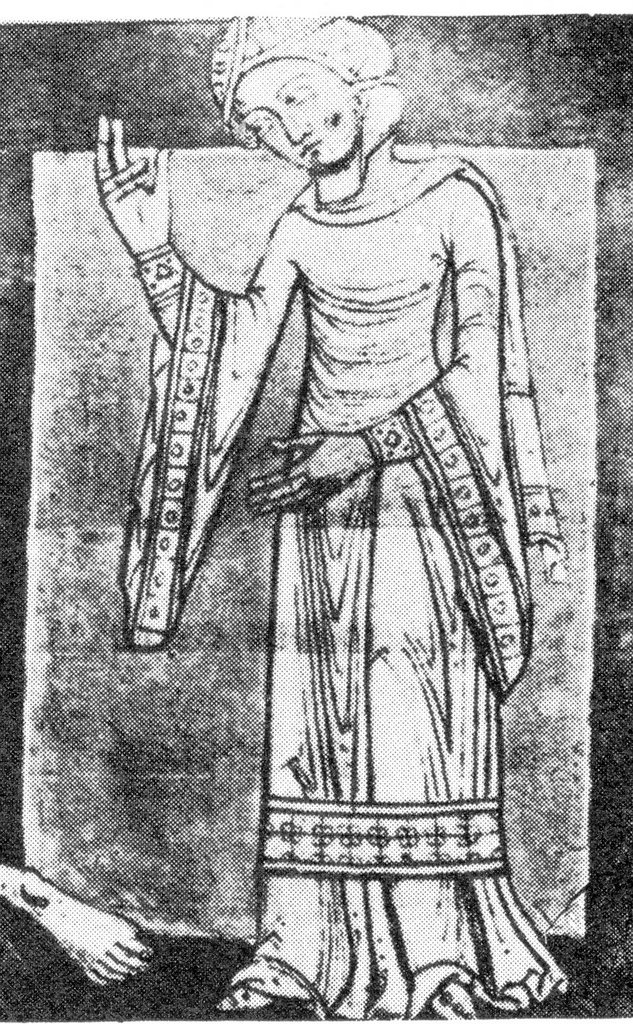
3rd figure: fol8v The presentation at the temple
  • I've already shown you a black and white copy of this - but this is colour.

  • An attendant to Mary, possibly a virtue, and dressed almost identically to the one in the gospel, except the colour at pattern of her tunic

  • her tunic is in a cross style - another popular design we see in extant textiles

  • The vertical trim could be a belt or it could be imitating byzantine styles, or it might be trim, but it looks a little awkward where it meets the base trim.

  • Notice she might have a slight wrinkly sleeve syndrome happening. Interesting.


Comparison (because I can't help myself)


First image is from the gospel, the second the psalter. You can successfully play spot 11 differences here, but the artist has definately copied a successful scene from one to the other. His changes have probably been primarily concerned with colour and spacial balance, and accomodating appropriate thematic elements (the pilgrim saint only present in one). This is a nice example of how artists worked from models such as other manuscripts, but it also shows how much variability could be instilled into the same scene too. (I'll come back to this topic later when I get around to rambling about byzantine origins). The psalter (second picture) is probably the earlier one of the two.

Thursday, 28 September 2006

German Dresses with Wrinkly sleeve linings


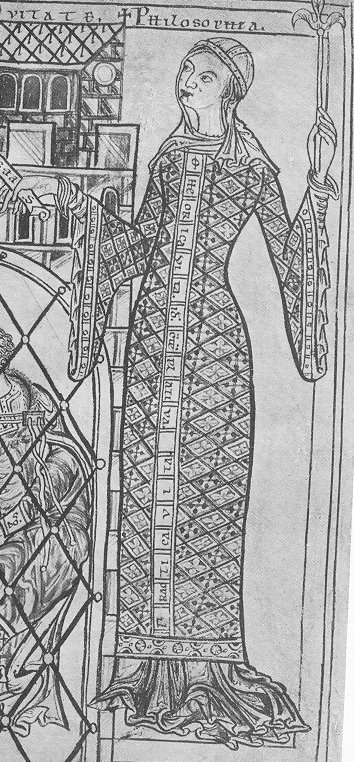
Aldersbach Abbey, Cod. lat. 2599, fol. 106 verso,Germany, about 1200, (Munich, Bayerische Staatsbibliothek).

Mentioned in - "The year 1200: volume II A background survey" article in book: Wormald, F "The monastic library" p169-174
also images available on bildindex (click to load)

  • Apparently technique used is a combination of outline drawing with thin coloured washes.

  • Aldersback Abbey is in lower (northern) Bavaria (and has a webcam feed :-) )


"Philosophia comforting Boethuis Senator". (see also close-up above)
  • the character is philosophy - another virtue personified.

  • Yes those are words along the central vertical decorative strip. I doubt this is meant to be literal - I think the artist was just looking for more places to convey messages, like those held in scrolls (see her left hand).

  • another cute hat

  • look at the fascinating chemise/underdress sleeves - slightly flared at the cuff, and maybe forming a lining in the sleeve. There is certainly something forming that lining in the sleeve that wrinkles so artistically


Prudence as Queen flanked by contemplative and practical philosophy, above the king of Antioch and Nebuchasnezzar
  • 3 styles of chemise cuff- flared, decorated with braid and undecorated wrinkled.

  • 2 of the women's dresses are short, 1 long

  • sleeves fairly uniform in cut - flare from elbow, end halfway down forearm, similar length and shape, and have a ruffly lining


Rhetoric (with sword) and Tullius Cicero f104v
    • same features as the others above


  • Dialect and Aristotle f104
    • same cut as previous example, except we can see the neckline on this one, and it has an unusual scalloped edge - never seen that outside this manuscript


    Geometry and Cassiodorus f106
    • similar cut, except pendulous nature of sleeves exaggerated
    • scalloped edged neckline decoration again
    • we can see some lacing at her side!


    Arithmetic and Boethius f102v
    • Unusually short skirt, and worn belted (none of the other female ones are, but some of the men's ones are) which makes it a tiny bit shorter again. In fact the lower half of her tunic looks like a guy's tunic.

    • sleeves and other details are pretty much to the same pattern as preceding examples. This is one of the few examples with braid on the tunic sleeve cuffs.

    • Note how the man's (Boethius') tunic neckline looks like it is folded in on itself at the centre front.


    Music (holding a monochord) and Pythagorias f103
    • more of the same design, in the mid calf length tunic variant.

    • her neckline looks like it might be folded over like Boethius' neckline in the previous image


    Grammatica (holding lamp) and Priscianus f102
    • scalloped edge to neck decoration - never seen that outside this manuscript

    • strong folds at edge of torso - indicative of lacing

    • not sure if full or calf length - can't tell bottom of wrap from tunic


    Astronomy and Ptolemy
    • scalloped neckline decoration
    • Braidcases or some kind of enclosing wrapping over hair
    • calf length tunic, without braid on bottom edge
    • tunic sleeves drawn differently to other examples. These seem to have a lot more fabric in them. The folds at the edge are formed by the fabric of the sleeve, not by a lining. The fabric sits in folds on top of the arm, probably meaning some of the fabric is cut flaring out above as well as below the arm. I speculate this is one of the "waterfall sleeves" that Rohesia and others have suggested - imagine a sleeve where the end flares out in all directions - rather like putting your hand through the narrow section of a funnel.
    The linking factor of these images are the unusual sleeve lining. The last image is most interesting as it is different. I don't think the other sleeves are bad redrawings of this style. but I wonder if the lining could be constructed in this style, and then stuffed in a maunche shaped sleeve? Would that give the required effect? Maybe you could sew in such a layer as a lining. Or make it part of the same layer as the bit on the floor.

    Looking at the sleeves again, it is possible that the artist is drawing the front edge straight, and the back edge as ruffled. But that makes no construction sense to me. not only that you would expect both sides to fall the same way, but that the sharp maunche shape that gets narrower before it gets wider doesn't seem conducive to this to me. Oh for a colour copy of these pictures!

    And just to prove it's not a fluke, another manuscript with those sleeves:


    Legendarium austriacom/Tractatus de Sacramentis Cod. 311 ; fol. 82v-83r. Klosterneuburg, Northern Austria 1150-1200 or 1185-95

    Initial T- Saint Mary Magdalene
    Initial B - Juliana from Nikomedia

    Dodwell says Austria had very strong byzantine influences throughItaly in the first half of the 12th Century.


    And some images from the same manuscript without those sleeves:
    just to show that they exist in the same manuscript, and the rest of the style is the same.


    And annother:


    Lot's wife. Salzburg Antiphonary, German, 1080-1150 (library of St Peter's Monastery).
    • stylistically, I'd be surprised if it is actually early in the given period.
    • Dodwell says Austria had very strong links to Bavaria, and also some byzantine influence
    • Davenport says her headwear is a turban. Perhaps it is one like this. If it is a turban, then that is probably a scarf around her neck, with decorated ends.