Months ago in February, (I admit, I've been slack about posting) I decided I wanted lots of pairs of hose for Rowany festival, since that part of my wardrobe was lacking (only 2 pairs for 4 days! and one of those thick wool.) I'm getting pretty good at hose by now, given that I've been using the same pattern each time. So I decided to time how long it took to construct a pair. Or to be more precise I constructed one first to check the fit in the particular fabric (it changes slightly each time), and the exact way I was doing the hose, and then timed the second one of the pair.
Construction, Pattern, stitching technique I've been making copies of the 14th Century Hose from MOL because I think they are the same pattern as 12thC ones for reasons I'll describe in a post soon.
 I decide to experiment with a couple of things on this pair. Firstly, I've found the rear seam to be quite weak (running stitch as described on the London hose snapped on the second wear in linen on linen on another pair), and the transition around the seam at the heel difficult. I wondered why the seam used on the foot didn't simply extend up the back of the leg. I guess it would be inelegant in wool with raw edges showing, but in linen all my edges were contained anyway. I tried this method (see pictures to left), and in linen it works just as well, maybe slightly better than the other method. The transition at the heel is slightly tricky, but it's even trickier in linen with double folds changing from this seam to flat felled apart seams.
 I chose to make a decorative hem using herringbone stitch on this pair of hose. The pictures to the right show the inside (decorative so it will look prettiest when turned over) and outside (plain) top hems. I have no evidence for this type of hem for this period, or on hose. It just is used on hems elsewhere and when and was pretty.
The last is a shot of how I handle the top of the vamp (top of the arch of the foot) . This is a slight adaption for the linen versus a wool that doesn't need hemming. The picture is mostly there to show how I do this.
Timeline
These hose were constructed on my way to work, sitting at the bus stop, on the train, at the train station, and so there was a lot of stopping and starting and a little unpicking. I probably could have made these slightly quicker under optimum conditions.
So here is my construction progress in pictorial form:


I think the decorative hem took longer than a simple line of backstitching as seem in the London hose would have. But the white linen thread on purple linen fabric is pretty.
Monday, 22 September 2008
Timeline of construction of a pair of Hose

Tuesday, 23 January 2007
Costume acessories from Cod. lat. 15903 Bayerische Staatsbibliothek
While I was browsing the rather lushly illustrated in the last post, I noticed lots of features not related to women's costume. Several of them are ones I haven't seen in visual sources before.
Remember, the manuscript was Periscope book of St Erentrud, Nonberg Abbey, Salzburg around 1140 (München, Bayerische Staatsbibliothek, Cod. lat. 15903) Garters
Fol . 68 Healing of the sick
That holy grail of pictures, a depiction of hose gartered at the knee. Not you can see what we know from extant examples. The extant examples have their garters sewn to the back of the hose at the top (eg Roger's pair - but you can't see that in this photo). The pair I've made so far I use a separate piece of cord and fold the top of the hose over. It works quite nicely, but I'll have to try the other way with my next pair.
The depiction is of gartered long hose, or at least it shows no tops of the hose, so I presume these are separate garters of necessity. Hose
Hose
Their are lots of depictions of people wearing hose in most manuscripts, but most don't give many clues to their construction. There are quite a few pairs of hose depicted in this manuscript that have diagonal stripes checks or diamond patterns. [1] , [2], [3], are just a few examples. These may be indications of the cut of the hose - extant hose are known to be generally bias cut (the later ones are definitely so, I don't have any info on 12th C ones), such that the hose are slightly stretchy. Plain woven stripes and checks become diagonal stripes and checks when cut on the bias. I think this tendency to show diagonal patterns on hose (which I've also seen on other artwork) represents this. This manuscript also contains the first example I've seen contrary to the rule - a pair of hose with horizontal stripes. Mind you, I think only a couple of stripes is unlikely to be a woven in pattern, so this could represent post-construction decoration. Or just an artist on a funny day.
Just for variety, there is also one pair with trios of dots on them. This manuscript also has a depiction of what I think are pairs of hose when not on the body.
folio 11v stoning of st Stephen
This site says stoners "were laying down their garments at the feet of Saul, that they might be more ready for the task devolved upon them" so the object should be clothing, unspecified variety. They look like hose to me, but I see no reason why they should remove only their hose and not their other garments. The feet of the hose are not visible, making this identification uncertain, but the string at the top point of this pair is just what we expect from 14th C hose. The pattern on the reverse side reminds me of the buskins of archbishop Walter Hubert (c1200), pictured on right. I presume showing one side patterned and the other not is artistic license for showing the folds more clearly. Sandals?
Fol 93, Martin divides his cloak with a beggar
This pilgrim/beggar (the caption and story say beggar, his bag and staff say pilgrim) looks like he might be wearing sandals. I've seen biblical figures with thonging around their feet, but they might just be romanticising the past. A pilgrim might wear rather humble footwear than average, so this might be realism. The drawing of his legs makes him look barelegged. Hoods?
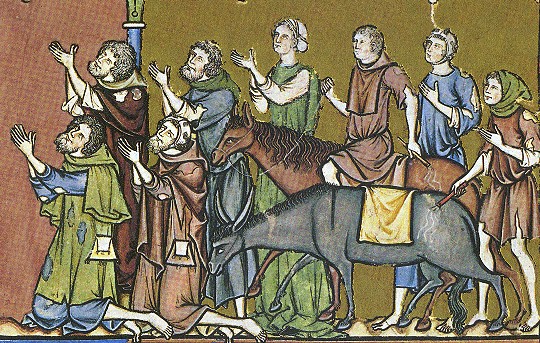
If you look at the object around his shoulders, you'll see an object that sits above his tunic. Quite a few other guys have these , but on the others you couldn't tell if it was part of the tunic (although in several cases it was a different colour) for example the trim or neck facing. This example clearly shows the object on top of the trim on the tunic. I can think of few objects that are wrapped around necks other than hoods and scarfs (and it looks to structured for a scarf). This is quite different (shorter) from any other 12th C hoods I've seen, but compare it to this 13th C hood (caption on this post), which is quite tight on the neck and doesn't extend far down the torso. I think it's a hood, but I can't prove it conclusively, since not one of the following examples from this manuscript wears one over his head: [1], [2], [3], [4], [5], [6], [7], [8], [9]. Bags
Bags
Fol 93, Martin divides his cloak with a beggar
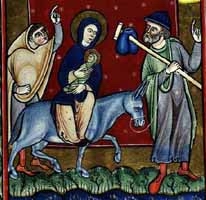
The pilgrim has a nice example of pilgrim satchel in fairly typical shape (rectangular or square with a flap, and pilgrimage symbol eg cross or shell) and size (look how small they are!). fol14, The flight to Egypt
This is another scene I've seen a few times (caption on this post)- poorer male travellers carrying their goods over a stick. The goods appear to be contained in some kind of saddlebag or roll. I've heard of a later period bag style where you make a roll like a long pillowcase, sew the ends closed and create a slit across the width of one side only of the middle. I think this has a similar construction, but not being a rich man's object we are unlikely to find out.

![[1]](http://www.bildindex.de/bilder/mi02399d01a.jpg)
![[2]](http://www.bildindex.de/bilder/mi02399f08a.jpg)
![[3]](http://www.bildindex.de/bilder/mi02399f13a.jpg)


![[1]](http://www.bildindex.de/bilder/mi02399f04a.jpg)
![[2]](http://www.bildindex.de/bilder/mi02399f01a.jpg)
![[3]](http://www.bildindex.de/bilder/mi02399e14a.jpg)
![[4]](http://www.bildindex.de/bilder/mi02399d11a.jpg)
![[8]](http://www.bildindex.de/bilder/mi02399c06a.jpg)
![[9]](http://www.bildindex.de/bilder/mi02399c04a.jpg)