Showing posts with label acessories. Show all posts

Tuesday, 5 March 2013

The world's simplest veil: headrails

Headrails

The simplest veil I know of is the headrail. Firstly it is simple to construct because it is quite simply a long rectangular piece of fabric. In fact a light pashmina scarf makes a great headrail, and requires no construction at all. I find my smallest one that works is 162cm long and a width of 60cm, but a little wider may be good (not too much -try for the distance from the front of your head over your head to your neck and a bit of spare), and any amount of excess length is fine - I have one which is over 2m long.

Secondly the headrail is simple because you don't need a fillet under it. This is a good veil for people who are scared of pins in their head, or claim they are too uncoordinated to get a veil on straight, especially at events where no large mirrors are handy. Thirdly the headrail is simple because there are only 2 steps to draping it.

I don't know where the name headrail comes from, but I expect it's a reenactor term. I think the 12th C person would have called it the local equivalent of veil, eg the anglo norman guimple or perhaps coife. I doubt the language would have had a specific word for this type of veil versus that one, but modernly we find it useful, especially when referring to 100's of years of veil types at the same time.

How to drape it

The first step is to place the centre of the veil on top of your head. It may be easier to drape it around your neck like a scarf, then pull it up onto the head.


In the picture I've deliberately made the two ends slightly uneven, so it drapes evenly. This really isn't necessary, nobody gets to see both ends at once. Next, grab one end, and toss it over your shoulder. It doesn't matter which side.


  And that simply, you have a headrail.
For tasks where the long headrail may drape into things in front of you, simply toss both ends over your shoulders. For even more demanding tasks, tie the ends in a simple single knot behind your back.


Comparison to other veils

While the simplest veil, the headrail isn't quite as versatile as other veils in this manner.  I do find myself adjusting it occasionally and it isn't well suited to tasks where I must bend over (it drops off forwards). If I sit in chairs with a back, the headrail also doesn't work as well because it relies on the weight of the fabric to hold the veil tight against my face.  Sitting in a chair takes the weight off the veil.  For the same reason, while I've seen little evidence for it being the way things were done in most places in the 12th Century, a beaded or heavy trim edging or fringe could really add weight to a headrail, making it stay on better.


Extant 12th C images

When I actually look for 12th C headrails, I actually find it difficult to prove such a veil was used. Here are some of the closest images I've found:


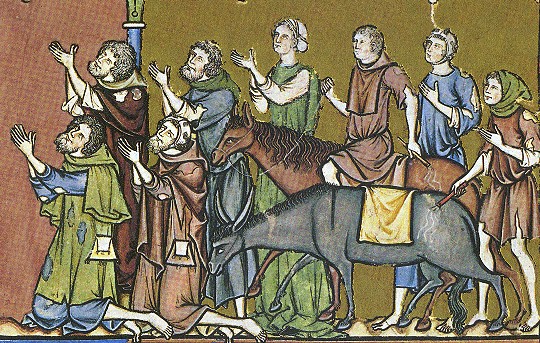
England, 1175-1200.
folios 11r, 12v and 15r


These images show an unusual amount of detail for the period - generally you can only see a white or whiteish veil wrapped around a head. But on these examples you can clearly see the veil crosses over itself at the neck. There are a few other examples which do show the crossing of layers of the veil, and many which do not.

But I'm not at all sure what shape of veil is depicted here - we can clearly see a corner on the first image, but that could for example be the corner of a half circle veil as the corner of a rectangular veil. So we must guess based on the shape produced by comparing to our results and hoping that the artist was actually trying for a realistic impression. Whatever shape the veil, both ends are flipped back over the shoulder in all but the first image. And the ends depicted are fairly short - whereas my ends are fairly long to keep this veil closed by itself.

In all but the first image, no hair is visible under the veil - I find this very difficult to achieve with a headrail alone - I generally either need veil pins or an extra layer underneath to cover the forehead, or otherwise my veil creeps backwards on my head.

Overall, I think the headrail is a quick and easy way to introduce people to veils, but I'm not convinced that this is exactly how a veil would be worn. But it does teach about what fabric drapes well, is easy to put people (even if afraid of pins), and teaches them how to flip the ends over their neck - so I think it serves a useful purpose. And it may be right for other time periods.

Thursday, 14 February 2013

Valentines Day Special: Love tokens

Today I present themed links for valentines' day. In fact the theme is love, and gifts of love. I'll look at extant gifts of love, particularly heart shaped objects, and also modern reproductions that you could give your lover.

Extant heart shaped broaches

There are surprising numbers of heart shaped broaches of the medieval period which have been found. The first type I noticed was broaches with an outline of a heart formed in a flat section which allows some of them to have inscriptions (or fake 'pseudo inscriptions') on their surface. This is a beautiful example of the style:
A 13-15thC copper alloy broach with traces of gilding

Some broaches of this style are a simple flat shape of a heart outline with a pin reaching across the heart:
A 13-14th C copper alloy broach

Fancier versions of this style can also be found:
15th C silver gilt broach
15th C gold broach originally enameled, decorated and with inscription.
c1400 gilt broach with inscription and formerly enameled decoration


In contrast, some have the pin diving the badge in two (pointing to the point)- Here are a few examples of these downwards facing pinned shaped broaches:
A 13-14th C copper alloy broach with pseudo inscription
A probably 13-14thC (almost symmetric heart shaped) copper alloy broach
A 'medieval' gilded copper alloy broach with intact pin
13-15th C gilded copper alloy broach with illegible inscription
13th-14th C cast copper alloy broach

These could be much more elaborate, I don't know if these are later, or just more expensive examples:
A 15th C silver gilt broach with inscription on the back
15th C silver gilt broach with inscription and decorative images
14-15th C gold broach with heart shape formed by arms with clasped  hands
14-15th C gold heart shaped broach formed by two arms with hands clasping

I find the two orientations of broaches interesting - I understand the broaches that pin across the heart shape, but the pins that reach downwards are more confusing - does this mean the modern idea of a heart being always oriented point downwards is a more recent development postdating the broaches? Or was the pin worn pointing downwards thorough the fabric? I think a downwards pointing pin would be less secure than across if you wished to hold something shut, but I may be wrong, or the pin may be purely decorative, in which case a downwards point may come open, but is less likely to fall off a garment.

The final broach on this list of fancy broaches with pins across the heart shape also has loops for pendants hanging from it confirming that the heart should face point downwards on this example, but i can find no such clues on the downwards pinned broaches.

Some broaches break all the rules - such  as this 14th C copper alloy broach which probably had 2 pins (on horizontal, one vertical). Or this apparently deliberately asymmetrical heart shaped broach, where all the above examples are symmetrical. This gold 'medieval' broach is also interesting because it is not a flat outline, but more like a wire shape. Whereas this 16th C copper frame broach is also an asymmetric heart shape (although the description says 'pointed oval') with a heart decoration on top - if it is just a pointed oval then this is an example of use of a heart as decoration instead of as shape of the broach. These oddities just prove how much there was a standard form of heart shaped broach though.

Other objects with hearts on them

While we are looking at extant objects with hearts, you could also branch out into objects other than broaches, for example one item that appears to be a common 14-15th C lover's token (according to the blurb on this find) is a heart shaped badge or lover's token, of which there are several examples, one even betrays it's purpose with the inscription 'hert be true". while other badges with hearts might have less specific meaning.

Another gift is a finger ring either with a heart shape soldered on to it  (and another)  or as part of a design moulded onto it (and another, and another, in fact a heart sprouting flowers is very common, very very common), while angel's holding hearts are common too) or a 'fede' ring (and another, apparently often used a betrothal rings), or with an engraved love inscription (and another, and another) which are clear lover's tokens (eg "all my desire"). This ring uses hearts in what might be a marriage ring rather than a lover's gift, while other rings may be more innocent in meaning or definitely have religious meaning.

There are also a lot of 15-16th C spindle whorls decorated with incised markings including hearts, or mostly consisting of hearts - I wonder if it was a nice gift for a man to give to his female lover? Although some usages appear more religious than love tokens. Heart shaped buttons are also a nicely feminine gendered gift of the affordable nature (and sturdy enough to survive burial so we rediscover it), and there are plenty of examples from the 15th C (and another) and many from the 15-17th C

I'm surprised there are not more thimbles decorated with hearts (this example is even a heart pierced by an arrow - clearly a love allusion) given they are similarly small and gendered gifts.

Looking for traditionally masculine gendered gifts for a man, I am astonished by the number of 15-16th C scabbard chapes (another and another and another and so many more) which makes me wonder if this was a common love gift or just a popular pattern with manufacturers. While some could be for ladies eating knives, I think some belong to swords, a clearly gendered item in medieval times.

Personal seals can have lots of connotations of love because they can be used to make love letters private. I wonder if the owners of these might have had a separate seal for sending to their lover that wasn't the one they used for their other friends? (they'd have a different seal for business mail) I certainly can't imagine sending your best friend a letter sealed with the words "I keep love's secrets" although an arrow piercing a heart might not provoke comment, while a seal with a 'sacred heart' is not at all a lover's symbol.

On hearts and love

There appears to have been a fad for heart shaped motifs and lover's tokens in this shape in the 15th-16 C. That's when most of the above examples date from. But was the heart motif in use earlier? Did it symbolise love earlier? The earlier examples I can find are rather more ambiguous as to the extent to which they are deliberate heart shapes or have symbology of love, for example a heart shaped hair pin from 6-11th C Leicestershire.

It mustn't be forgotten that hearts were also used for more ordinary objects, for example as part of a 15-16th C merchant's mark, as a purse fitting, a lead weight (and another) or as a decorative feature amongst other decoration, for example on a 15-16th C stud,  , a 15th-16th C dress tag and a  16th C dress hook, (and another) on a book fitting, vice handle, on various and decorative mounts and swivel mounts and suchlike. Heart shaped appears to be a standard shape for chafing dish handles (and so many more). I doubt these chafing dish handles are deliberate uses of a heart, and I wonder how many of the other uses symbolise love? We can only be sure the heart symbolises love when it's use is tied to objects that we know have love symbolism (eg rings) or is accompanied by further imagery that underlines the symbolism (eg an inscription, or the flowers sprouting from a heart symbol).

While the heart as a motif might just have been decorative earlier, or might not have enjoyed popularity as a universal symbol of love, an object that has an incidental heart shape might convey such a meaning to modern reenactors. In the same way there might be many of pre-15th C items which conveyed love to their recipient and maybe even to an audience that today we cannot tell apart from ordinary objects. For example a plain ring without a design of hearts on it might be a love token, but tells us nothing of it's use.  Given the rapidity with which the heart shaped objects occur, it seems probable that it was not a society shattering rapid increase in the practice of love token giving that was occurring, but that merely the exact form of the love token changed rapidly with fashion, now enabling us to identify them. Indeed we have plenty of literary references to the practice of giving love tokens earlier and a few objects which make their purpose clear. As reenactors, perhaps the exchange of objects with shared meaning between the participants would be better understood by a medieval person than worrying about a specific object type?

Adding a little raunchiness

All these heart symbols are very pretty and pleasing to give to a lover, but what if you'd like to give something a little more suggestive as a lover's token?  Rather than a heart shaped object, you might prefer a naughty "carnival badge", such as this extant example (these are not exactly work safe)

Or you might wish to be more subtle in your message, such as this badge shaped as a comb with a pretty design of um, foliage, yes definitely foliage.

I have no proof these were used as love tokens, in fact they seem more likely to have been not, instead being parodies of religious iconography.

Buying reproductions

If you want to buy some reproductions of heart shaped broaches, mainly medieval has a simple gem studded heart shaped annular and lorifactor has a 13-14th C heart broach with birds (I'm sure a number of other retailers have items too that I haven't spotted).

Mainly medieval also sell 15th C lovers tokens of a heart crowned and pierced by an arrow, a heart with flowers sprouting from it, a crowned heart, "true love" and "par amour".

If you are looking for naughty carnival badges, these seem to be much more popular with reproduction suppliers (obviously this takes the fancy of reenactors), with many offerings available (I'm going to number instead of name them to keep this work safe): 1, 2, 3, 4, 5, 6, 7, 8, 9,  and some are also offered by this store, but not on their website.

Tuesday, 4 December 2012

On 12th Century fans

No I'm not talking of rockstar style fans, but of ways to keep one cool in warm climates.

There is remarkably little trace of the early history of fans. What types were available? Folding fans? fixed fans? how were they decorated? Were they even used? 

Flag Fans


The only image of a fan I've seen is from the work 'Liber ad honorem Augusti sive de rebus Siculis' (MS. 120 II  Bern Burgerbibliothek) composed in Palermo (Sicily) by Petrus de Ebulo  in 1196. In fact there are two images of fans in the manuscript both fanning people in bed - the latter is a dying William II, and I think the other image is probably also of a sick person. (Click on the links below to view the full picture)


The fan shown resembles a Renaissance flag fan. There are extant examples of a flag fan from c1600 which might provide clues as to possible construction methods for a proposed 12th C version. The second example in this image (from Katerina's page) is woven of plant material, which reminds me of the basketweave pattern shown on the manuscipt image (the manuscript image is even a neutral type of colour which would be consistent with dried plant matter).

Flabellum


Other than the above manuscript example of a flag fan, there are a few extant flabella (liturgical fans) which have been kept because of their exceptional decoration. Many extant examples I have seen are only the central portion of the fan, the metal portion would have been surrounded by parchment, feathers or cloth or something light I assume.

The 9th Century Flabellum of Tornus has accordion folded parchment (painted) held on a central ivory rod. This page has a few very good views of that flabellum as well as examples of flabella being used in modern liturgical practice. A similar 12th-early13th C piece of accordion folded parchment (British Library Add Ms 42497, unfortunately not yet digitised) has also been found, without a handle, but identified as the parchment portion of a flabellum. Part of a carved ivory handle, which might have belonged to a different 12th C german flabellum can be found in the British museum.

There are a number of other extant medieval examples of flabella I have heard rumors of too (note not the 19th C neo-gothic one in the cloisters though), for example a 13th C one of which I have no details. Some of these metal ones may not be central holders, but purely ornamental pieces, waved about in a ceremonial way rather than expected to actually move the air. I also expect there will probably be some written evidence for such liturgical fans, but haven't checked for it.

Perhaps secular examples of flagella existed the the 12th Century such as this 15th C example (courtesy of Karen Larsdatter)? This author claims sources for roman folding fans of the flabellum style, with a simple guide to construction.


Other types of fans?


Finally, what of modern folding fans? Most websites claim the folding fan didn't reach Europe until the 15th Century. The modern folding fan differs from the flabellum only in being a partial rather than full circle, and not having a long handle because of this. It wouldn't take much adaption to create this change, but why bother when something is working? The presence of accordion folded flabellum makes the modern folded paper fan more plausible, and by extension the modern panels of wood fan is only a step further away, but was it a step that was made? We may never know.

When searching for examples of fans in manuscripts images, I find it useful to consider what other forms of fans existed in later (or earlier) time periods. If I did not know of flag fans, I might have missed the example given above. Karen Larsdatters page on fans gives many renaissance examples of fans, including flag fans, folding fans, feather fans, and straw fans. Knowing of the existence of items such as the straw fan helps as such biodegradable items would not be expected to survive in the extant record, and would not be expensive enough to be deliberately well kept, and once aware of the possibility, we can search more easily for references.  Islamic art and extant artifacts might also provide a number of examples of shapes of early fans, as I believe more examples of fans exist in artwork from the east of the era.


But were fans used?


There is very very little evidence for personal fans in the 12th  Century Europe, but this could be just a case of them being not worth mentioning, rather than explicitly not used. Everyday objects are really hard to find in 12th C artwork, and literature can often be far too focused on other matters to describe the practical. There are certainly plenty of Renaissance era personal fans in Europe.

I obviously expect fans to be more used in places with warmer climates, and that holds true with the sparse evidence I've gathered for secular use is from Sicily. Perhaps most of Europe was too cool to bother with fans most of the time in the 12th Century? Liturgical fans are partially to keep insects out of the communion wine and part tradition, which would account for their being used even in cool weather.

Another hypothesis is that perhaps personal fans simply weren't used because they hadn't really been introduced in Europe. Both Spain and Sicily both had strong Islamic populations (and not as a repressed subclass) in the 12th Century, and I believe fans are clearly shown in Islamic art, so perhaps personal fans spread slowly from east to west? The presence of liturgical fans suggests this didn't need to occur, as the fans were present as inspiration to anyone in the west who was too hot.

I think it most likely fans were simply the sort of common object that we have such trouble finding in the historical record because they were largely beneath notice, rather than any of the above elaborate hypotheses. But any construction of personal 12th C fans must involve a moderate amount of interpretation unless more evidence comes to light.

Wednesday, 15 August 2012

Hairstyles and veils

Today, an intorduction to veils.  Yes, I know others have posted similar descriptions, but most use a band under the chin (which doesn't suit  a number of 12th Century styles) or aim at a different style, so here's how I make my simplest style of veil. Of course many variants exist, and I'll attempt to explain some of the ones I use later, but don't be afraid to experiment - If it's giving you the look you see in the illustrations, you are probably heading in the right direction.


The fillet
Veils don't just stay on by magic. And if you just jam a crown or circlet on your head on top of your veil, you run the risk of getting the dreaded muffin head effect. In fact, there are plenty of veils in manuscripts that don't have a circlet on top of them, so something else must be holding them up. My favourite way to do so is a fillet.

A fillet is a strip of fabric a bit bigger than the size of your head. Good fillets are made from fabric that will grip a little. For example a shiny satin ribbon works badly, slipping off easily. A velvet ribbon works a bit better because its pile grips the veil better. But those are both modern examples of materials. Period examples are likely to be linen bands or strips of tabletweaving or similar woven narrowwares. I have both and both work quite well.

Here's pictures of attaching the fillet:

The tabletwoven strip I prefer to tie behind my head, while the linen bands don't tie very comfortably or securely - I prefer to pin those tightly to itself at the back of my head.


Once the fillet is sitting on your head, you can now attach the veil. I'm using a simple oval veil today, but this method should work for most other vaugely cirular shapes of veils. Drape the veil over the fillet in the position you want it to be in.

Pop in a pin in the centre, that is above your nose

Add a pin on each temple.
And so the final product which drapes, but doesn't fall off your head when you dance. You can place a another fillet over top of this again, be it a simple metal circlet, a wreath of flowers, a cloth band or a crown. I'm told the underneath fillet will support the weight of a crown a bit, although I can't speak from personal experience.

Tuesday, 13 January 2009

full length hose

We're revisiting my 2008 creations here - I'm determined to get all my 2008 making things projects (the research projects will take too long) recorded before we get too far into 2009.

Here's my first foray into full length hose:


The fabric is linen, as is the thread (cheaper than wool, and friendlier on the thighs). The pattern for the bottom half is the same I've used previously, while the upper half is an attempted extension of this. seams are run and fell over the whole hose, since I can't work out just why the london hose open the back seam on their hose yet. It's weaker, I guess it could be more elastic, but is that really needed? The top of the hose fabric is turned over and a line of backstitch located about 3mm from the top edge to provide stiffness and reinforcement. The edge of the fabric turned over at the top is turned under and whipstiched to the rear of the inside. I have no historical justification for doing this, but it seems right given I'm not strengthening the portion by

This pair turned out fairly well for a prototype. The legs are possibly a little short, and maybe a little tight at the back of the knee. I discovered why so many period examples have a particular type of join at the top of the leg when my pattern exceeded the width of my fabric. This strange curving shape is in fact the straight line where a bias cut pattern meets the edge of the fabric at 45degrees. Here's another example in linen, although the seam is seems to be on the wrong side. I remember at least one more example in the latest patterns of fashion book. I wish I had used such a seam to give me extra room in these hose, but I'm reluctant to unpick a finished article.

I think the tightness at the back of the knee problem relates to me making this section moderately tightly fitted like the rest of the hose - I think this may be one of the places where a bit more looseness is needed. Experimentation with more wear and on later models will tell.

The top of the hose has an eyelet bound in buttonhole stitch, from which I used ribbon (a temporary measure) suspended from a band of ribbon at the waist. This mostly worked, which is surprising since I expected to need proper braes to make the suspension work properly. I don't think these hose will get a lot of wear until I have braes though.

That's about all I can think to say about these hose for now. In the interests of discretion, I'm not providing photos of me wearing them until I have braes.

Saturday, 28 July 2007

buttons

I was investigating how to make turk's head buttons, when I ran across this nice site that describes how to make some buttons in other techniques.
Here's my ribbed button (sorry the photos are so dark):

It's pretty simple to make, just time consuming. Take a bead, and some embroidery or perle coton threaded in a blunt tapestry needle. The hole needs to be moderately big, but I found the holes on these beads a little too big (about 3mm in a 9mm bead) making it harder for me to fill up the gap at the end. Tie a knot around the bead. Move the knot to the end of the bead, and then wrap around the bead 5 or so more times, from hole to hole. These are your ribs.Don't pull them too tight or too loose, or it will get difficult later.
Now work perpendicular to these ribs, slipping the needle under a rib, then pass the thread over the rib, and back under the rib lower down the rib. Pull this tight, and poke it as high up on the bead as possible. Do the same on the next rib, and so on until the bead is covered. You can save a step by passing under two ribs at a ime once you gt the hang of things. Make a few stitches freehand at the end to neaten up the end. If you have a large hole like me, you'll need more, with a smaller hole a simple knot (eg french knot) might suffice.

I found a different way to make the even weave button. Here's my finished product:

This version is woven. It sits tighter and neater than the other version (assuming both use a solid core). I don't think this is any harder to make than the ribbed button, and is slightly quicker too. I prefer the elegance of the single colour version, but the multi colour version displays where the threads go better for instruction purposes, and could be cute for some uses.
Start by making a lot of ribs around the bead, the same as the ribbed button, but many more ribs. I prefer enough ribs that the bead is mostly covered, without overlapping. Make sure you have a number of ribs that is a multiple of 3 for your first bead.
Now point your needle perpendicular (tangential) to the ribs and pass it under 3 adjacent ribs. Pass over the top of the next 3 ribs, under the next 3 and so on. When you return to the start, repeat this pattern over and under the same ribs for 3 more turns. Then the following turn, pass the thread under 6 ribs, before resuming this pattern of 3 over, 3 under. After 3 more circuits of the bead, pass the thread under 6 ribs again, and your stitches should be the same as in the first row. Continue until the bottom of the bead, then finish the end with a few stitches if needed.

This bead is worked as a 3 by 3 weave, I think this is a nice looking balance for the thread and bead size. It could be worked in other weaves eg 1 by 1, 2 by 2 , 5 by 5, 3 by 2, etc. Anyway, for the 3 by 3 weave, to look nicest you need a multiple of 3 ribs. Counting might work, but I find it easiest to begin weaving the first row and then if needed add an extra rib or two (using the other end of the string which I've left deliberately long) just before I finish my first lap of the bead, when it's easy to count how many ribs I have. Annother option is to simply have a group of 2 or 4 ribs that sits slightly unsymetrical, but barely noticeable.

Wednesday, 18 July 2007

wire rings

Some of you might have seen my wire rings by now. I'm fascinated by medieval wire jewelry because it's so simple to make with few tools, and looks cool. I've taught making these with stripped copper electrical wire, and was able to briefly explain the context, and get people to make rings and even the slowest was complete within 45 minutes. I can't think of many other medieval mini projects that can be taught on such a short timescale without the teacher doing a lot of preparation work.

Here's my latest collection (in silver so they could be donated as silver rondell tokens):
These are based on an brass wire example from late 13th- early 14th C London, as described in "Dress Accessories".

The original piece is rather carelessly made, with less care to where the wire sits than I now show. They did take care to make sure the ends of the wire pointed outwards, rather than into the finger though.

I've been playing with the subtle changes you can make to the pattern. Here are some closeups as examples.(Sorry the closeup photos are dark, otherwise the reflection off the wire is too much with my primitive photography setup).

With lots of twists close together:With one twist separated by wide gaps:
With two twists separated by gaps:With three twists separated by gaps:
Note that the one-two-three twists represent the first three passes of the neatest way to make these rings - by making multiple passes around the ring. At first I thought it would be better to make all the twists in one pass around the ring, but that doesn't work well in wire. The medieval example though, only makes one pass around the ring - it just doesn't add many twists.

And here's a few experiments (not at all based on medieval precedent), that I did just for fun:

Tuesday, 23 January 2007

Costume acessories from Cod. lat. 15903 Bayerische Staatsbibliothek

While I was browsing the rather lushly illustrated in the last post, I noticed lots of features not related to women's costume. Several of them are ones I haven't seen in visual sources before.

Remember, the manuscript was Periscope book of St Erentrud, Nonberg Abbey, Salzburg around 1140 (München, Bayerische Staatsbibliothek, Cod. lat. 15903)

Garters
Fol . 68 Healing of the sick
That holy grail of pictures, a depiction of hose gartered at the knee. Not you can see what we know from extant examples. The extant examples have their garters sewn to the back of the hose at the top (eg Roger's pair - but you can't see that in this photo). The pair I've made so far I use a separate piece of cord and fold the top of the hose over. It works quite nicely, but I'll have to try the other way with my next pair.

The depiction is of gartered long hose, or at least it shows no tops of the hose, so I presume these are separate garters of necessity.


Hose
Their are lots of depictions of people wearing hose in most manuscripts, but most don't give many clues to their construction. There are quite a few pairs of hose depicted in this manuscript that have diagonal stripes checks or diamond patterns. [1] , [2], [3], are just a few examples. These may be indications of the cut of the hose - extant hose are known to be generally bias cut (the later ones are definitely so, I don't have any info on 12th C ones), such that the hose are slightly stretchy. Plain woven stripes and checks become diagonal stripes and checks when cut on the bias. I think this tendency to show diagonal patterns on hose (which I've also seen on other artwork) represents this. This manuscript also contains the first example I've seen contrary to the rule - a pair of hose with horizontal stripes. Mind you, I think only a couple of stripes is unlikely to be a woven in pattern, so this could represent post-construction decoration. Or just an artist on a funny day.
Just for variety, there is also one pair with trios of dots on them.
This manuscript also has a depiction of what I think are pairs of hose when not on the body.
folio 11v stoning of st Stephen
This site says stoners "were laying down their garments at the feet of Saul, that they might be more ready for the task devolved upon them" so the object should be clothing, unspecified variety. They look like hose to me, but I see no reason why they should remove only their hose and not their other garments. The feet of the hose are not visible, making this identification uncertain, but the string at the top point of this pair is just what we expect from 14th C hose. The pattern on the reverse side reminds me of the buskins of archbishop Walter Hubert (c1200), pictured on right. I presume showing one side patterned and the other not is artistic license for showing the folds more clearly.


Sandals?
Fol 93, Martin divides his cloak with a beggar
This pilgrim
/beggar (the caption and story say beggar, his bag and staff say pilgrim) looks like he might be wearing sandals. I've seen biblical figures with thonging around their feet, but they might just be romanticising the past. A pilgrim might wear rather humble footwear than average, so this might be realism. The drawing of his legs makes him look barelegged.

Hoods?
If you look at the object around his shoulders, you'll see an object that sits above his tunic. Quite a few other guys have these , but on the others you couldn't tell if it was part of the tunic (although in several cases it was a different colour) for example the trim or neck facing. This example clearly shows the object on top of the trim on the tunic. I can think of few objects that are wrapped around necks other than hoods and scarfs (and it looks to structured for a scarf). This is quite different (shorter) from any other 12th C hoods I've seen, but compare it to this 13th C hood (caption on this post), which is quite tight on the neck and doesn't extend far down the torso. I think it's a hood, but I can't prove it conclusively, since not one of the following examples from this manuscript wears one over his head: [1], [2], [3], [4], [5], [6], [7], [8], [9].

Bags
Fol 93, Martin divides his cloak with a beggar
The pilgrim has a nice example of pilgrim satchel in fairly typical shape (rectangular or square with a flap, and pilgrimage symbol eg cross or shell) and size (look how small they are!).

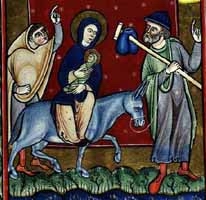
fol14, The flight to Egypt
This is another scene I've seen a few times (caption on this post)- poorer male travellers carrying their goods over a stick. The goods appear to be contained in some kind of saddlebag or roll. I've heard of a later period bag style where you make a roll like a long pillowcase, sew the ends closed and create a slit across the width of one side only of the middle. I think this has a similar construction, but not being a rich man's object we are unlikely to find out.

Thursday, 18 January 2007

Dresses from Salzberg - Cod. lat. 15903 Bayerische Staatsbibliothek

The source, courtesy of Bildindex:
Periscope book, Saint Erentrud, around 1140 (München, Bayerische Staatsbibliothek, Cod. lat. 15903)

  • Commonly known as the "Periscope book of St Erentrud", but don't try googling that, or all you'll end up with is a single link to this blog :-) (almost a googlewhack!)
  • Saint Erentrud or Nonnberg Abbey is a Benedictine Monestary in Salzberg (in fact it's the one in Sound of Music).
  • Like most Austrian art it has a strong italo-byzantine influence, but Dodwell says it also has an Ottonian influence. I think I can see this in the fatness and posture of some figures, and maybe also in some of the trim positioning?
  • I don't know exactly what periscope book means - no-one wants to give me an exact definition (it might be something to do with spiritual illumination)
  • You can see one colour folio (men only) on wikipedia commons.
I'm going to summarise all the women in this manuscript below, but I'm not going to show all the pictures - none of these women have the fancy calf length style I'm looking for at the moment. In fact, most of them are cut pretty much the same as the first picture, although many have less details (no trim on sleeve edges, or sometime less dangly sleeve).

folio 58: Helena and Emperor Constantine
  • A fairly standard full length dress with flared sleeves, partially concealed by a wrap
  • Trim on sleeve edges
  • what looks like a cingulum style belt
  • Most interestingly, the tight sleeves under the flared oversleeves are a coloured patterned fabric. Most dresses show pale sleeves that could be a chemise, but this one is either a patterned fabric underdress or a chemise with wide decorative cuff panels applied. And it looks like there is a different coloured band at the cuff, which argues for the former. Exciting!
  • There is something strange hanging out of the bottom of the sleeve.
Folio 102v - Christ and Mary (not pictured here - follow link)
  • Fairly standard floor length dress with flared sleeves.
  • standard pale wrinkled tight sleeves under the flared ones.
  • Something strange hanging out of the bottom of her outer sleeves too (pictured, clearer on this picture than previous folio)
  • shoes with line of decoration down vamp
Folio 84 - Mary gives Birth (not pictured here - follow link)
Folio 39 - The 3 Mary's at the Tomb
Folio 76v - Waking of Jarias' daughter
  • Nothing special, clothing mostly obscured by blankets, cloaks or people
Folio 81 - Mary dies
Folio 70 - Healing of the mother-in-law of Petrus (caption points out that's what the text says even though it's obviously a man being healed)
Folio 31 - Annunciation
  • Clothing mostly obscured by cloak
  • shoes show line of decoration down vamp
  • Folio 81 and 31 also show use of scalloped edges as trim. This is also seen (eg pictures) in a number of the men's garments in this manuscript: 1, 2, 3, 4, 5
    and as men's belts with scalloped edges: 1, 2.
Folio 71v - Birth of John the Baptist
  • pretty average European ladies
  • what appears to be a byzantine midwife -I've seen extant earrings before, but only from byzantine and Russian sources. I've read a literary description (was it in Goddard?) that good European women didn't wear earrings, that only shameless byzantine hussies did (or at least that's what the Europeans were saying - I'm sure the Byzantines thought something similarly uncharitable about the western Europeans). It certainly fits with the archaeological absence of earrings in Europe - metal is more likely to survive and the German empresses did get buried wearing jewelry. I'm pretty sure I've seen earrings in byzantine art. So I guess this lady is a byzantine or Russian lady, but I can't think why she is appearing in this particular scene. (were byzantine midwifes better? was there a Byzantine princess married in to that family?) She also has an unusual hairstyle.
    Folio 14 - Flight into Egypt
    Folio 15 - The Circumcision (of Jesus)
    Folio 17 - The 3 Kings
    Folio 46 - "Noli me Tangere" ("touch me not" - what Jesus said to Mary Magdalen)

    • Mary's Dress and sometimes veil & Cloak both have trio's of dots on them. These dots also appear on some of the other characters. They could annotate decoration, but I've heard this could also be a symbol used to annotate a holy person. A clear giveaway that this is so in some other works is when trios of dots appear on foreheads or similar non-clothing places. I can't see any examples of that here
    • Other details of dress are obscured by cloak
    • Folio 46 Mary's veil - which is dark coloured, not the more common pale
    Folio 27 - Presentation in the temple
    Folio 9 - Birth of Christ
    • Most details of dress are obscured by cloak.
    • Different Coloured sleeves to dress on both pictures. Does this mean Mary is wearing some kind of sleeveless garment (surcoat, pelicon?) such that we see this surcoat over her legs, but the layer underneath over her arms. Or is she wearing widely flared sleeves that are hidden under the cloak. I can't see any clue to them, so I think not. Could the artist just be confused? Entirely possible. I really need a picture that isn't obscured by a cloak.
    • Folio 9 lady's veil has a bit of a fringe, but it doesn't continue all the way around. Looks like artist got bored halfway through. Is there another explanation? The fringe has 3-5 strings that are knotted together and end in a blob. It reminds me of this Mantiple (Aachen, Germany c1200) where strands of threads are pulled together to pass through a bead. Except this one has a different pattern, and I think each thread ends in a bead or knot (knots would be nearly as easy to use where the threads gather together too. I've been considering beading one of my headrail style veils - because that would add weight to the lower edge, making it stay in place better.
    Summary:
    Not much exciting on the dresses, indeed no patterned fabrics, calf length dresses, or beanie hats. But the accessories are shown in unusual detail, with some interesting variations. I'll continue with the accessories the men have in another post soon.